




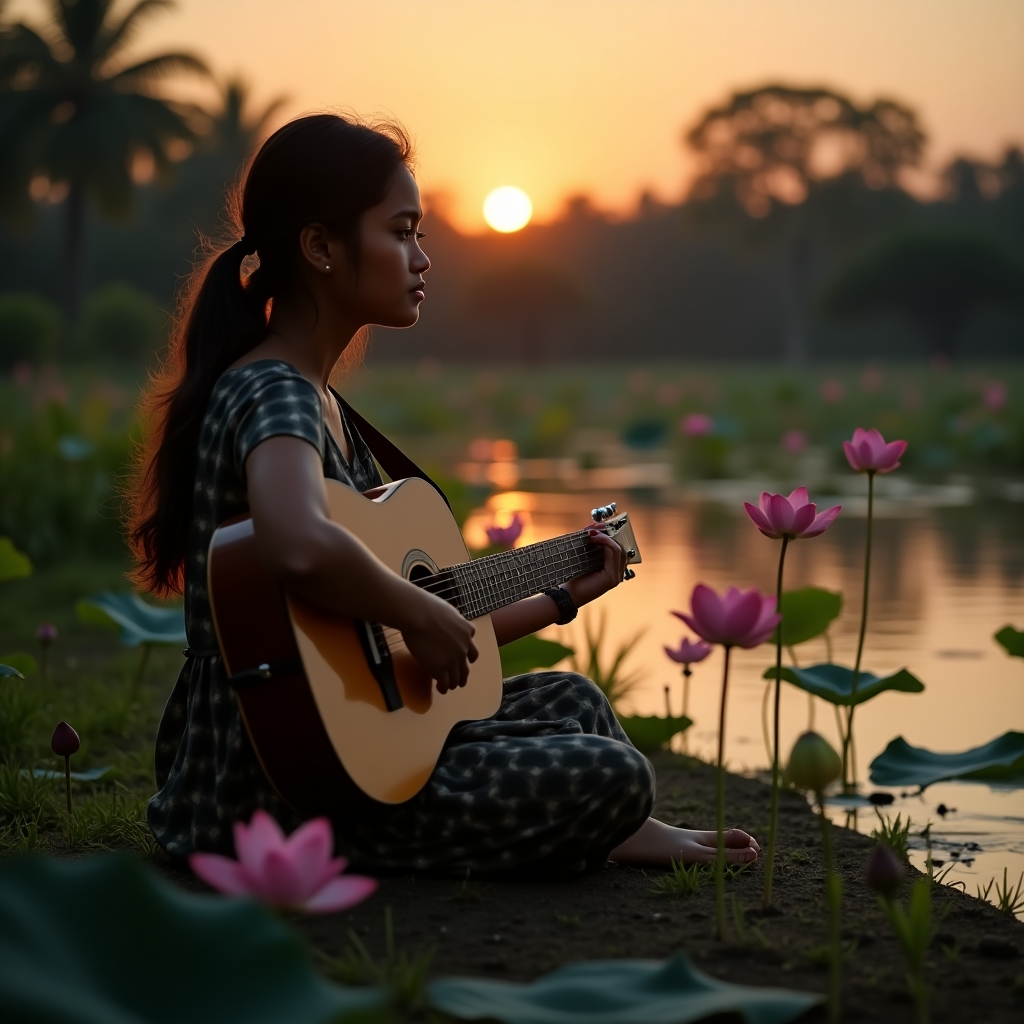
The sun set gently over the small town, bathing the earth in hues of orange and gold. Satya stood by the window of her modest bedroom, watching the gentle swaying of the lotus pond that had become her sanctuary over the years. The room bore the hallmarks of tradition; a shrine with incense sticks, images of deities, and the intricate embroidery of the curtains—all reminders of the world she inhabited. Yet, Satya felt the quiet tug of her soul yearning for something different.
Growing up, Satya had been imbued with her family’s rich heritage. Her parents, first-generation immigrants, had instilled in her the values and customs of their homeland. They often spoke of their sacrifices, how they had left everything behind to build a new life in a foreign land, and how important it was for Satya to carry on their legacy. “You are the bridge between the past and future,” her mother would say, her tone both proud and insistent.
Satya loved her family deeply. She appreciated the traditions that had colored her childhood with stories and rituals that felt like magic. Yet, beneath her admiration lay a quiet dissonance. The path her family had laid out for her—marked by expectations of marriage to someone within their community and a career deemed respectable—felt increasingly like a mantle too heavy to bear.
In the evenings, she would retreat to the lotus pond, its serenity offering a canvas against which her thoughts could unravel without judgment or fear. There, beneath the wide expanse of the sky, she imagined a life where she could pursue her passion in music—a path that felt as natural as breathing but was seen as impractical by her pragmatic parents.
Torn between loyalty to her family and her own aspirations, Satya often found herself in a state of quiet turmoil. Her parents’ voices echoed in her mind, interwoven with her own desires, each trying to claim space in her heart. She feared disappointing them, feared being labeled ungrateful, yet knew that suppressing her dreams was a betrayal to herself.
Satya’s struggle was not one of loud rebellion or fiery confrontation but a subtle dance of compromises and negotiations within her own soul. She attended the family functions, wore the traditional attire, and played the role expected of her dutifully. But with each performance, the weight of her unspoken desires grew heavier.
The moment of clarity came quietly one evening as she sat by the pond, the air cool and thick with the scent of lilies. Her fingers strummed her guitar absentmindedly at first, then with more intent, each chord vibrating through her until her entire being resonated with it. In the music, she heard the voice of her true self, clear and resolute. It whispered of love and authenticity, urging her to trust in her own path.
That night, Satya knew she couldn’t bury her truth any longer. She returned home, her resolve solidified like never before. As she sat with her parents, she spoke softly, her voice steady, every word carrying the weight of her journey. She shared her dreams, her love for music, and her desire to forge a path that felt true to her soul.
The room was silent, the air thick with unshed tears and unspoken fears. Her parents listened, their expressions a tapestry of confusion and concern. Yet, within their eyes, she saw the glimmer of something she hadn’t expected—understanding. Slowly, her father’s hand reached out to grasp hers, a gesture of acceptance, albeit laced with reluctance.
In that moment, Satya felt the gentle unraveling of tension. She had not ignited a revolution, but had begun a quiet evolution within her family. It was a step towards her truth, a bridge between the love for her heritage and the love for herself.
As the lotus pond shimmered under the moonlight that night, it mirrored Satya’s inner light—a flicker of hope and courage, blossoming amidst the still waters of tradition.