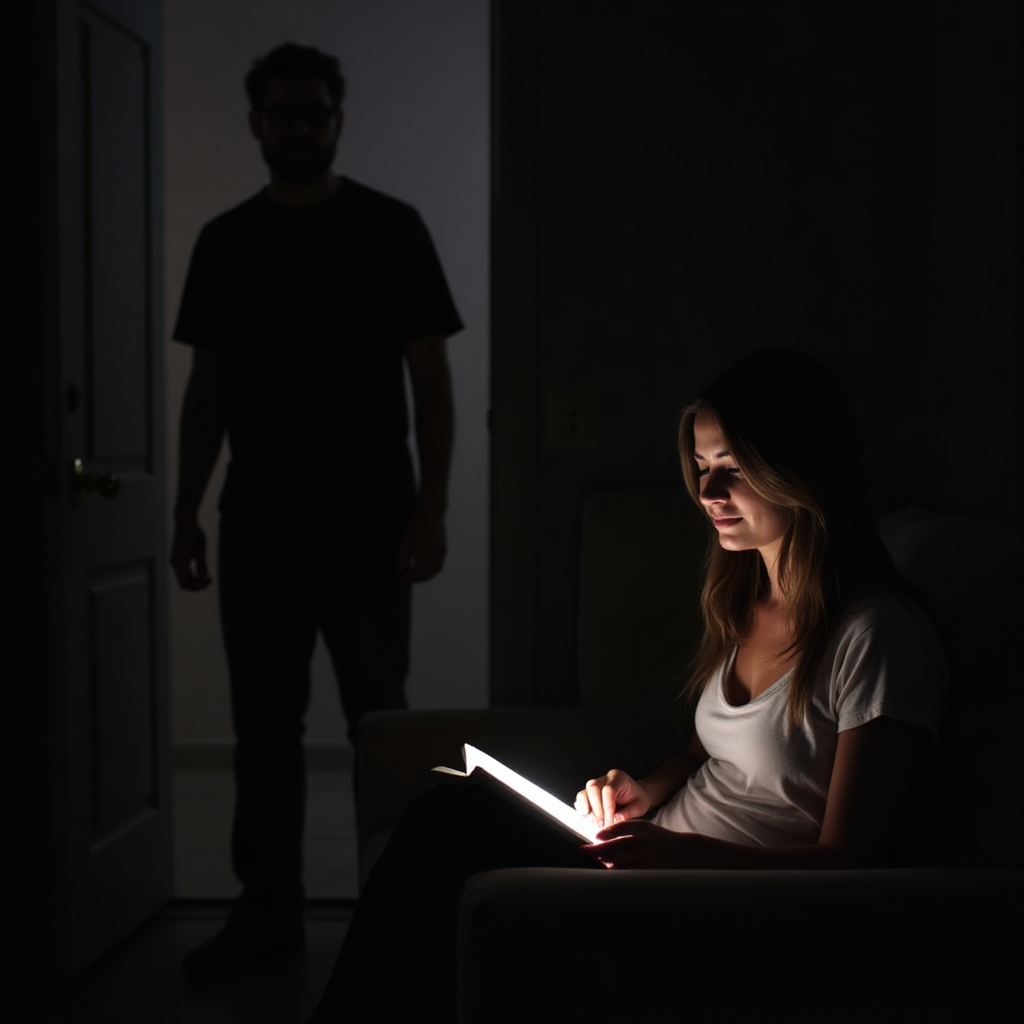


Emma had always been the kind of person who found comfort in silence. Growing up in a house where her father’s voice reverberated like a thunderstorm, she learned early on that her thoughts were best kept to herself. Her mother, a shadowy figure who drifted through the house like a ghost, offered no sanctuary. As Emma grew older, she became adept at playing the role expected of her—quiet, compliant, dependable.
For years, Emma’s world was small and predictable. She worked at a local bookstore, a job she loved for its solitude and the smell of paper that seemed to wrap her in a familiar embrace. Her relationship with David, her college sweetheart, was reassuringly stable. He wasn’t like her father—not harsh or demanding—but he had his ways of controlling her, veiled in gestures of care that left her with little space to breathe.
“I’m just looking out for you,” David would say, gently taking the car keys from her hand when she planned a weekend trip alone. “It’s safer if we go together.”
Emma nodded, swallowing her discontent like a bitter pill. She convinced herself that these were acts of love, even as the walls around her world closed in tighter.
But the unease in her chest grew like a weed. When she stood on her balcony in the evenings, she watched birds soar against the setting sun, yearning for their freedom. It was during one of these evenings that Emma’s perspective began to shift. She noticed a neighbor, an elderly woman, tending to her garden with a serene smile. The woman’s contentment was palpable, a stark contrast to Emma’s own internal chaos.
“You have such a lovely garden,” Emma ventured one day, surprising herself with the sudden courage to speak.
The woman looked up, her eyes crinkling in a warm smile. “Thank you, dear. It’s my little sanctuary.”
The simplicity of her words struck Emma deeply. A sanctuary. The idea took root in her mind and refused to let go. What was her sanctuary? Did she even have one?
Over the next few weeks, Emma’s mind was a storm of thoughts and questions. Little by little, she began to test the boundaries of her own existence. She started taking walks alone, relishing the moments when she could hear her own thoughts without interruption.
“Where were you? I was worried,” David would say when she returned.
“Just needed some air,” she replied, not meeting his eyes.
The shift was gradual but unmistakable. Emma became more attuned to the details around her: the way sunlight filtered through the windows, the sound of rain pattering against the rooftops, the warmth of a cup of tea in her hands. Each sensation was like a secret whispered to her alone—intimate and profound.
Then came the day when the whispers turned into a shout she couldn’t ignore.
It was a Saturday evening, and Emma was preparing dinner. David was in the living room, watching a football game, the noise of the commentator’s voice filling the house. As Emma chopped vegetables, she felt a sudden urge for solitude, a need to escape the constant hum of expectations that surrounded her.
She set down the knife, wiped her hands on a towel, and walked into the living room.
“David,” she began, her voice steady but soft.
He muted the television and looked at her expectantly.
“I think I need some time alone tonight,” she said, each word a careful step on thin ice.
A shadow of confusion crossed his face. “What do you mean?”
“I just… I need to be by myself for a while.”
The silence stretched between them, thick and heavy.
“Emma, are you okay?” he asked, concern laced with an undertone of disbelief.
“I am,” she said, more to herself than to him. “I just need to be alone.”
Emma held his gaze, feeling the weight of her decision settle over her like a comforting blanket. It was a small step, a quiet assertion of her need for space, but it felt monumental.
When David finally nodded, a reluctant acceptance, Emma slipped on her shoes and stepped outside. The evening air was cool, the sky a tapestry of stars. A sense of peace washed over her, as if she had finally found her sanctuary not in a place, but in the act of choosing herself.
As she walked down the empty street, Emma knew she was still at the beginning of a journey—a journey toward reclaiming her life, one quiet step at a time.