



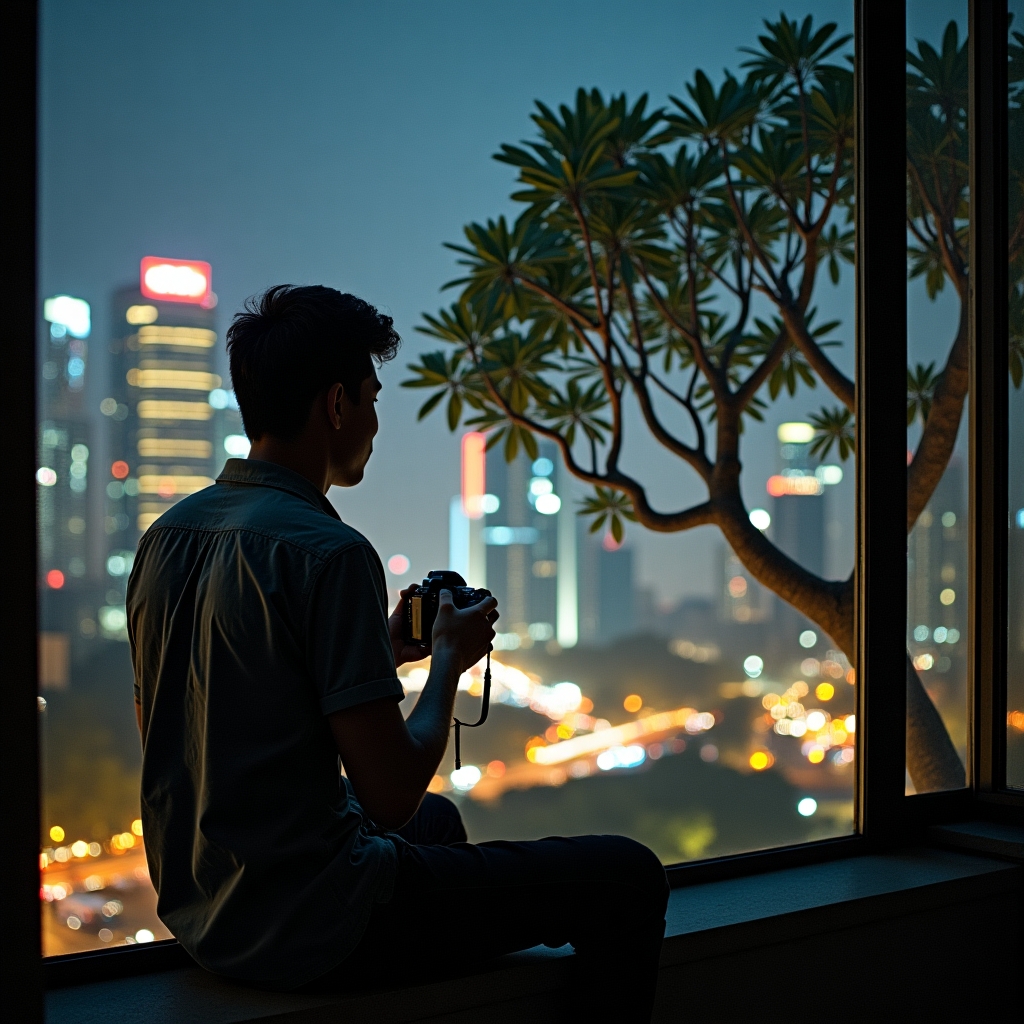
In the heart of a vibrant city where skyscrapers kissed the sky and traditions etched the ground with invisible lines, lived Aditya, a young man of twenty-four. He worked in a bustling tech firm during the day and spent his evenings with friends in cafés that lived on the edge of modernity. His life, however, was a delicate balance, a dance between two worlds straddling the line between his personal values and the expectations of his family.
Aditya’s family hailed from a small village rich with customs and expectations. His parents, having moved to the city to provide a better future for their children, held tightly to these traditions, a lifeline to the roots they feared losing. Aditya often felt like an actor playing two roles, his scripts written by others. At home, he was the dutiful son, nodding politely during conversations that hinted at a future in the family business or, more pressingly, the gentle prodding into an arranged marriage.
But in the quiet of his own thoughts, a different Aditya emerged, one who longed for creative pursuits, for writing stories and capturing life through photography—passions his family saw as hobbies rather than viable futures. His soul yearned for authenticity, yet guilt shadowed every step he took away from familial desires. The psychological tension was a constant companion, a whisper of doubt that gnawed at his sense of self.
Aditya’s struggle was not marked by outbursts or dramatic declarations. It was a subtle wrestling, a silent tug-of-war that played out in small moments—a hesitation before speaking, a pause before deciding to stay late at work, a twinge of guilt when he turned down visits to the family village.
One evening, after a particularly intense day at work, Aditya sat on the balcony of his apartment, the city lights flickering like stars scattered in the night sky. He held his camera, a gift to himself purchased with the first paycheck from his side projects, a symbol of his hidden self. As he clicked through the photos stored in its memory, images of cityscapes and candid portraits of strangers, he was struck by their vitality, a vibrancy that seemed to mock the shadowed corners of his constrained life.
In that moment, a photograph caught his eye—a picture of his own reflection, framed between the ancient banyan tree in his family’s courtyard and the towering glass of his apartment building. The image resonated with him deeply, encapsulating his internal conflict, the pull of the past and the lure of a self-determined future.
That night, Aditya lay awake, the rustle of city life outside his window harmonizing with the cacophony of thoughts in his mind. He realized that avoiding confrontation only deepened his internal divide. His parents’ dreams for him were woven with love and fear—fear of losing their culture, their identity in an ever-evolving city. But his dreams were stitched with his own threads, vibrant and undeniably his.
The epiphany came quietly, settling like dawn’s first light. He didn’t need to reject his heritage to embrace his future. Instead, he could intertwine them. He could share his vision with his parents, not in defiance, but with respect and hope for mutual understanding.
The next weekend, Aditya visited his parents. The air was thick with the smell of incense and the sounds of early morning rituals. As he helped his mother in the kitchen, slicing vegetables for the evening meal, he spoke. He spoke of his love for writing, how it connected him to stories of the past and the present. He shared his photographs, explaining their significance, and voiced his longing to blend his heritage with his aspirations.
To his surprise, his parents listened. There were no immediate tears or proclamations, but also no dismissals. In their eyes, he saw reflection—perhaps a glimpse of their own youthful dreams, now tethered to tradition but still alive.
In the weeks that followed, Aditya’s life began to realign. He continued his work, but with renewed purpose, carving time for his creative passions. His parents, slowly, began to understand his vision, even if not completely, they were willing to try.
Aditya’s quiet struggle had led him to a place of emotional clarity. It wasn’t a conquering but a harmonious blend of the past and future. From the whispers of ancestral echoes emerged a new narrative, one that honored both tradition and individuality, forging a path to generational healing.