On the surface, everything in the Sutton household appeared painstakingly normal. Their colonial-style house stood on a neat, tree-lined street in suburban New Jersey, where neighbors nodded in familiar greeting but rarely stopped for meaningful conversation. Inside, the walls carried whispers—the kind that linger in the shadows of an otherwise perfect family portrait.
Elaine Sutton, at thirty-eight, had quietly slipped into a life dictated by others. Her husband, Mark, was a man of firm decisions and louder proclamations. Their children, Laura and Max, followed along as children do, leaving little space for dissent in a house where calm was mistaken for contentment.
Elaine lived by a rhythm set not by her own heart but by the expectations around her. Her days were filled with obligations that seemed to stretch endlessly—piano lessons for Max, debate club for Laura, weekly grocery shopping, and the unending cycle of laundry that seemed to multiply overnight. Her dreams had atrophied over time, replaced by the small tasks that kept everyone else’s world turning smoothly.
It was a Sunday afternoon, the one day the Suttons tried to spend together, though they often didn’t. Mark preferred the solace of his home office, claiming work was always a breath away from total chaos, while the kids oscillated between their rooms and the backyard.
Elaine stood by the kitchen sink, the afternoon sun filtering through the window, casting patterns on the countertop. She watched the shadows in silence, a quiet storm brewing in her chest. It was a feeling she’d tried to ignore for years, a soft voice that had grown hoarse with neglect.
“Mom, where’s my blue sweater?” Laura’s voice cut through, her footsteps echoing down the stairs.
“It’s in the laundry basket,” Elaine replied absently, her gaze still fixed on the sunlight.
“Can you get it for me? I need it like… now.”
“In a minute, Laura,” she said, hearing the slight tremor in her own voice.
Elaine’s reluctance was new, unfamiliar even to her. Yet, it felt like a thread she needed to follow, a string of autonomy she could sense in the distance.
As the afternoon wore on, Elaine found herself on the back porch, the cool autumn air crisp against her skin. She could hear Max’s laughter mingling with the rustle of leaves, and for a moment, she closed her eyes, imagining herself somewhere else.
When she opened them again, Mark’s voice greeted her unexpectedly. “Elaine, did you sign those school forms yet? They’re due tomorrow.”
She turned to face him, the weight of his constant demands pressing against her. “I haven’t yet,” she admitted, choosing words carefully, aware of the fine line she was walking.
“It only takes a few minutes,” Mark replied, his tone edging on impatience.
“I know,” she said, her voice steady, surprising herself. “I’ll do it later.”
Mark frowned, his eyebrows knitting together in confusion, not used to resistance in their unspoken agreements.
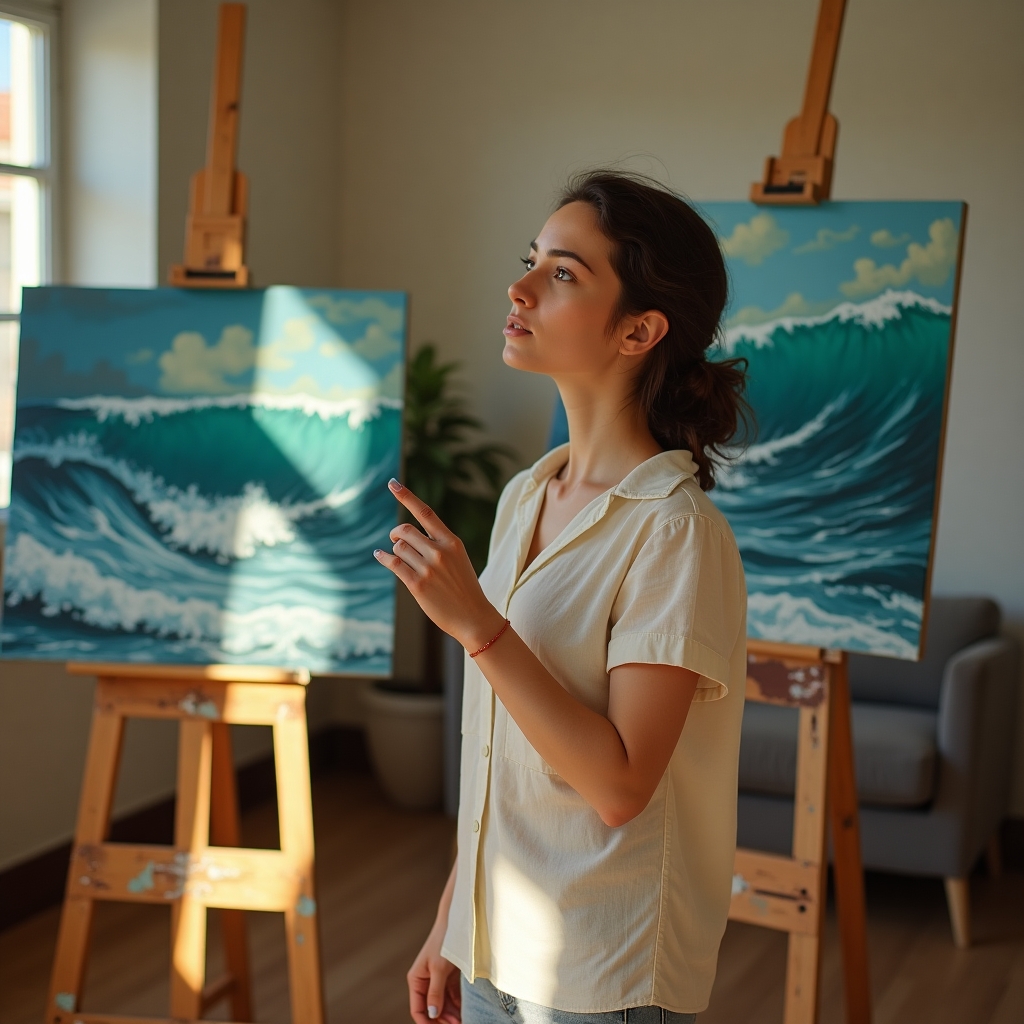
Elaine retreated to the small room at the back of the house, her sanctuary that had once been a guest room but now served as a crafts space that she rarely used. The unfinished painting of a seascape lay by the window, its colors muted, waiting for the life she had yet to breathe into it.
She reached for her paints, fingers trembling slightly as she touched the brush to the canvas. Each stroke felt like a small act of rebellion, a quiet assertion of her forgotten desires.
For the first time in years, Elaine allowed herself to dive into the soothing rhythm of creation. The sea came alive under her hand, each wave painted with care and intention, reflecting not the calmness of her life but the turbulence she felt inside.
The hours passed unnoticed until the sound of Mark calling her name broke the trance. She stepped back, gazing at the canvas and the image that reflected back—a vivid seascape with waves that seemed to crash and recede, an honest articulation of her internal battle.
“Elaine, are you coming?” Mark’s voice was closer now, his footsteps pausing at the door.
She turned to face him, the paint still fresh on her fingers. “I will, but I need a few more minutes.”
He glanced at the painting, his expression softening slightly. “It’s good,” he acknowledged, a rare compliment.
“Thank you,” Elaine replied, her voice carrying both gratitude and resolve.
As Mark walked away, the air felt different—lighter. Elaine returned to the painting, her heart whispering promises of more moments like this. Moments where she could choose herself without the weight of explanation or apology.
In that small room, with the world outside the door, Elaine allowed herself to be seen, no longer content to remain the invisible architect of everyone else’s happiness.
A week later, Mark found the unsigned school forms just as the kids needed to leave for the day. He glanced at Elaine, a mix of surprise and understanding crossing his face.
“Did you forget?” he asked tentatively, the usual firmness replaced with something softer.
Elaine met his gaze, feeling the solidity of her decision. “No, I didn’t forget,” she replied calmly, offering no further explanation.
It was a small act, but it was enough—enough to begin rewriting the story she’d lived for so many years. A story where her voice, her desires, held space alongside the others in her life.
As she watched them leave that morning, Elaine felt a sense of peace. Not because everything was resolved, but because she had taken a step towards authenticity, one wave at a time.