

In a small town nestled between rolling hills and endless fields of sunflowers, Leila found herself standing at the crossroads of her life. At twenty-four, she was young enough to feel the pull of infinite possibilities, yet old enough to feel the weight of expectation resting heavily on her shoulders. Raised in a family that valued tradition, Leila had always known what was expected of her: to follow in the footsteps of her mother and her mother’s mother, to marry within the community, to uphold the cultural values that had been passed down through generations.
Leila loved her family deeply. She cherished the warmth of their gatherings, the laughter, and the stories shared over dinner. But there was another part of her, a quiet whisper that spoke of a different path. It was the part that loved poetry and art, that dreamed of traveling the world, that longed to explore the depths of her own heart without the fear of disappointing those she loved most. This internal tug-of-war left Leila feeling as if she were living between two worlds, never fully belonging to either.
Her days were filled with a subtle, gnawing tension. She would wake up early to help her mother with the morning chores, feeling the soft pull of familial duty. Yet, as she stood in the kitchen, her hands working mechanically, her mind would drift to the writings of Emily Dickinson and the paintings of Frida Kahlo. She yearned to spend her days immersed in creative expression, to find her voice in the vibrant colors and stirring words that filled her dreams.
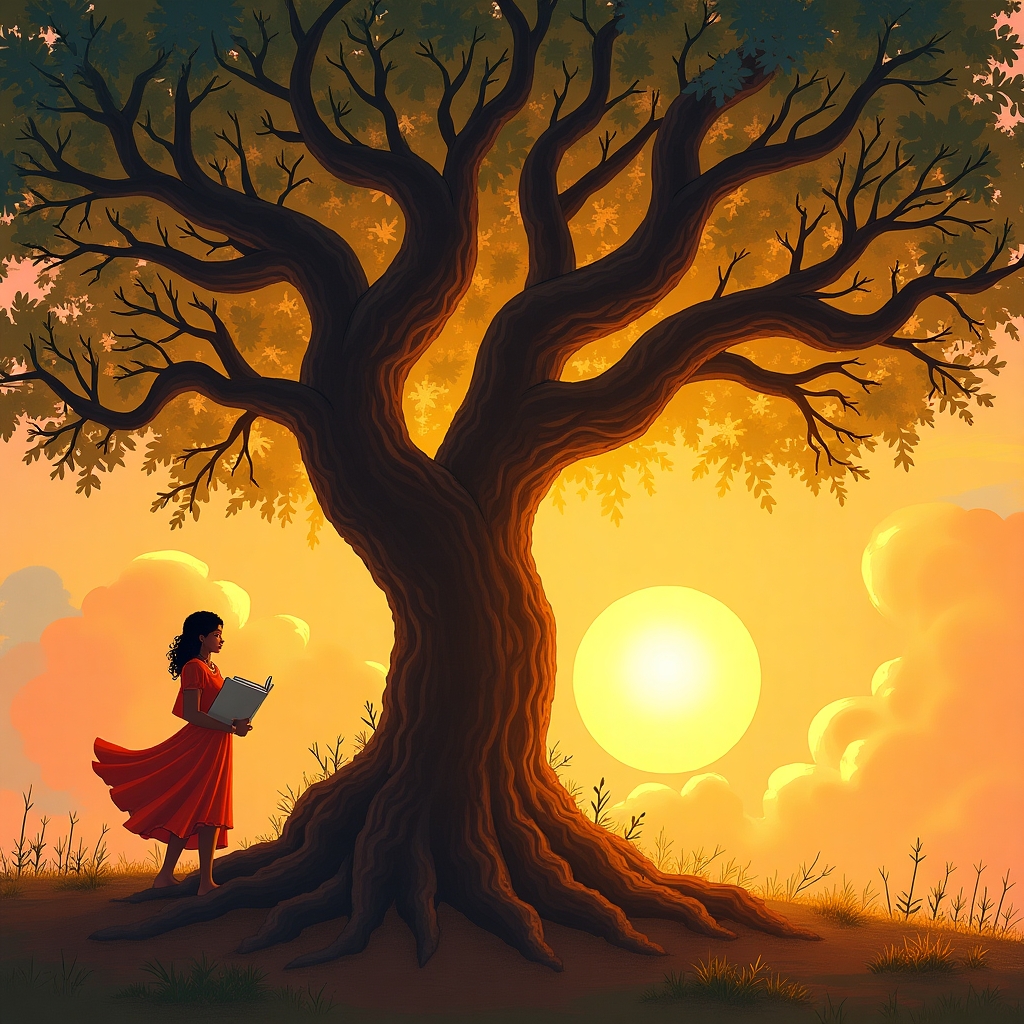
In the evenings, Leila would take long walks through the sunflower fields. It was during these walks that she felt most at peace, the golden blooms nodding in silent understanding as she wandered through them. The sunflowers seemed to hold a sacred space for her thoughts, gently urging her to listen to her own heart.
Despite the calm of these moments, the tension would return each time she stepped back into the world of familial expectations. Her parents, loving but firm, would remind her of her duty to the family, to the community. Their conversations were never overtly forceful, but the subtle implications were clear. “Have you thought about your future, Leila?” her father would ask gently, his eyes filled with love but also the unspoken weight of expectation.
Leila knew what these questions meant. They were reminders of the unspoken contract she was expected to uphold, the cultural legacy she was meant to carry forward. Yet, each time she heard them, her heart ached a little more, caught in the delicate balance between love and loyalty, desire and duty.
Her best friend, Maria, was the only person who understood. They had grown up together, their friendship a safe haven where dreams could be whispered and fears laid bare. One evening, as they sat beneath the stars, Maria turned to her. “Leila,” she said softly, “what do you truly want? Not what you think you should want, but what makes your heart sing?”
The question lingered in the air, its simplicity belying the profound truth it sought to uncover. Leila felt an electric jolt of clarity pulse through her, as if Maria had unlocked a door she hadn’t known existed. In that moment, she realized that her quiet struggle was about more than just choosing a path; it was about claiming her own identity and letting go of the fear of disappointing others.
The next morning, with the first light of dawn casting a warm glow over the fields, Leila stood at her window and took a deep breath. She felt a sense of calm settle over her, a quiet certainty that had been absent before. She knew that the journey ahead would not be easy—a path of honesty and emotional courage never was—but she was ready to take the first step.
At breakfast, she sat across from her parents, her heart pounding in her chest, and spoke her truth. “I love our family,” she began, her voice steady but her hands trembling slightly. “I love our traditions and all that they mean to us. But I also love art and poetry and the dreams that call to me from deep within. I need to explore them, to find out who I am beyond the expectations.”
Her parents listened quietly, their expressions a mix of surprise and understanding. There was a pause, a moment of suspended time that felt both eternal and fleeting. Then her mother reached across the table and took her hand. “We love you, Leila,” she said softly. “And we want you to be happy, to find your own way. We may not fully understand it, but we will try.”
In that moment, Leila felt a release, a shedding of weights she hadn’t realized she was carrying. Her parents’ words were not just an acceptance of her path; they were a bridge between generations, a promise of healing and understanding.
As she continued her journey, Leila knew there would be challenges ahead, but she also knew she had the strength to face them. She had found clarity not just in her own desires, but in the love and support of those who mattered most.
She walked out into the sunflower fields, the morning sun warming her face, and let herself smile. It was a new day, a new beginning, and Leila was ready to embrace it with open arms.