


Sylvia had always been the steady one in her family. Her mother used to say, ‘Sylvia, you’re the rock. We all lean on you.’ And lean they did, until Sylvia could hardly breathe under the weight. Growing up as the anchor had its gravities, and her family never seemed to notice the question marks swelling under her skin.
The cozy town of Maple Hill, with its singular bakery and two long streets, was her whole world. Her sister, Anna, had moved to the city, chasing dreams larger than Maple Hill could contain. Sylvia stayed behind, working at the local library, a place as quiet as her own heart had become.
Her days were predictably ordinary. The library was nestled between a florist and the only café in town, where the smell of ground coffee was a lingering companion. Sylvia found solace amid the books, where stories unspooled like secret lives she could almost imagine living herself.
At home, her parents’ house buzzed with familiar chaos, though Sylvia was often the silent orchestrator behind the scenes. Her father’s health had been fragile, and her mother, though well-meaning, leaned heavily on Sylvia for every wobble in their universe.
‘Sylvia, can you grab his prescription?’
‘Sylvia, did you remind Dad about his doctor’s appointment?’
She carried lists in her head and empathy in her heart, but somewhere along the way, she misplaced her own desires.
It was during a book club meeting in the library that the first tremor of change began. The group was discussing a novel about a woman who, after years in a stifling marriage, took a solitary trip to Paris. Ellen, one of the newer members, remarked with a fervor that caught Sylvia off guard, ‘Imagine just packing up and going. It’s like she finally let herself breathe!’
That night, Sylvia lay in bed, Ellen’s words replaying in her mind. She turned them over, like stones in a river, noticing their smooth, uncompromising weight.
The next morning, Sylvia wove through her routine like a ghost. She cooked breakfast, picked up her father’s medications, and exchanged polite smiles with the librarian regulars. But Ellen’s words wouldn’t budge.
During lunch, Sylvia’s mother dropped a casual, ‘You’re doing okay, right, Sylvia?’ It was like a poke to a dam, and Sylvia felt something shift beneath her practiced smile.
‘Yeah, I’m okay,’ she replied automatically. Then, almost like a confession, she added, ‘I’ve been thinking… about trying something new.’
Her mother, eyes on the ceramic teapot, nodded but didn’t inquire further. That was how their conversations usually went, passing through the surface like raindrops on a pond.
The small act of voicing her thought was a seed, one that rooted deeper with each overlooked glance and thankless task. Over the following weeks, Sylvia began imagining tiny rebellions—a skipped chore, an unreturned call. Most remained fantasies, but they fed her growing sense of self.
One Saturday afternoon, while shelving books, Sylvia came across a pamphlet wedged between two novels. Its cover read: “Finding Your Voice: A Creative Writing Workshop.” Without hesitating, she slipped it into her bag.
The workshop was an hour’s drive away. The idea of attending felt both thrilling and terrifying, like stepping onto a tightrope. She wrestled with it for days, a tug-of-war between her habitual obligations and this unfamiliar yearning.
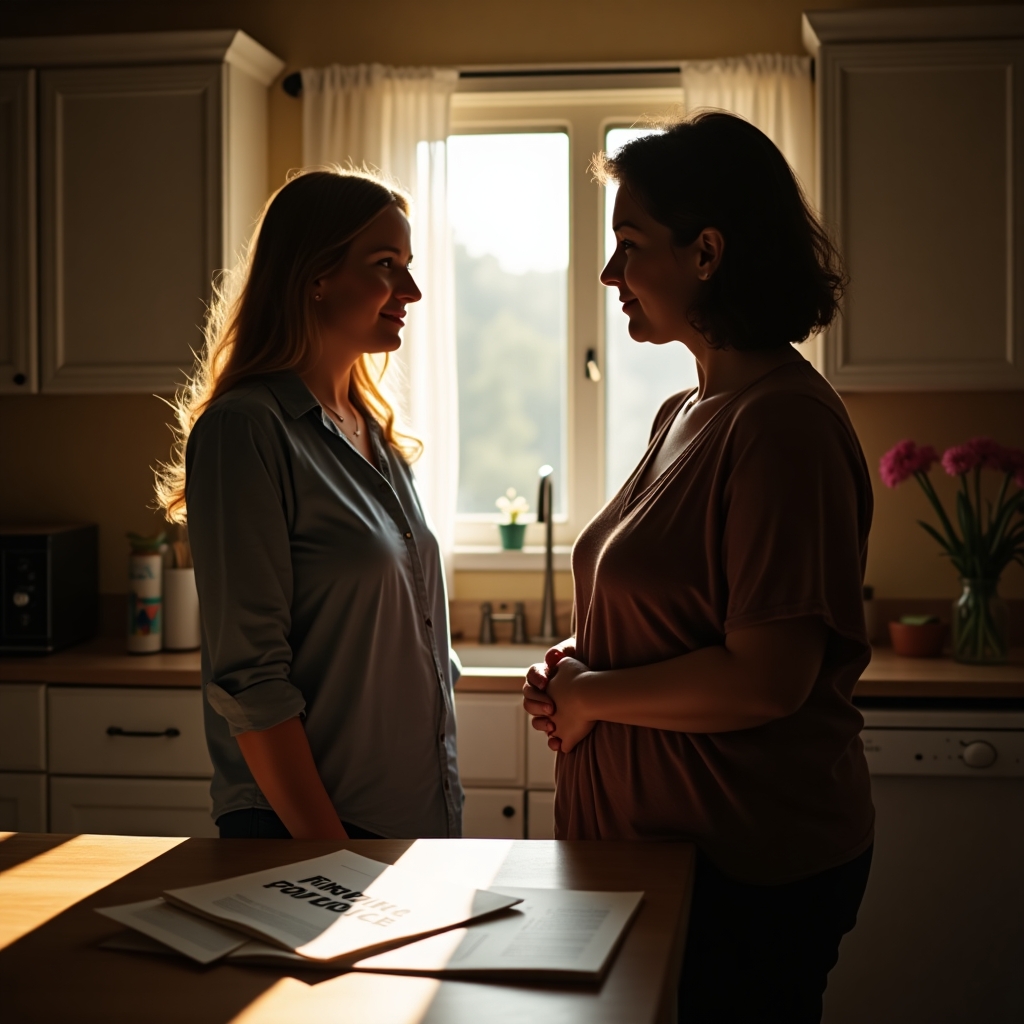
The evening before the workshop, Sylvia stood in her small kitchen, the pamphlet unfolded on the table. Her mother’s voice floated in from the living room, dulcet and unaware, ‘Don’t forget we’re visiting Aunt Mary tomorrow.’
A pause. Sylvia’s heart thudded in her chest, a quiet rebellion building like a summer storm.
‘I can’t go,’ Sylvia said, her voice barely above a whisper.
Her mother’s footsteps approached. ‘What do you mean, dear?’ The concern edged with the expectation of compliance.
‘I have something I need to do,’ Sylvia replied, firmer this time. She met her mother’s eyes, seeing the surprise and confusion there.
The silence stretched, and in that space, Sylvia felt a shift inside. It was as if she had stepped into a new room in her own house, one she hadn’t realized existed.
‘Are you sure?’ her mother finally asked, the words hanging heavy between them.
‘Sure as anything,’ Sylvia replied.
In the dim kitchen, under the soft glow of evening, Sylvia felt something quietly victorious unfurl within her. It wasn’t dramatic or defiant, but it was real—a small click of freedom echoing around her heart.
The next day, Sylvia drove to the workshop. The miles rolled away like an untangling, the road stretching out endless possibilities. It was in that journey, away from expectations and towards herself, that Sylvia felt a strange lightness, a rediscovery of something lost.
In the quiet room filled with strangers who might become friends, Sylvia found her seat, opened her notebook, and wrote, ‘I am ready.’
Her words were shaky at first, but they flowed, each line a thread piecing together the tapestry of her own voice. The workshop was just a beginning, but for Sylvia, it was the start of something beautiful—her quiet bloom.