

Neha always felt a quiet storm brewing within her, a tempest tangled in the roots of tradition and the wings of her own aspirations. Growing up in a bustling Indian household in New Delhi, she was enveloped in the warmth and sometimes suffocating closeness of her family’s expectations. Her parents, first-generation professionals who climbed the ladders of success through sheer grit, had their hearts set on seeing Neha become a doctor. Yet, in the quietude of her own thoughts, art was where her soul found tranquility.
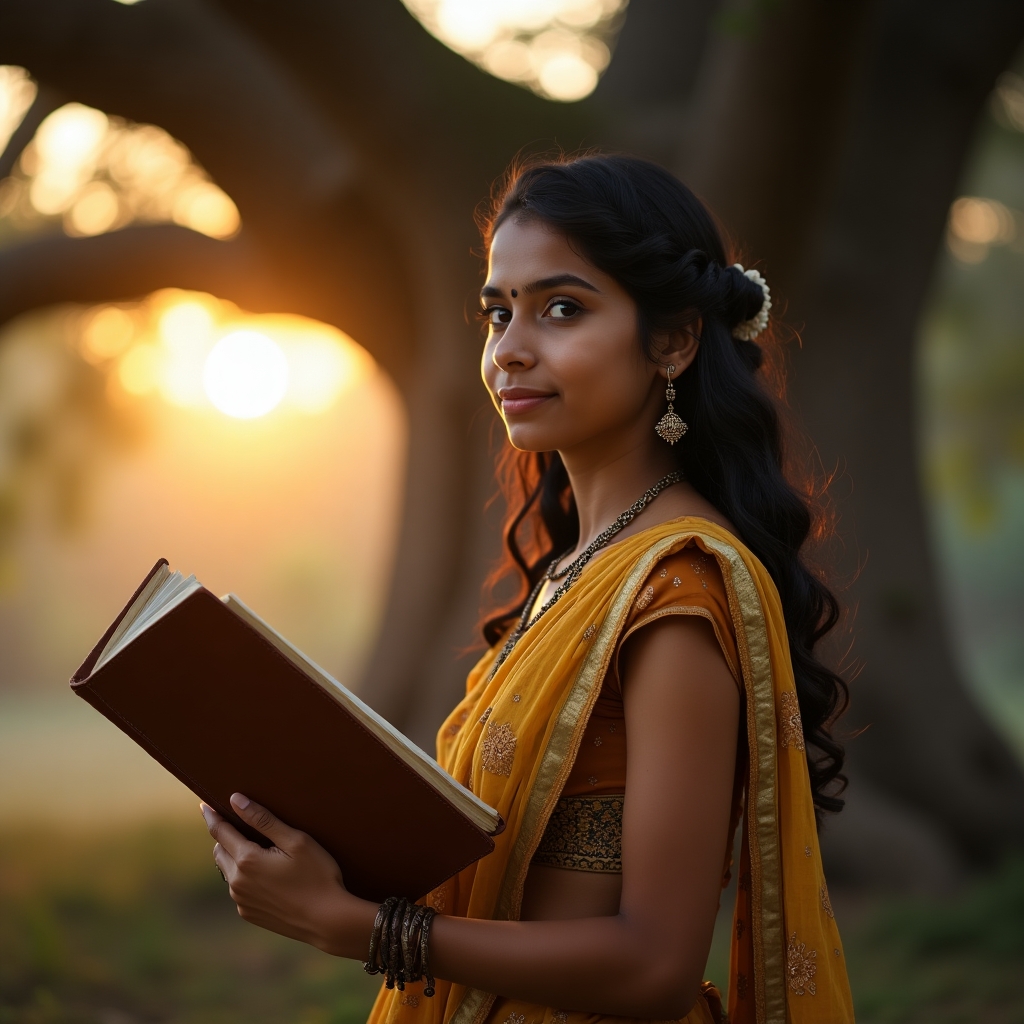
Every Sunday morning, Neha would sit in her grandmother’s garden, sketching under the expansive, watchful branches of the old banyan tree. It loomed over her like a gentle guardian, whispering secrets from generations past in the rustle of its leaves. Her grandmother, a woman of few words but profound wisdom, would often sit beside her with a serene smile, knitting silently, her eyes tracing the deft movements of Neha’s pencil. In these quiet moments, Neha felt a semblance of peace, a space where her dreams didn’t feel so at odds with her family’s desires.
Neha’s father, an esteemed cardiologist, often left medical journals scattered around the house, each copy a silent nudge toward the path he envisioned for her. He never forced, yet his love and hope were embedded in every page. Her mother, while more vocal, expressed her wishes through stories of relatives and acquaintances who had flourished in traditional careers. Their dreams for Neha were woven into the very fabric of their daily lives, expressed through celebratory tales of success at family gatherings, where Neha often smiled and nodded, feeling the weight of her silence.
But Neha’s heart ached for colors and canvas, for the freedom to express the kaleidoscope of emotions she felt inside, a tapestry only art could capture. Each time she tried to broach the subject of pursuing a career in art, her words would catch in her throat, buried under layers of unspoken fears and the fear of disappointing those she loved most.
It wasn’t until a rainy afternoon in July that the storm inside her began to find its voice. Neha had entered her work, a vibrant depiction of the monsoons, into a national art competition. When she received notice that she had won the top prize, her heart leapt with joy but was immediately tethered by the thought of her family’s reaction. She hesitated for days, carrying the knowledge like a fragile ember, unsure whether to stoke it into a flame or let it die quietly.
The turning point came one evening when her grandmother gently led her outside, beneath the banyan tree, aware of the storm brewing within her beloved granddaughter. The air smelled of rain and earth, a promise of renewal. Her grandmother handed her a worn leather-bound journal, its pages filled with sketches, poems, and musings. It was her own, a testament to the dreams she had once harbored but never pursued.
“Why didn’t you ever show this to me?” Neha asked, her voice barely a whisper, the journal heavy in her hands.
Her grandmother’s eyes, soft and filled with bittersweet nostalgia, met hers. “Sometimes,” she began, “we silence our own dreams for the sake of others’ happiness. But your dreams are not a burden, Neha. They are your truth.”
In that moment, Neha felt an unspooling within her, a release she hadn’t known she needed. It was as if the banyan tree itself sighed, shedding its leaves in acceptance. Her grandmother’s words were a balm, a quiet permission to let her own voice rise above the rustling leaves and distant echoes of expectations.
The next morning, with trembling hands, she laid the competition notice and the prize letter on the family’s breakfast table. The room was silent, her parents’ eyes scanning the papers, their expressions unreadable at first. But as her father looked up, a small, proud smile tugged at his lips. “I always wondered where those sketches of yours might lead,” he said softly, a hint of awe in his voice.
Her mother, though quiet, moved to hug her, whispering, “We just want you to be happy, Neha.”
Neha realized then that the act of sharing her truth had not only liberated her but had also allowed her family to step into her world, bridging the gap between love and expectation. The storm had not passed—it had transformed, like rain into a river, carving a new path forward. Her dreams, once whispered, now danced openly amidst the banyan leaves, a promise of what could be.
In the days that followed, Neha noticed a lightness in her step, a new rhythm to her life. Her art blossomed in the newfound sunlight of her family’s support, and the generational whispers around the banyan tree turned into a harmonious song of acceptance and love.