



Mia sat at her kitchen table, staring blankly at the untouched cup of coffee growing cold in front of her. The kitchen was immaculate, as always, just the way Tim liked it. Every item had its place, every surface wiped spotless. Outside, the sun was beginning to peer through the gray clouds, casting soft shadows through the window.
“Mia, could you iron the shirts for tomorrow?” Tim called from the living room, his voice drifting into the kitchen like a habitual reminder of all the things left unspoken between them.
“Sure,” she replied, her voice steady and compliant. The word was more automatic now than conscious, a reflex rooted in years of routine.
As she moved to fulfill Tim’s request, her mind wandered back to a book she had been reading, hidden beneath the pile of magazines she never had time for. It was a novel about a woman, much like herself, who decided one day to change everything. Mia had read it late at night, long after Tim had fallen asleep, feeling a quiet kinship with the character’s muted rebellion.
In the evening, after dinner, Mia found herself in the backyard, pulling at the weeds that had begun to creep into her flower beds. The garden was her sanctuary, one of the few places she felt truly at peace. Her hands worked methodically, yet her mind was elsewhere, questioning if she was destined for a life of ironing shirts and unremarkable days.
Her sister, Lena, had called earlier. “You sound… different,” Lena had observed, detecting the slight shift in Mia’s tone, the barely-there defiance.
“Do I?” Mia had replied, deflecting the comment with a small laugh.
“You know you’re always welcome to visit. I worry about you,” Lena continued, gently probing, knowing better than to push too hard.
“I know,” Mia assured her, though the conversation lingered in the air long after they hung up, like a gentle nudge from a distant corner of her consciousness.
The next day, Mia’s routine unfolded predictably. The dishes clattered softly as she placed them in the sink, and the vacuum hummed monotonously in the background. But there was a new undercurrent to her movements, a small tug of resistance.
Tim noticed it too. “Everything alright?” he asked, his eyes briefly meeting hers as he sipped his coffee.
“Yes, fine,” Mia replied, the automatic response slipping out, but she caught herself, adding, “Just thinking.”
Tim nodded, accepting her answer, the way he had accepted their patterns, like worn grooves in a well-trodden path.
As the days passed, the quiet rebellion within Mia grew louder. She began to question, softly at first, the necessity of every task she performed, every duty expected of her. Her world started to feel like a series of choices, not obligations, and that realization was liberating.
One morning, as she ironed yet another shirt, Mia paused. Her eyes fell on the window, where a bird was perched on a branch, singing a song to the open sky. She placed the iron down deliberately, unplugged it, and stepped away. The action was small, unremarkable in the grand scheme, but monumental in its defiance.
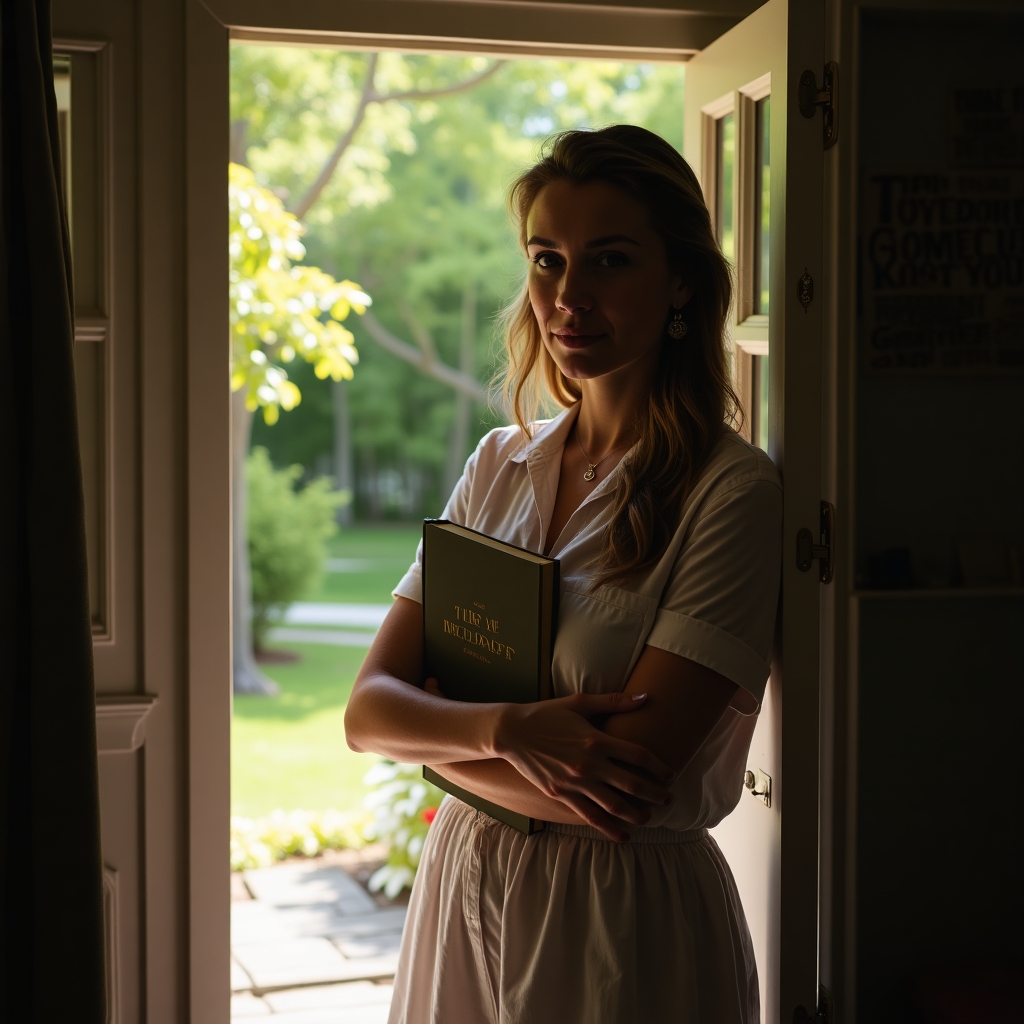
She found herself moving towards the bookshelf, retrieving the novel she had hidden and clutching it to her chest. She opened the door and stepped into the crisp morning air, feeling the cool breeze kiss her skin, as though awakening it anew.
Tim called out to her from inside the house, “Mia, the shirts—”
“I’m going for a walk,” she interrupted, her voice steady, unwavering.
There was a beat of silence, filled with the charged possibility of his response.
“Alright,” he finally said, his voice tinged with surprise.
Mia smiled to herself as she walked down the path, each step feeling like an exhale she had been holding her entire life. The world outside was vibrant, alive, reflecting the newfound freedom that pulsed through her veins.
This moment was hers, a quiet yet powerful proclamation of autonomy. And with each step, she felt the remnants of her former self fall away, leaving behind a person who was finally beginning to emerge from the shadows.
The breeze carried her laughter away, into the trees, and for the first time in years, Mia felt truly alive.