


In the quiet suburbs of Northbridge, there was a house at the corner of Elm and Third Street where a family resided for over four decades. The Saidi family was a well-reputed name in the community, carrying with them the rich traditions of their ancestry with pride. Inside this house lived Amara, a twenty-five-year-old with eyes that sparkled with curiosity and a heart as vast as the cosmos she often gazed into at night.
Amara had always been adroit at balancing the expectations of her family while navigating the mercurial tides of her own desires. Growing up, she followed the path laid before her—academic excellence, cultural proficiency, and the anticipated career in medicine. It was a path paved with the hopes and dreams of her parents, who had emigrated with the intent of providing her with boundless opportunities.
Yet, within her, there roiled another world, rich with passion for the arts and an inexplicable draw towards the written word. She would spend her evenings writing poetry that she tucked away in journals hidden beneath textbooks. Her love for expression was a quiet rebellion against the predetermined life she felt obliged to lead.
The pressure to conform was not outrightly oppressive, but it was a gentle, insistent whisper that shapes one’s actions without overtly dictating them. Her parents, Aamir and Leila, often spoke of the sacrifices made for her to be able to succeed in this land of promise. The weight of that narrative hung over Amara like a shroud, one she wore with both gratitude and burden.
Amara knew her parents’ story by heart, the tales of struggle, and triumph in a foreign land. To honor their journey, she enrolled in a pre-med program, attending lectures with the diligence expected of her. Yet, in the hushed corners of her soul, she continued to nurture her true calling, attending workshops and poetry readings in secret.
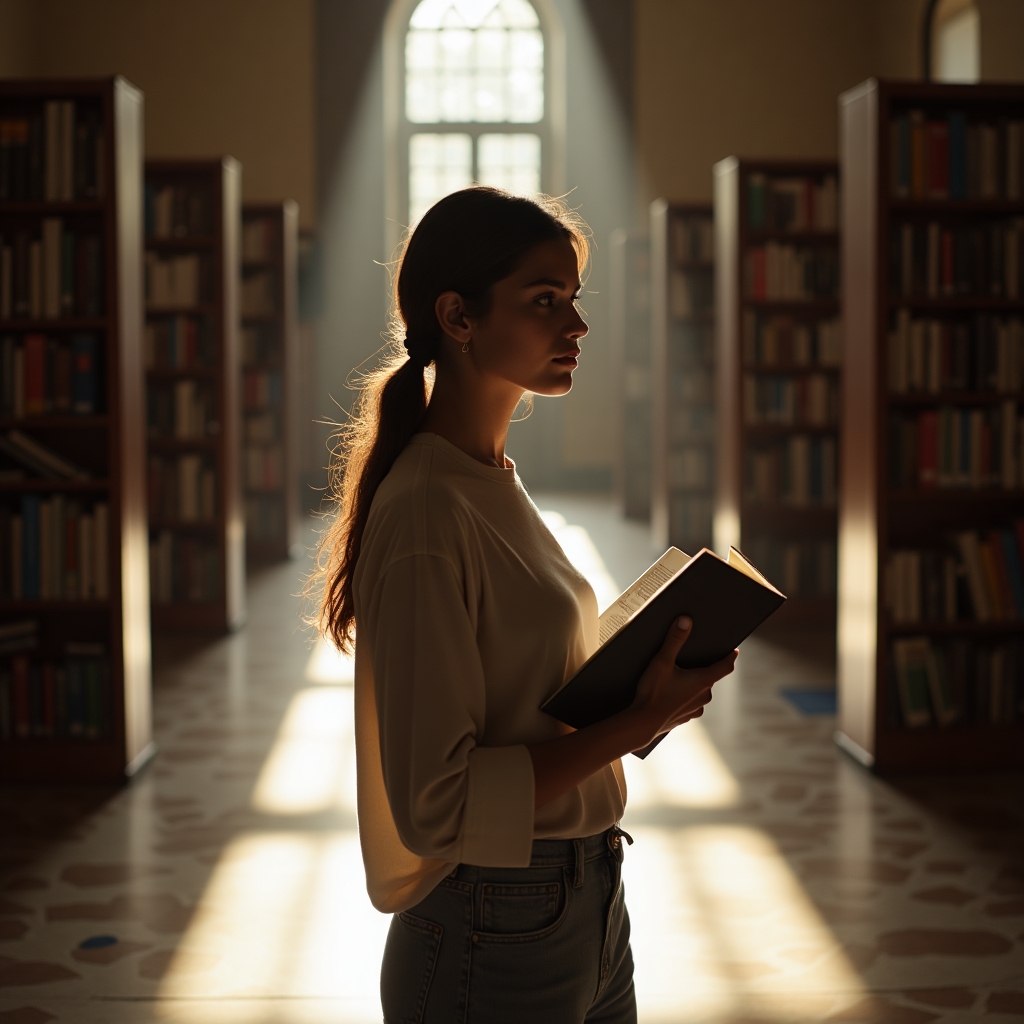
In the echoing halls of the university library, Amara often found herself at war with her own thoughts. The books around her spoke of two worlds; one of scientific triumphs and discoveries, and another of the human spirit explored through literature and art. It was during one such afternoon, with sunlight filtering through the library windows, that she felt the familiar tension in her chest crescendo.
A gentle voice interrupted her thoughts. It was Professor Jensen, her literature instructor, who had often commented on Amara’s profound insights during class discussions. “Amara,” he began, “I noticed you seem distracted. Is everything alright?”
Amara hesitated, the practiced smile faltering for a moment. She nodded, unsure if words could convey the tempest within her. “Just busy,” she replied, flipping the page of her textbook absentmindedly.
Professor Jensen studied her, his expression open and encouraging. “You know,” he said gently, “balance is important, but never lose sight of what lights up your soul.”
His words lingered with her, a quiet affirmation she desperately needed but feared to embrace fully.
That evening, as Amara returned home, the suffocating weight of unspoken expectations enveloped her once more. Her parents sat in the living room, discussing with animated enthusiasm the prospects of her upcoming med school applications. The conversation was filled with pride and hope, yet Amara felt like an imposter in her own life.
The days turned into weeks, and Amara’s internal conflict grew. The pressure became a constant presence, a dull ache at the back of her mind. She felt as though she was living two lives—one in which she adhered to her family’s wishes and another where she indulged in her clandestine passion for writing.
It was during an unexpected phone conversation with her grandmother, a woman of few words and profound wisdom, that the moment of clarity arrived. They spoke of ordinary things, the weather, the family garden, and then, as if sensing Amara’s turmoil, her grandmother asked, “Are you happy, my dear?”
The question was simple, yet it cut through the veneer of Amara’s practiced answers. She paused, the truth bubbling up to the surface with an urgency she could no longer ignore. “I… I’m not sure,” Amara confessed, her voice barely above a whisper.
Her grandmother was silent for a moment, and then she said with gentle firmness, “We plant seeds hoping they will grow, but we must also respect the direction in which they seek the sun.”
In that moment, Amara felt an emotional clarity wash over her. It was as if the scales had tipped, and she finally recognized the power within her to define her own path. The realization was not a dramatic epiphany but a quiet, resolute understanding that she could honor her family’s sacrifices while also nurturing her own dreams.
Amara began the gradual process of weaving her love for writing into her life more openly. She spoke with her parents, not about abandoning the path they envisioned, but about expanding it to include her passions. Her words were met with concern and hesitation, but also with a willingness to understand.
In time, Amara found a new equilibrium, one where her two worlds didn’t have to exist in conflict but in harmony. The change was subtle, marked by small victories—a poem published, a story shared, a proud nod from her father, a quiet smile from her mother.
The journey was ongoing, a testament to the complexity of balancing tradition and personal truth, but Amara stepped forward with the knowledge that her path was her own to navigate, lit by the dual lights of gratitude and authenticity.