


In the heart of a bustling city where modernity brushed gently against the edges of deep-rooted tradition, there lived a young woman named Lila. She was a reflection of her city, a tapestry woven with threads of old customs and the vibrant hues of her own dreams. Lila’s family had moved from a small village generations ago, bringing with them stories and expectations that wrapped around her like a well-worn shawl—familiar, comforting, yet sometimes suffocating.
Lila had always felt the pull of her cultural heritage. Her grandparents’ tales of ancestral land, of life lived in accordance with the rhythm of seasons and rituals, were imbued with a certain nostalgia and reverence. Her parents, while adapting to the city life, still held these traditions close to their hearts and hoped Lila would carry on the legacy. Yet there was a quiet yearning within Lila, a desire to carve out her own path, one that was distinct from the well-trodden one her family had laid out for her.
Each morning, Lila would rise with the sun, the city a canvas of opportunities basking in golden light. She pursued her studies in art, a subject that stirred her soul, though it was deemed impractical by her family. “A degree in art won’t feed you,” her father would often remind her with a gentle smile, his eyes filled with the unspoken hope that she might one day follow in his footsteps and join the family business.
Their home was a tapestry of cultural artifacts—a testament to the family’s past. Each object had a story: the hand-carved wooden idols, the vibrant tapestries that told of epic tales, and the delicate porcelain tea set from her great-grandmother’s dowry. These were not just objects but heirlooms of expectation, silently urging Lila to uphold her heritage.
The pressure to conform wove itself into Lila’s everyday life. At family gatherings, her aunts would inquire about her future plans, their questions laden with the weight of tradition. “When will you settle down?” they would ask, their voices a chorus of expectation. Marriage, children, a stable career—these were the milestones by which a life was measured. Yet, Lila’s heart longed for something different. She dreamed of traveling, of capturing the world through her art, of living a life not defined by societal norms.
Lila’s internal struggle was a silent one, fought in the quiet corners of her mind and heart. There were no loud arguments or dramatic declarations, just the gentle, constant pull between duty and desire. She often found herself at the local art gallery, seeking solace among the brushstrokes and sculptures, each piece a testament to the courage of those who dared to live their truth.
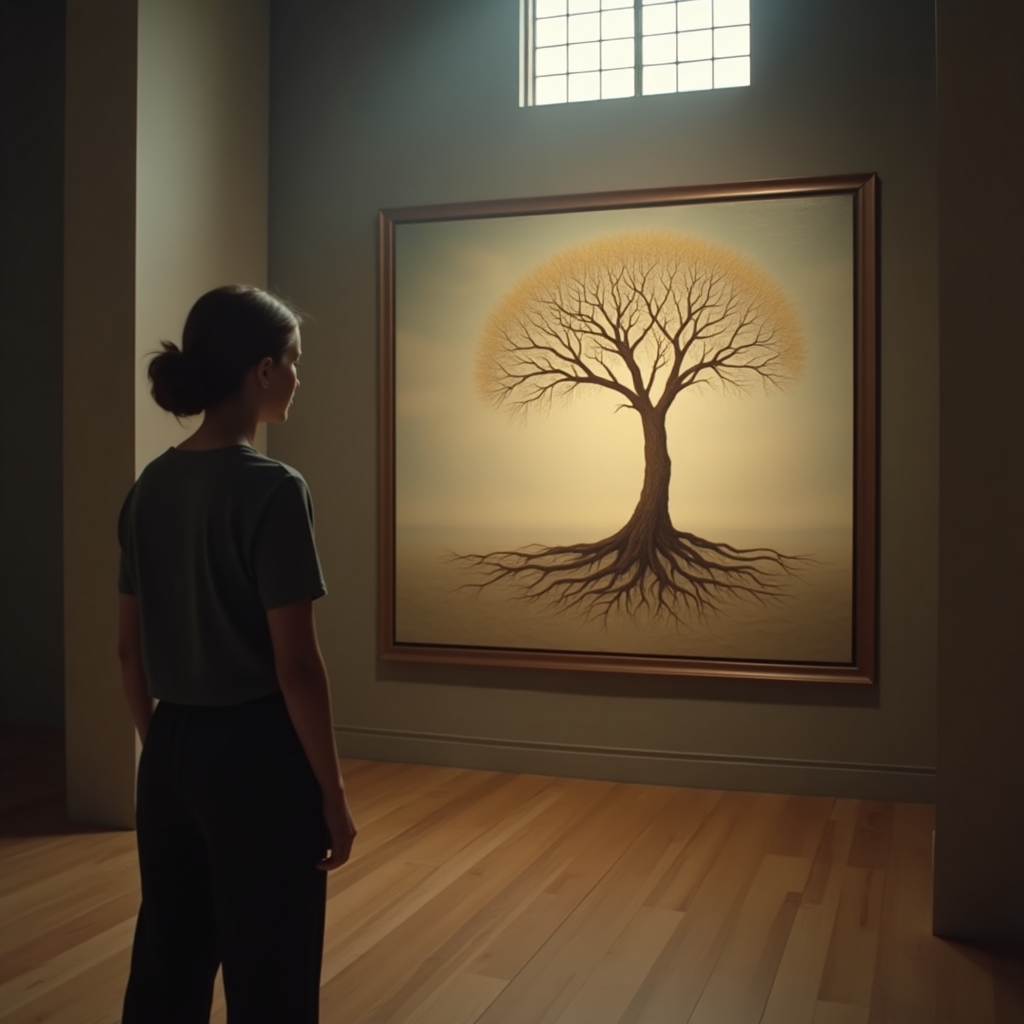
It was during one such visit that Lila experienced a moment of profound clarity. She stood before a painting that seemed to mirror her internal turmoil. The piece depicted a solitary tree, its roots deeply embedded in the earth yet its branches reaching upwards, yearning for the sky. In that image, Lila saw herself—a person grounded in her heritage yet yearning to grow beyond it.
In the quietude of the gallery, surrounded by the timeless conversation of art, Lila understood that her roots were not chains but foundations. She realized that honoring her heritage did not mean sacrificing her own dreams. Tradition and individuality were not mutually exclusive; rather, they could coexist, weaving together a narrative that was uniquely hers.
With this newfound clarity, Lila returned home, feeling a lightness she hadn’t known before. She shared her revelation with her parents, choosing her words carefully but speaking with the conviction of her truth. She explained her desire to pursue art not just as a hobby but as her life’s work. To her surprise, they listened, their expressions shifting from concern to understanding.
Her father, after a long pause, nodded slowly. “Your art,” he said, “is another way of telling our story. Perhaps it is time our story is told through new eyes.” In that moment, something shifted within the family fabric. There was still the weight of tradition, but now it was balanced by the light of Lila’s truth.
As the days followed, Lila began to embrace her path with a newfound confidence. She continued to explore the duality of her existence, becoming a bridge between the past and the future. Her journey taught her that emotional courage was not about loud declarations but the quiet confidence to live one’s truth, even when it diverged from the expected path.
Through her art, Lila connected with her heritage in ways she had never imagined, infusing each piece with the essence of her family’s legacy while weaving her own story within it. It was not an abandonment of tradition but an evolution—a testament to the enduring strength of roots and the boundless possibilities of growth.