

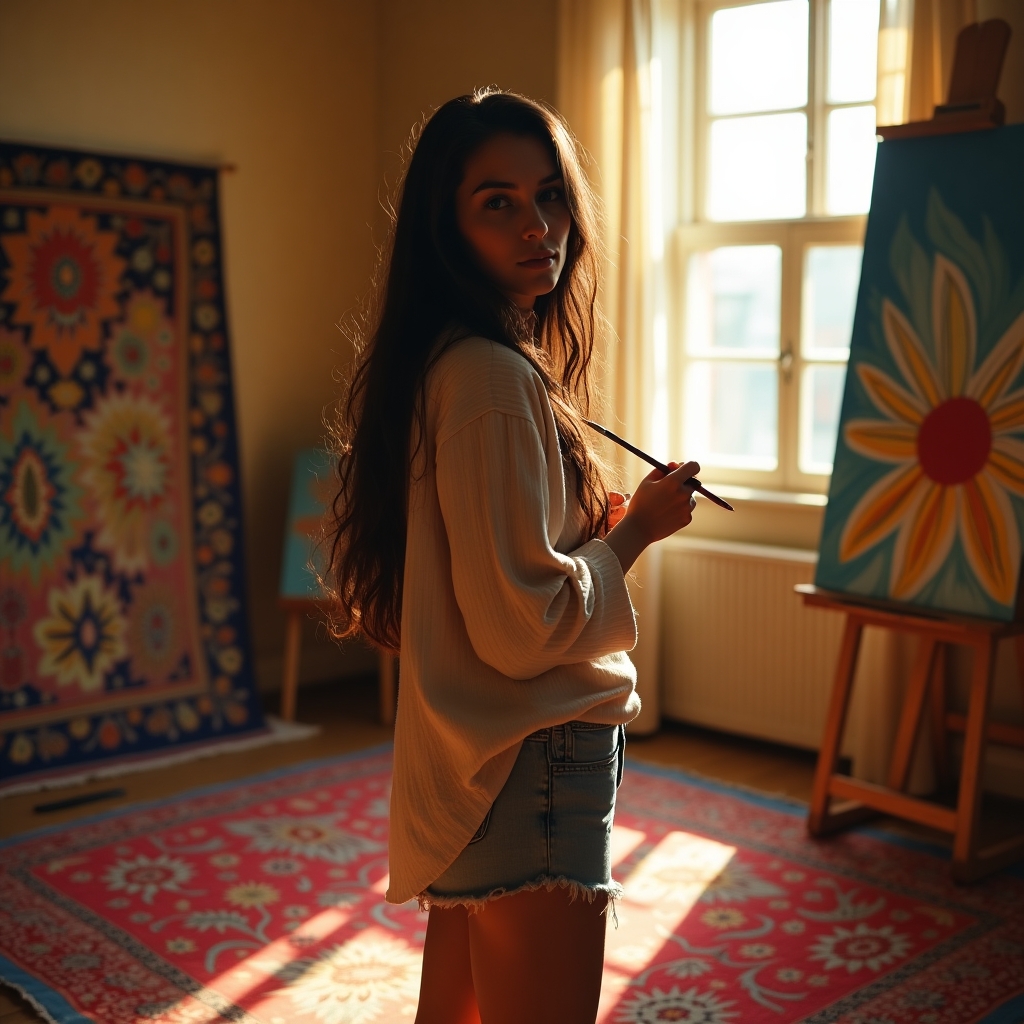
Amara sat quietly on the edge of her bed, her gaze glued to the intricate patterns of the Persian rug that adorned her bedroom floor. It was a handcrafted tapestry that had been passed down through generations, a constant reminder of her family’s rich heritage and the weight of expectations that came with it. Her parents had always emphasized the importance of maintaining their cultural traditions, despite living in a bustling, diverse city far from their homeland.
Though she cherished the stories and customs embedded in her family’s past, Amara also felt the pull of the modern world, a world where she could forge an identity separate from the one defined by her lineage. She had always been a dutiful daughter, attending every family gathering, mastering the art of traditional dance, and excelling in academics, as was expected of her. But now, at twenty-two, the whispers of her own desires grew louder, clashing with the steady rhythm of her parents’ expectations.
Her father, a kind man with deep-set eyes that spoke of wisdom and sacrifice, had always dreamed of her becoming a doctor. It was a noble profession, one that commanded respect and assured financial stability. Her mother, with her gentle voice and ever-present scent of jasmine, often expressed her wishes for Amara to marry within their community, to uphold the customs that kept their people united.
But Amara’s heart sang a different song, a melody woven with dreams of becoming an artist. She longed to paint the world as she saw it, in vibrant hues and abstract forms that told stories words could not capture. Her art was her solace, the place where she could breathe freely, unencumbered by the weight of tradition.
Every Sunday, her family gathered for brunch, a feast of dishes that painted a colorful array across the dining table. This particular morning, Amara felt the familiar knot of tension in her stomach as she joined her family. The conversation was light, filled with laughter and tales of relatives, until her father turned to her, his expression suddenly serious.
“Amara, have you thought more about applying to medical school?” he asked, his tone gentle yet firm.
She nodded, which was partly true. She had thought about it constantly, weighed it like a heavy stone in her heart. “Yes, Papa,” she replied, her voice betraying nothing of the turmoil within.
“Good, it’s important to have a clear path,” he continued, oblivious to the silent storm brewing within her chest.
Sitting there, enveloped by the warmth of her family’s presence, Amara felt like two worlds were colliding within her. One world was filled with duty, expectations, and the comforting familiarity of her parents’ dreams. The other was a realm of uncertainty but also of possibility, where she could pursue her passion and find fulfillment on her own terms.
That evening, Amara retreated to her room as she often did, seeking refuge among her canvases and paints. She picked up a brush and began to paint, each stroke releasing a piece of the tension that gripped her heart. Her mind wandered to the stories her grandmother used to tell her, tales of strong women who carved paths of their own despite the societal confines of their time.
It was then that something shifted within her—a subtle, yet profound realization. Her ancestors had faced their own struggles, their own battles between individual desires and collective traditions. In her own way, wasn’t she continuing their legacy by stepping onto a path that honored both her roots and her wings?
The realization brought a calmness she hadn’t felt in months. She understood that while her journey might defy her parents’ expectations, it didn’t have to disregard the values instilled in her. She could carry her heritage proudly while still pursuing her dreams.
The following Sunday, as her family gathered once again, Amara felt a newfound resolve blooming within her. The conversation turned to her future once more, and this time, when her father asked about her plans, she looked him in the eye, her voice steady and clear.
“Papa, I’ve decided to pursue art,” she said, her heart pounding.
Her father paused, surprise flickering across his features. Her mother’s eyes widened slightly, a soft intake of breath the only sound that broke the silence.
“Art?” her father repeated, his voice tinged with disbelief.
“Yes, art,” Amara confirmed, her voice unwavering. “It’s where I find my true self. It doesn’t mean I’m turning my back on our culture, but rather, I want to share it through my work.”
For a long moment, the room was still, the air thick with unspoken words. Then, slowly, her father nodded, a small smile tugging at his lips. “If that is your choice, then we will support you,” he said softly, his voice filled with a bittersweet acceptance.
Her mother squeezed her hand, a silent acknowledgment of the courage it took to speak her truth.
In that moment, Amara knew she had not only taken a step toward her dreams but had also opened a door to healing the generational gap. She understood that by embracing her own path, she was not severing ties with her past, but rather weaving new strands into the tapestry of her family’s story.
The tension within her eased, replaced by a sense of peace. Amara realized that true loyalty wasn’t about following expectations blindly but rather honoring her truth while respecting the foundations laid by those who came before her. With this understanding, she felt ready to paint her own journey with the colors of courage, compassion, and love.