
In the quaint town of Alton Valley, nestled between gentle hills and sprawling fields, lived a young woman named Elara. She was a dreamer by nature, with thoughts often wandering like the soft breeze that caressed the vast open plains. Elara was the adored only child of the Whitfields, a family known for their fierce loyalty to the town’s traditions, tracing back to generations.
Elara’s parents had always been loving, but there was an unspoken expectation that she would carry on the family legacy—a chain of doctors, each leaving their indelible mark on the community. Her father, Dr. Whitfield, held a revered place in the valley, his practice synonymous with trust and care. Elara’s mother, a former nurse, had long since devoted herself to supporting her husband’s esteemed work and grooming Elara for a similar path.
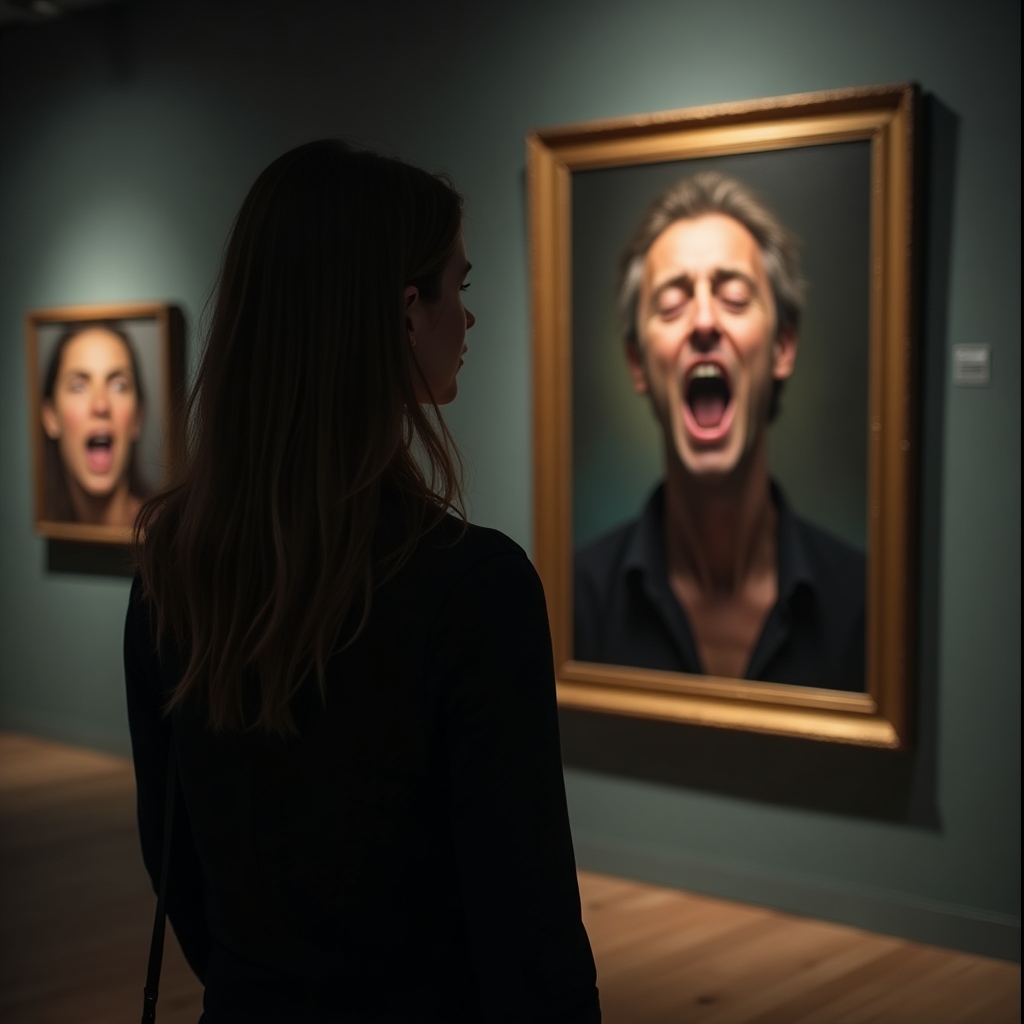
From the age of ten, Elara knew the color of scrubs she would wear, heard the rhythm of the stethoscope against her chest, and felt the weight of the Whitfield legacy like an unyielding shadow. Yet, her heart sang a different tune, one that thrummed with colors and emotions only paint could capture. She found solace in her art—landscapes of the valley, portraits of school friends, and sometimes abstract expressions of feelings she could not yet articulate.
But every time Elara sat down to paint, a sliver of guilt curled around her heart like a vine. Her love for art felt like a betrayal of her family’s dreams, a deviation from the path she was expected to tread.
Elara’s struggle was a silent one. It was woven into the fabric of her daily life—a smile that didn’t quite reach her eyes, a sigh hidden by the creak of wooden floors, and a daydream interrupted by her father’s voice echoing through the house with stories of his patients.
The valley’s annual Harvest Festival was approaching, a time when the town celebrated its rich bounties and families shared in the joy of tradition. The Whitfields always played a central role, and Elara’s parents were set to make a significant announcement regarding her future in medicine. The weight of expectation felt heavier than ever.
She stole moments alone in the attic, her sanctuary, where she kept her art private. Her fingers would glide over the canvas, her heart speaking through every brushstroke, yet every painting felt like a secret she had to hide from those she loved most.
As the festival loomed closer, Elara found herself standing at a crossroads, torn between the love for her family and the yearning to be true to herself. She contemplated the future—a path dictated by familial loyalty, the other by an internal compass leading her toward an unknown yet deeply personal horizon.
One afternoon, Elara walked to her favorite spot, a secluded overlook with a view of the valley below, where wildflowers danced in the wind. She sat for hours, the sun dipping lower in the sky, thoughts swirling like the clouds above her.
In that quiet moment, surrounded by nature’s raw beauty, Elara felt an awakening. It wasn’t dramatic or sudden, but a gentle unfolding within her—a realization that authenticity was the greatest loyalty she could extend to herself and, eventually, to her family.
She had come to understand that the love of her family, though expressed through tradition, was rooted in a desire for her happiness. And her happiness lay not in a clinic, but on a canvas.
The day of the festival arrived with the crisp promise of autumn in the air. Elara dressed carefully, her heart steady. She knew what she needed to do.
As twilight descended over the valley, Elara approached her parents, her voice calm but resolute. She spoke of her love for art, her dreams, her hopes for a future that blended her passion with purpose. Her father listened, eyes steady but softening, while her mother placed a gentle hand over hers, understanding dawning slowly.
There was silence, a pause in which the world seemed to hold its breath. And then, her father spoke, words carefully chosen, acknowledging her courage, her truth—a blessing in unspoken terms.
In that exchange, the veil that had quietly shadowed Elara’s life lifted, revealing not just a path, but a journey towards healing and authenticity—a bridge between generations.
The harvest moon cast its glow over the Whitfields that night, a family bound not by expectation but by love’s quiet strength. And Elara felt free, her future a canvas yet to be painted, with colors of her choosing.