


Ava sat at her desk, an array of papers, notes, and books sprawled out before her. The warm glow of her lamp cast a soft light against the dimming twilight that seeped through her window. Her fingers traced the edges of a letter she had started and stopped a dozen times — a letter that was supposed to explain everything but somehow explained nothing. In the quiet corners of her mind, Ava felt the echoes of two worlds colliding within her.
Raised in a close-knit Indian-American family, Ava felt the weight of her parents’ dreams constantly pressing against her own burgeoning desires. Her family was one of tradition, of expectation; their love was a wellspring, but also a tether. Ava understood their hope that she would follow in the footsteps of her father, a respected engineer, or her mother, a dedicated physician. Both avenues were honorable, lined with the promise of security and respect.
Yet, Ava’s heart thrummed to a different beat — the rhythm of stories, words, and the spaces they created. Ever since she was a child, the world of fiction had been her sanctuary, a place where she could explore and become anyone at all. Writing was not just a hobby; it was her pulse. But the path of a writer was uncertain, fraught with instability. It was not the future her parents envisioned.
Ava could sense their silent disappointment, wrapped in well-meaning questions and lingering looks. In their eyes, her writing was a splendid diversion, perhaps a phase. They never voiced outright disapproval, but it was the unspoken that weighed heaviest. Every conversation at the dinner table was a gentle nudge back toward the path they deemed safe.
Inside, Ava felt the tension coil tighter with each day. She attended her classes, earned her grades, but in the quiet moments, when the world slowed, she wrote. Her desk became her haven late at night, the only time she felt truly herself. Through her stories, she spoke truths she could not voice aloud.
The resolution existed just beyond reach, a whisper she couldn’t quite catch. The longer she waited, the more her soul felt stretched, desperate for authenticity. With each passing week, the disparity between her internal world and her external obligations grew. Ava wondered if she was being cowardly, if her hesitance was a betrayal of her parents’ sacrifices.
It was on an unexpected morning, sitting at her usual café, that Ava’s thoughts found clarity. The café was alive with soft conversations, the clinking of cups. She’d been scribbling in her notebook when the words formed as if from someone else’s hand: ‘To live a life half-true is to deny the full essence of one’s self.’
The words echoed in her mind, resonating with a truth she had long evaded. In that moment, Ava understood that her life needed to be her own, not just an extension of her family’s history. Her parents’ dreams were built from their journey, and while she loved them deeply, her path diverged.
This realization was not a rejection of their love but an embrace of her own. It was a moment of emotional clarity that allowed her the courage to honor her values. She could be the bridge between worlds, one foot in her culture, the other in her passion, enriching both.
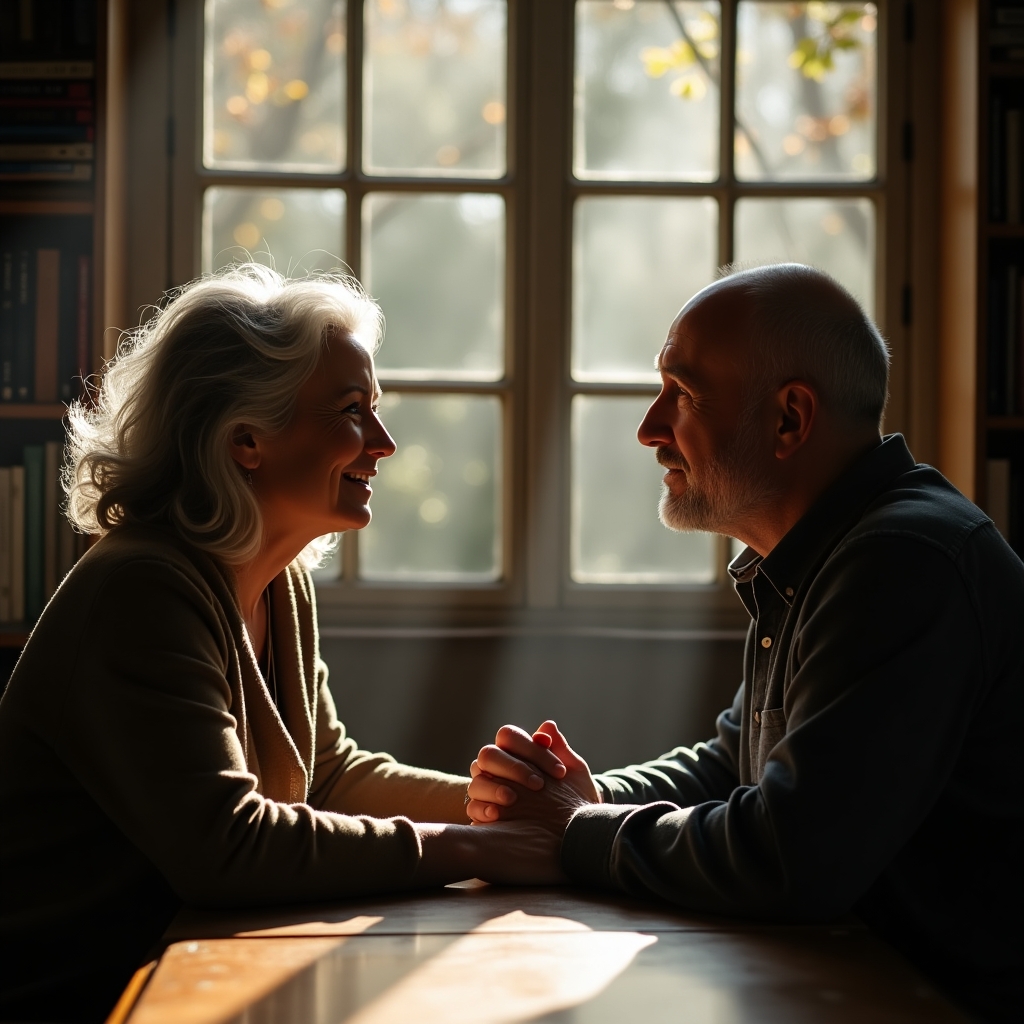
The following evening, Ava spoke to her parents. Though her voice trembled, she laid her heart bare, explaining her dreams and the importance of writing to her very being. Her parents listened, their expressions a tapestry of emotions — surprise, concern, and perhaps the understanding that comes only with true love.
To her wonder, they nodded, an acceptance in their eyes that words alone could not capture. While the path ahead remained challenging, Ava felt lighter, buoyed by the knowledge that she had finally spoken her truth. It was a quiet yet triumphant unraveling, the beginning of a new chapter where she could live fully, as both a daughter and a storyteller.
In the months that followed, Ava continued to weave her narratives, but she no longer wrote alone. Her parents, slowly but surely, began to take tentative steps into her world, reading her stories and attending her readings. It was through this shared vulnerability that healing truly began, fostering a new understanding, one built on mutual respect and love.