




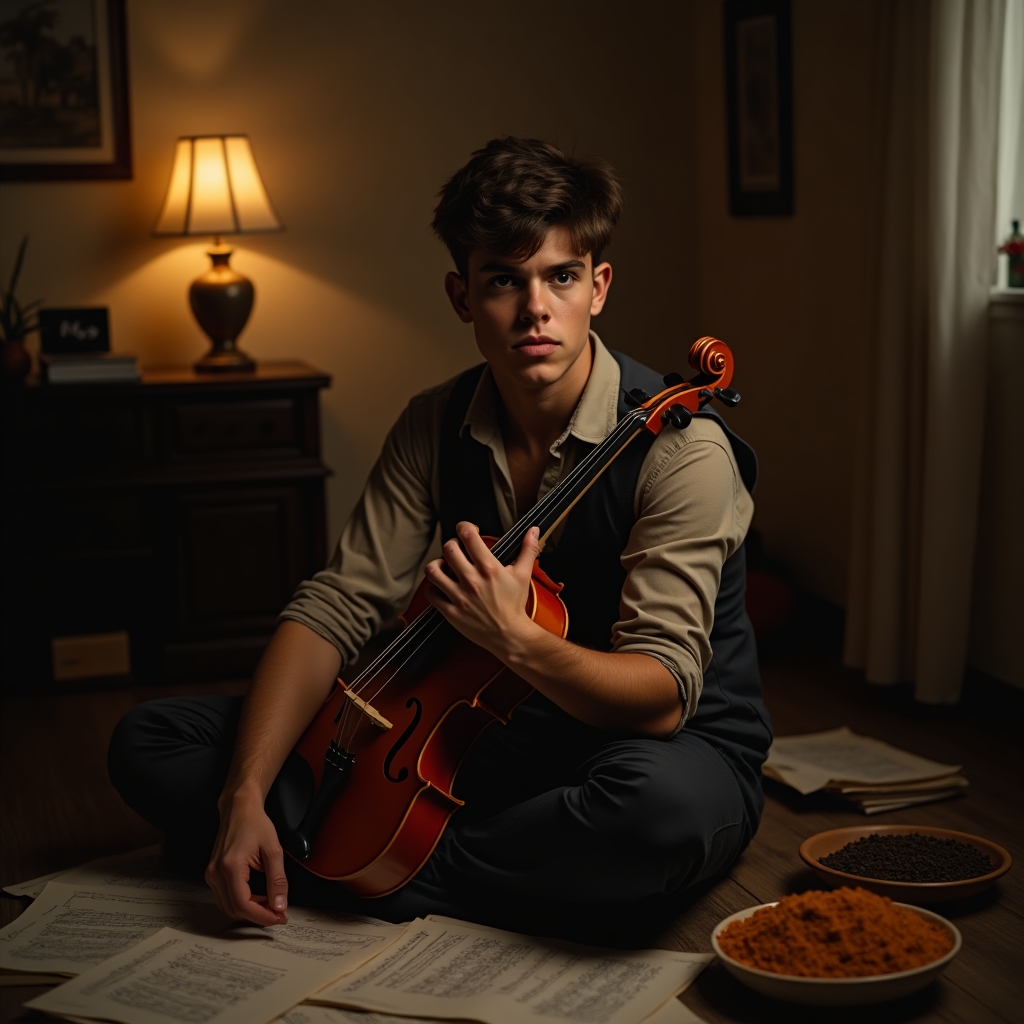
Eli sat on the edge of his bed, a patchwork of crumpled dictionary pages and hastily jotted notes surrounding him like a chaotic nest. Each sheet bore snippets from his two lives—the one he lived for himself, and the one lived for others. For years, Eli had been trapped in the delicate dance of balancing his own dreams against the expectations laid out by his family. Raised in a household where tradition was revered, Eli was expected to join the family business—a long-standing enterprise that supplied exotic spices to gourmet restaurants. But Eli’s heart lay elsewhere, in the strings of his violin and the echo of his own voice. Music was his sanctuary, where he could weave his thoughts into melodies free from judgment.
The family dining room was often filled with the aroma of rich spices, but to Eli, it was the scent of confinement. His father, always seated at the head of the table, would speak passionately about the business, his enthusiasm as strong as the cumin he loved so dearly. Eli would nod, smiling in response, while his heart played a melancholy tune. His mother, with her eyes always carefully observing, would often place a reassuring hand on his back—as if to remind him of the lineage he was bound to.
Yet outside those walls, Eli’s evenings were spent in dimly lit bars and open-air concerts, places where he could be just another face in the crowd, consumed by the music and camaraderie. His soul felt unshackled during those nights, but they were always followed by the weighty mornings of familial duty.
The quiet tension inside him grew, a constant hum that colored each interaction with his family. Eli loved them deeply, and he understood the sacrifice and love that built the life they had. His grandfather’s story was legendary in the family—arriving as a young man with nothing but a burlap sack of spices. Over the decades, he built more than a business; he built a legacy. And now, that legacy was Eli’s to uphold.
One evening, after a particularly intense family dinner where future plans were discussed with an air of finality, Eli retreated to his room. The soft lamplight cast a warm glow over the violin resting on the chair. He picked it up, and as he drew the bow across the strings, the familiar vibrations seemed to tune directly to his soul.
The melody flowed, and with it, Eli’s inner conflict. Each note was a conversation with himself, a questioning of where he truly belonged. The music gave voice to his silence, unraveling the tension with each measure. In those moments, a delicate realization began to dawn on him—a sense of clarity that had eluded him until now.
His parents loved him, of that he had no doubt. But their love was anchored in a world that Eli was only partially part of. They saw him as the next guardian of the family’s history, but Eli began to see himself as a bridge—a link between the old and the new, the remembered and the yet-to-be-created.
The next morning, Eli woke with the remnants of that melody still resonating in his heart. He knew what he needed to do. In the quiet of the early hours, Eli sat with his father in the small sunroom, the aroma of freshly brewed coffee hanging in the air.
“Dad,” Eli began, his voice steady yet soft, “I’ve been thinking a lot about the future.” His father looked up, his eyes filled with a mix of hope and expectation.
“I love music,” Eli continued, “and I believe I can honor our family’s past while still pursuing my passion. I want to contribute to our legacy by bringing something new, something that speaks to who I am.”
His father’s face was unreadable at first, the silence stretching between them like a drawn-out rest in music. Then, slowly, he nodded, his expression softening. “Eli, your grandfather… he often spoke of wanting to be a poet. His dreams took a different shape, but they never left him. I see that same spark in you.”
In that moment, Eli understood that his path didn’t have to be one of conflict but could be one of harmony. His own song, played alongside the familial melody, could create something beautiful.
That realization, quiet and profound, was the emotional clarity Eli needed. It was the strength to be true to himself while honoring those who came before him.