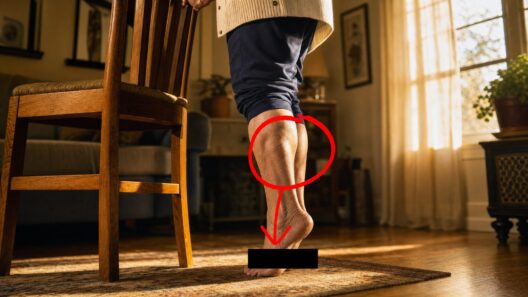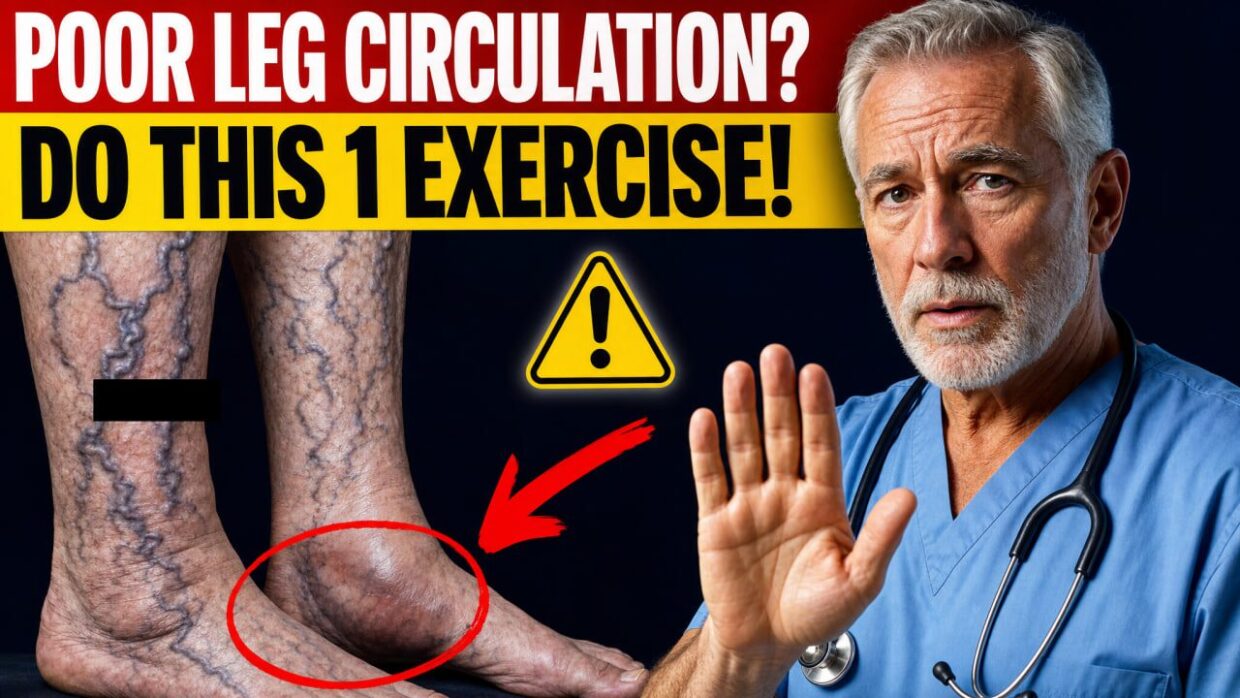
By evening, your legs whisper that something is off. The heaviness sets in around dinnertime. Your ankles look a little puffier than they did at lunch. Your feet feel cool against the bedsheet even though the house is warm. Sit too long, and a low, tight burn starts to creep along your calves.
You have done the obvious things. You walk most days, even when your legs feel like sandbags. You prop them up on a cushion in the evening. You pull on your compression socks before breakfast and wear them faithfully. Friends nod and say it is just what happens after 60.
But the discomfort keeps returning. The cold creeps back into your toes. The swelling settles into your ankles by the end of the day. Slipping shoes on in the morning feels just a little tighter than it did a year ago.
Here is something most people over 60 are never told plainly: this pattern is rarely “just aging.” It is a quiet circulation problem with a specific cause and a specific fix — and the fix takes about five minutes a day, standing in your kitchen.
The hidden cause: your “second heart” has fallen asleep
Inside your calves sits a muscle system surgeons quietly call the second heart. Every time those calf muscles contract, they squeeze the deep veins in your lower legs and push blood up against gravity, back toward your chest. Your heart drives blood downward; your calves are what drive it back up.
After 60, especially after years of sitting more than standing, this second heart starts to drift into a kind of sleep. The contractions become weaker. The pump softens. Blood begins to pool around your ankles instead of moving briskly upward. That pooling is what you feel as heaviness, swelling, a slow burn, and cold feet — long before any doctor uses the word “circulation.”
The data is sobering. The National Institutes of Health summarizes that nearly one in five adults over 70 already shows measurable peripheral artery disease in the legs, and more than half of them have no idea. By the time the body starts asking for help, the second heart has often been quiet for years.
Why walking alone is not enough
Most people are told the answer is simple — walk more. Walking is genuinely good for you and should stay in your week. But walking does not reliably wake a sleeping calf pump.
Each step puts your weight on one foot for only a brief moment before you swing through to the next stride. There is no sustained squeeze. Your second heart taps lightly and then lets go. For someone with strong, well-conditioned calves, that tapping is enough. After 60, with softer muscle and slower veins, it usually is not.
What the calf pump actually needs is a slow, deliberate contraction held long enough to push the pooled blood up and over the threshold — and then repeated, gently, until the system remembers how to do it on its own.
The one technique: the Standing Calf Pump Hold
The movement that does this best is so simple it almost looks like nothing. Surgeons and rehabilitation teams use it after leg operations to bring circulation back online before patients are even allowed to walk. The full name is the Standing Calf Pump Hold.
Here is why it works. When you slowly rise onto the balls of your feet and hold there for several seconds, your calves squeeze the deep veins like a strong fist around a tube of toothpaste. Blood is forced upward out of the lower legs. As you lower with control, fresh blood flows back in. Each repetition is one full cycle of the second heart, deliberate and complete, instead of the half-tap that walking provides.
To do it well:
- Stand behind a sturdy chair or at your kitchen counter, feet about hip-width apart, fingertips resting lightly on the support for balance.
- Lengthen your spine. Crown of the head lifted, shoulders soft, eyes looking straight ahead at a point on the wall.
- Rise slowly onto the balls of your feet over about three seconds, lifting your heels as high as feels comfortable.
- Hold at the top for three to five slow breaths. This is where the pump actually works.
- Lower with control over three seconds, keeping the descent smooth all the way to the floor.
Start with eight to ten repetitions, once a day. Over two to three weeks, work toward fifteen or twenty. If your balance is still settling, keep both hands lightly on the support. As confidence grows, let one hand hover just above the chair, then both.
That is the whole movement. About five minutes. The simplicity is the point — anything more complicated would not survive in your daily routine.
Mistakes that quietly cancel the benefit
A few small habits can turn this exercise into a balance drill instead of a circulation drill. Watch for them.
Rushing. Bouncing up and down quickly uses momentum, not muscle. The calves never get a real squeeze, and the pump never engages. Slow is the medicine here.
Skipping the hold. The pause at the top is where blood actually moves. Without it, you are doing a small heel raise; with it, you are doing the second heart’s work. Even three seconds counts.
Gripping the support too tightly. White-knuckling the chair lets your arms do the stabilizing your legs should be doing. Keep the touch as light as the tips of your fingers on a piano key.
Leaning forward. Bending at the hips shifts your weight off your calves and reduces the squeeze. Stand tall through the rib cage. Imagine a thin string lifting the crown of your head.
Pushing through sharp pain. A warm, working sensation in the calves is good. Sharp pain in the heel, arch, or Achilles tendon is a signal to stop and check with your clinician before continuing.
What to expect over two to four weeks
The change is quiet at first, the way most real healing is. By the end of the first week, many people notice the evening heaviness arrives a little later than it used to. By week two, ankles tend to look a touch less puffy at the end of the day, and shoes slide on more easily in the morning.
By week three or four, the small daily things shift. Climbing the stairs feels less labored. Standing up from a low couch feels steadier. Feet stay warmer through the evening because more oxygenated blood is actually reaching them. None of this is dramatic. All of it is real.
There is also a quieter gain that takes longer to notice — steadier balance. The calves and ankles are central to how you catch yourself when you stumble. Waking them up with this movement helps your nervous system react more quickly when the rug bunches under your toes or the curb appears sooner than you thought.
The bigger picture
Circulation, at this stage of life, is not just about comfortable ankles. It is about being able to walk to the mailbox without thinking about it. About bending to lift a grandchild without feeling your legs protest. About standing long enough at the kitchen counter to make a meal you actually enjoy. About not bracing every time you stand up from a chair.
The Standing Calf Pump Hold is small. It does not look like much. But five quiet minutes of it a day, done consistently, supports the system that protects all the larger things — independence, mobility, and the freedom to make your own plans. Those are the real stakes, and they are worth the five minutes.
This article is for general education and is not a substitute for personalized medical advice. If you have peripheral artery disease, deep vein thrombosis, a recent leg injury, severe varicose veins, or any condition affecting your balance, please speak with your physician before beginning a new movement routine.