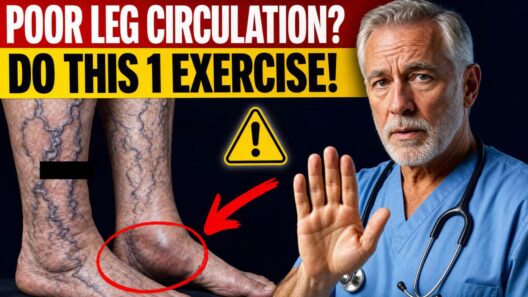
If your legs feel swollen, heavy, or strangely tired by the time the afternoon rolls around, you’ve probably been told the same thing for years: that’s just what aging looks like. You slow down. You sit more. Your legs catch up to you. So you accept it — the way you accept gray hair or stiffer mornings.
But here’s the part most people over 70 never hear from their doctor in plain words: in a huge number of cases, the heaviness in your legs has very little to do with your heart, and not even that much to do with your arteries. The real culprit is a quiet little muscle system in your lower legs that has slowly, almost invisibly, stopped doing the job it was built for.
And once you understand what that job is, one specific exercise — done at home, in your living room, without any equipment — starts to make sense as the single most useful thing you can do for your legs after 70.
Your Calves Are a Pump, Not Just a Muscle
In vascular medicine, there’s a concept that’s been taught to surgeons for decades: your calf muscles act as a second heart for your lower body.
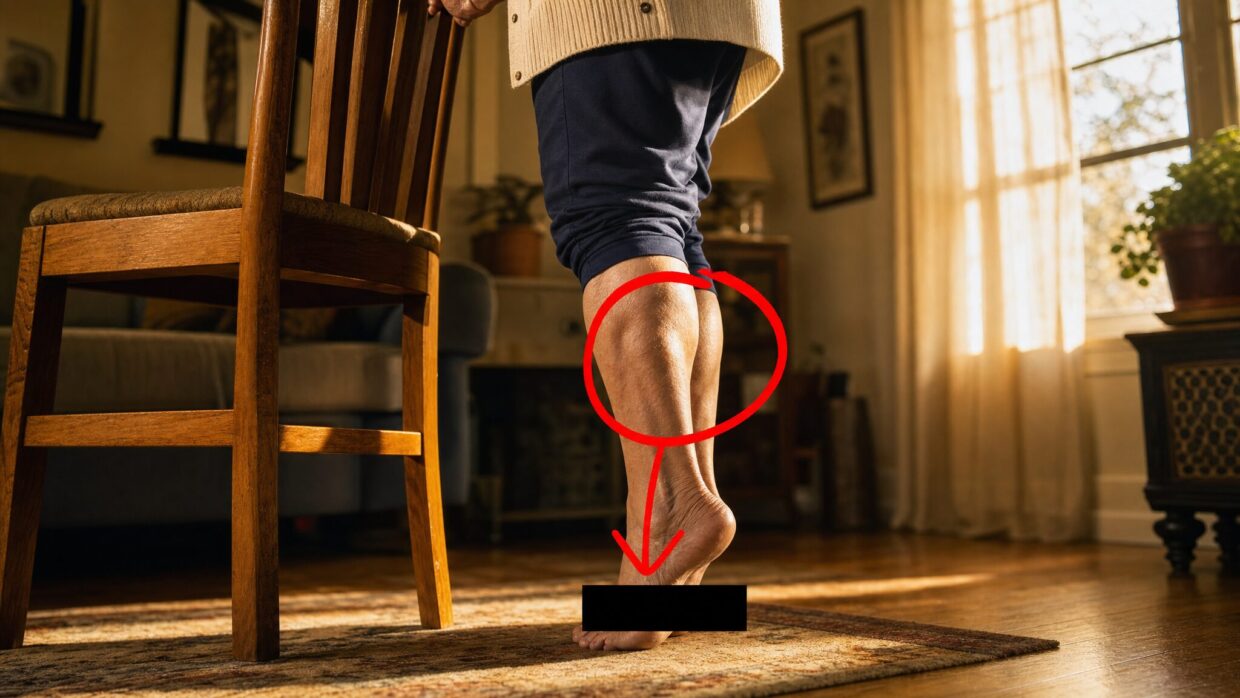
Every time you take a step, climb a stair, or even rise out of a chair, your calves squeeze. That squeeze isn’t just movement — it physically pushes blood upward, back toward your heart, fighting gravity the whole way. When the calves work, blood flows. When they go quiet — from too much sitting, from inactivity, from years of unintentional disuse — blood begins to settle in the ankles and lower legs.
That’s where the heaviness comes from. That’s the swelling around the ankles by 4 p.m. That’s the dull ache that shows up after a car ride. It isn’t really about the heart pumping harder. It’s about the legs forgetting how to pump for the heart.
A 2021 paper in the Journal of Applied Physiology followed a group of older adults with mild circulation issues and tracked what happened when they were guided through targeted calf-muscle activation. Within just a few weeks, blood return through the veins improved noticeably. None of them were running. None were lifting weights. They were doing one slow, controlled movement most people would dismiss because it looks too gentle to count.
“But I Already Walk Every Day”
This is the most common pushback, and it’s a fair one. Walking is excellent. Walking should not stop.
But walking alone — especially the slower, shorter walks many seniors settle into — does not always send a strong enough signal to the calves to fully wake the pump. The contraction is mild, the rhythm is gentle, and the calf muscles can stay underused even on a person who walks every day.
That is exactly why a small group of clinicians, particularly orthopedic and vascular surgeons, quietly recommend one additional exercise on top of walking — one that targets the whole leg as a working unit and reactivates the second heart in a way the body remembers.
The One Exercise: Controlled Heel-to-Stand Flow
This is the movement many surgeons consider the most valuable single exercise for leg circulation after 70 — not because it’s difficult, but because it does three things at once. It activates the calves. It moves the ankles and knees through a gentle, lubricated range. And it teaches the legs to handle body weight in a controlled, daily-life pattern. All in one quiet sequence.
Here is how it works.
Stand behind a sturdy chair or beside a kitchen counter. Place both hands lightly on the support — not gripping, not leaning, just resting. Your feet are about hip-width apart.
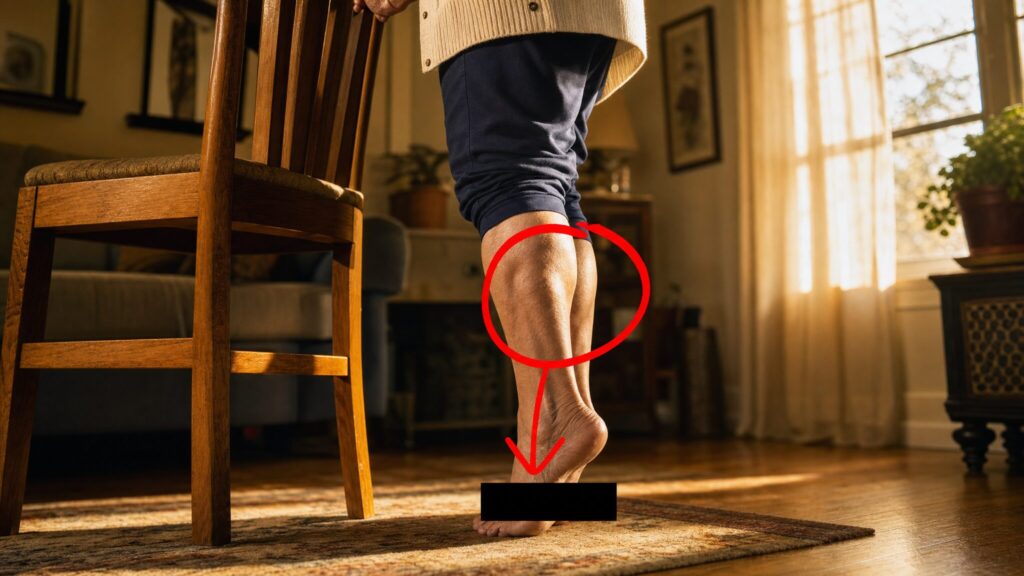
Step 1 — The heel lift. Slowly raise both heels off the floor, keeping the balls of your feet planted. Lift only as high as feels comfortable. Pause for a breath at the top. Then lower the heels back down with the same control.
Step 2 — The gentle knee bend. From flat feet, bend your knees just slightly — about an inch or two. You are not squatting. You are not lowering into a chair. You are simply softening the knees. Then straighten back up to a tall, easy stand.
Step 3 — Flow the two together. Heel lift, lower. Soft knee bend, rise. Heel lift, lower. Soft knee bend, rise. Slow, breathing normally, hands always lightly available on the support.
That’s the whole exercise.
Start with five to eight rounds. Stop when your legs feel warm and slightly awake — not tired, not burning. Do it once a day to begin. Some seniors work up to twice a day after a few weeks.
Why This Tiny Sequence Beats Bigger Workouts
For most adults under 50, this would look like a warm-up. For someone over 70 dealing with heaviness, swelling, or tired legs, it is the workout — because it asks the body to do, in slow motion, the same coordinated muscle dance that real life requires.
When you rise from a chair, your calves, thighs, and hips fire together. When you take a step, the same muscles fire together. When that coordination breaks down — which happens silently as people sit more and move less — circulation suffers and balance starts to feel uncertain.
Guidance from the National Institutes of Health has repeatedly emphasized that combined lower-body activation supports venous return and functional mobility in older adults far more reliably than isolated, single-muscle movements. The Heel-to-Stand Flow is essentially that principle, distilled into one small, repeatable sequence.
Mistakes to Avoid
A few patterns will quietly steal the benefit if you let them.
Rushing. Speed isn’t the point. Bouncing through the heel lifts trades muscle work for momentum, and the calves stop pumping. Slow is the entire mechanism.
Holding your breath. Many older adults instinctively brace and hold a breath during something new. Keep breathing normally — the diaphragm assists blood flow more than people realize.
Locking the knees at the top. When you straighten back up from the soft knee bend, leave the knees relaxed, not pushed back hard. A locked joint receives less circulation, not more.
Pushing into pain. Some warm muscle pull is fine. Sharp pain in the knee or ankle is the signal to reduce the range — smaller lift, smaller bend — not to stop entirely. The pain-free version still works.
What to Expect Over a Few Weeks
Most seniors who do this consistently — even just five minutes a day — start to notice three quiet changes within two to four weeks.
Legs feel lighter by evening. The ankle swelling that used to settle in by dinner shows up less, or stops showing up at all.
Standing up from a chair feels easier. The “oof” sound goes away first; the hesitation in the hips and knees fades next.
Walking feels more confident. Not faster, necessarily — just less hesitant. The legs trust the next step a little more than they did the week before.
None of these are dramatic. That’s part of why this exercise gets overlooked. The benefits arrive quietly, the way circulation itself does — small, steady, and far more important than they look.
The Bigger Picture: Why This Matters Beyond Comfort
Supporting circulation in the legs is not really about cosmetic swelling or end-of-day tiredness. It’s about staying independent. It’s about getting up from the couch without thinking twice. It’s about being able to walk to the mailbox, the kitchen, the grandchildren — without your legs becoming the deciding factor in whether the trip happens.
After 70, the body responds to clarity and repetition more than it does to intensity. One small, well-chosen exercise, done consistently, can quietly hold open the door to mobility for years.
The Heel-to-Stand Flow is exactly that kind of exercise. Five minutes. A chair. A quiet living room. And the slow, deliberate reactivation of the second heart your legs forgot they had.
This article is for general educational purposes and is not a substitute for personalized medical advice. If you have a history of blood clots, varicose vein complications, recent surgery, balance problems, or any cardiovascular condition, talk with your doctor before starting a new exercise — even a gentle one.