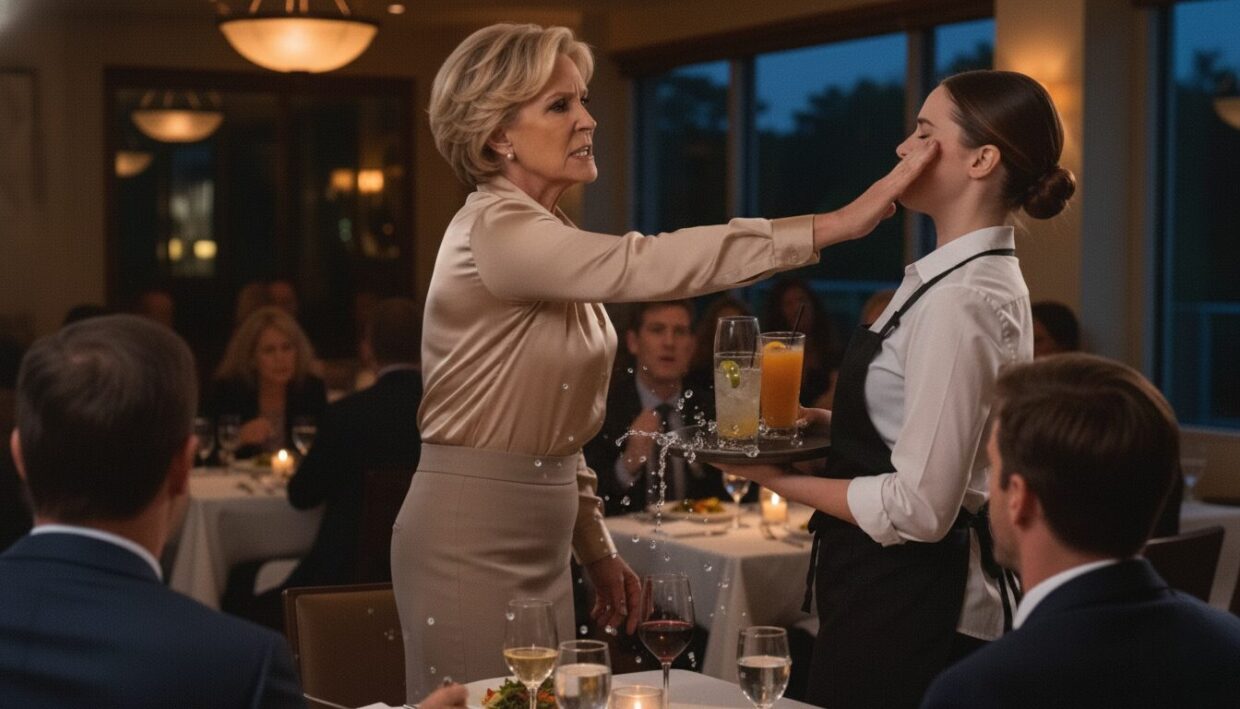
She slapped a waitress in front of the entire restaurant for being “too slow”… But the woman she hit owned every table, every chair, and the building itself.
The slap echoed like a gunshot.
Every fork stopped. Every glass froze mid-air. The entire dining room at Whitewood Grill turned to Table 9.
Karen Bellworth stood over the waitress, her palm still raised, her diamond bracelet catching the overhead light. The waitress — a woman in her early thirties with her auburn hair pulled back in a simple ponytail — held a tray of drinks steady with one hand while the other touched her reddened cheek.
“Maybe now you’ll work faster,” Karen said, loud enough for the whole room to hear.
The waitress didn’t flinch. She set the tray down on the edge of the table, straightened her apron, and looked Karen directly in the eye.
“I’m already working fast enough.”
Karen’s husband, Doug, shifted in his seat. He tugged at her sleeve. “Karen, sit down.”
“Don’t tell me to sit down,” Karen snapped. “We’ve been waiting forty minutes for appetizers. Forty. This is unacceptable.”
“It’s been twenty-two minutes,” the waitress said calmly. “And your calamari is on its way.”
Karen stepped closer. “Excuse me? Are you correcting me?”
“I’m telling you what happened.”
Karen’s face twisted. She turned to the nearest table — a couple in their fifties who were staring open-mouthed. “Did you see that? The attitude? In a place like this?”
The man at the table cleared his throat and looked away. His wife pressed her napkin to her lips.
Karen spun back. “I want your manager. Right now.”
The waitress nodded once. “Sure.”
She turned and walked toward the back of the restaurant with a steady, unhurried stride. Karen crossed her arms and shook her head, turning to Doug.
“Unbelievable. When the manager hears what I have to say, this girl is done.”
Doug rubbed his forehead. “You hit her, Karen.”
“I corrected her.”
“You slapped her in the face.”
“She was rude.”
“She was doing her job.”
Karen rolled her eyes. “Whose side are you on?”
Before Doug could answer, a man in a dark suit emerged from the kitchen. Mid-forties, broad shoulders, salt-and-pepper hair. His name tag read “PAUL — General Manager.”
He stopped at the edge of Table 9 and folded his hands.
“Ma’am. I’m Paul Driscoll, the general manager. I understand there’s been an incident.”
Karen straightened up, smoothing the front of her blouse. “Yes, there has. Your waitress — whatever her name is — has been incredibly slow, rude, and combative. I’d like her fired immediately and I’d like our meal comped.”
Paul didn’t blink. “Could you describe what happened?”
“She took forever. We ordered twenty minutes ago—”
“Forty,” Karen corrected herself. “Forty minutes ago. And when I asked her about it, she got sarcastic and disrespectful. So I gave her a little wake-up call.”
“A wake-up call,” Paul repeated.
“I tapped her.”
A woman at the next table muttered, “She slapped her across the face.”
Karen shot the woman a glare. “Nobody asked you.”
Paul inhaled slowly. “Ma’am, I need to be transparent with you. We have security cameras in this dining room. I’ve already seen the footage.”
Karen blinked. “So?”
“So I watched you strike a member of our staff. That’s assault.”
Karen laughed. “Assault? Don’t be dramatic. She’s a waitress. She works for tips. She should know how to take feedback.”
Paul’s jaw tightened. He glanced toward the kitchen, then back to Karen. “There’s something you should probably know about the woman you just hit.”
“What? That she has a bad attitude?”
“That she owns this restaurant.”
The silence that followed was suffocating.
Doug slowly set down his water glass. Karen’s mouth opened. Then closed. Then opened again.
“What?”
“Her name is Claire Whitewood. She’s the founder and sole owner of Whitewood Grill. She owns this building, the one next door, and the parking structure you parked in.”
Karen looked at Doug. Doug looked at the tablecloth.
“That’s… No,” Karen said. “No. Owners don’t wait tables.”
“Claire does,” Paul said. “She works the floor three nights a week. She always has. She believes the only way to understand a restaurant is to live every role in it.”
Karen took a step back. “Well — that doesn’t change the fact that the service was slow.”
“The kitchen had a fire alarm trigger thirty minutes ago. A small grease flare. Claire personally handled it, reset the system, and came right back to the floor. She never missed a step. Your food was delayed by exactly four minutes beyond our standard time.”
Karen’s confidence cracked at the edges. She reached for her purse. “Fine. We’ll just leave.”
“I’m afraid not,” Paul said.
Karen froze. “What do you mean, ‘I’m afraid not’?”
“Claire has already contacted the police. You struck her in front of forty-seven witnesses and four HD cameras. She’s pressing charges.”
The blood drained from Karen’s face. “You can’t be serious.”
“She’s very serious.”
Doug stood up. “Okay, let’s just calm down. I’m sure we can work this out. I’ll pay for the table, for the trouble — whatever it takes.”
Paul shook his head. “Mr. Bellworth, this isn’t about money. Claire has a zero-tolerance policy for violence against her staff. She built that policy after a busboy was punched by a customer three years ago. She fought to get that man charged, and she’ll do the same tonight.”
Karen’s voice dropped to a whisper. “I’m a member of the Westbrook Country Club. I chair the Heritage Gala. I can’t have this on my record.”
“You should have considered that before you hit someone,” Paul said evenly.
The front door opened. Two police officers stepped inside — one tall, one stocky, both calm. They nodded to Paul and walked toward Table 9.
“Ma’am,” the taller officer said. “We got a call about an assault. Could you step over here with us?”
Karen looked around the room. Every single diner was watching. Some had their phones out. The hostess by the door was biting her lip.
“This is a misunderstanding,” Karen said.
“We’ll sort that out,” the officer said. “But right now, we need to speak with you.”
Doug grabbed his coat. “I’ll call the lawyer.”
“You’ll need one,” Paul said quietly.
As the officers walked Karen to the front of the restaurant, Claire emerged from the kitchen. She’d taken off her apron. Her cheek still carried a faint red mark.
She stopped by the bar and poured herself a glass of water.
A regular — an older man named Gene who came every Thursday — leaned over from his barstool.
“You okay, Claire?”
“I’m fine, Gene.”
“Hell of a right hand she had.”
Claire almost smiled. “Sloppy form, though.”
Gene chuckled. “You pressing charges for real?”
“Already filed.”
Gene nodded slowly. “Good. You shouldn’t have to put up with that. Nobody should.”
Claire took a sip of water and glanced toward the door. Karen was standing between the two officers, gesturing wildly, her voice rising. Doug was on the phone in the corner, pacing.
Paul walked over to Claire. “The footage is backed up. Crystal clear. Three angles.”
“Thanks, Paul.”
“You want to take the rest of the night off?”
“No,” Claire said. “Table 12 still hasn’t gotten their risotto.”
Paul stared at her. “You just got assaulted.”
“And the risotto is getting cold.”
She grabbed a fresh apron from behind the bar, tied it on, and headed toward the kitchen.
That’s when the night turned.
Karen, now fully panicking, broke away from the officers and marched back toward Claire.
“Wait — wait. Please. I’m sorry. I overreacted. Can we just forget this happened?”
Claire stopped. She turned around slowly.
“You slapped me,” Claire said. “In my restaurant. In front of my guests.”
“I know, and I’m—”
“You didn’t just disrespect me. You disrespected every person who works here. Every cook. Every busser. Every host. You treated this place like your personal stage and you treated me like I was beneath you.”
Karen’s lip trembled. “I didn’t know you were the owner.”
“And if I wasn’t? If I was just a waitress working a double to pay rent — would that make it okay?”
Karen had no answer.
“That’s what I thought,” Claire said.
She turned back toward the kitchen. Karen reached for her arm.
One of the officers stepped in immediately. “Ma’am, do not touch her.”
Karen pulled back. Her mascara was starting to run. “Please. I’ll pay anything. I’ll apologize publicly. I’ll—”
“You’ll go to the station,” the officer said. “That’s what’s happening right now.”
Doug appeared at her side, phone still in hand. “The lawyer’s meeting us there. Let’s just go.”
Karen looked at the room one final time. Not one person met her eyes. The couple at the next table had turned their chairs away. A woman by the window shook her head slowly.
“Let’s go, Karen,” Doug said.
The officers escorted her out. The heavy front door closed behind them with a soft thud.
For a moment, the restaurant was still.
Then someone started clapping.
It was Gene. Slow, deliberate claps from the end of the bar.
Then the couple at Table 6. Then a family near the window. Then the whole room.
Paul looked at Claire, who was standing at the kitchen door with a tray of risotto plates balanced on her forearm.
“You good?” he asked.
“I’m good,” she said.
She pushed through the swinging door and delivered the risotto to Table 12 with a warm smile.
“Sorry for the wait. House fire. You know how it is.”
The woman at the table laughed. The man raised his glass. “On us tonight, Claire. Whatever you’re having.”
“Water,” Claire said. “I’ve still got four tables to close.”
She moved on to Table 14. Then 15. Then 17. She refilled drinks, cracked jokes, checked on desserts, and cleared plates. She worked the floor the same way she had for eleven years — from the night she opened with three tables, a borrowed stove, and a dream she funded by waitressing at a diner across town.
Two hours later, the restaurant was empty. The chairs were up. The lights were dimmed.
Claire sat at the bar with Paul. A single glass of red wine between them.
“You know this is going to go viral,” Paul said.
“Probably.”
“Three people were live-streaming.”
Claire sighed. “Great.”
“You might want to make a statement.”
“My statement is the same one it’s always been. Don’t hit people.”
Paul laughed quietly. “Simple enough.”
Claire’s phone buzzed. She glanced at it. Her lawyer.
“Karen Bellworth,” the message read. “Charged with simple assault. Arraignment Monday. Also — her country club just dropped her from the gala committee. Someone on their board was dining at Table 5 tonight.”
Claire read the message twice. Then she set her phone down.
“Karma’s got good timing,” she muttered.
“What was that?”
“Nothing. Good night, Paul.”
She grabbed her jacket, flipped off the bar lights, and walked toward the back exit. She paused at the door and looked over her shoulder at the empty restaurant — the low glow of the pendant lights, the polished bar top, the framed photos along the wall of every staff member who’d worked there since day one.
She’d built this place with her hands. Every tile. Every menu. Every late night mopping floors alone at 2 a.m. She didn’t do it for praise or status. She did it because she loved it. And she’d be back tomorrow, apron on, tray in hand, serving tables like she always did.
The door clicked shut behind her.
Three weeks later, the story had exploded.
The video — captured by a diner at Table 3 — had forty-two million views across every platform. News outlets ran it on morning shows. Late-night hosts cracked jokes about it. “Don’t Slap the Owner” became a trending phrase.
Karen Bellworth pleaded no contest to simple assault. She was sentenced to community service — two hundred hours at a local food bank. The judge added a public apology, which Karen delivered in a courtroom with trembling hands and zero eye contact.
Her country club membership was revoked. Her gala chair position was given to someone else. Three of her closest friends quietly unfollowed her on social media. Doug filed for separation two weeks after the arraignment, citing “irreconcilable differences” — though mutual friends said it was the embarrassment that broke him.
Claire never did a single interview.
She declined every podcast, every news segment, every book deal, and every reality show pitch. She posted one thing — a photo of her staff, all nineteen of them, standing in front of the restaurant with a handwritten sign that read: “We serve food, not egos.”
It got twelve million likes.
Reservations at Whitewood Grill tripled. Claire hired six new staff members and gave everyone a raise. She started a scholarship fund for hospitality workers — paid for entirely out of her own pocket.
And every Thursday, Friday, and Saturday night, she was right there on the floor. Apron on. Tray in hand. Pouring water, clearing plates, and greeting every guest at the door with the same line she’d used since opening night:
“Welcome to Whitewood. Glad you’re here.”
She meant it every single time.