A daughter-in-law banned grandma from seeing her own grandson and made a scene at the family dinner table… But a six-year-old boy said one sentence that exposed every lie she’d told for months.
The Sunday dinner had been Margaret’s idea.
She’d set the table herself — the good china, the linen napkins, the candles she only brought out for holidays. She wanted everything perfect. She wanted everyone together. Mostly, she wanted to see her grandson, Eli, who she hadn’t held in forty-three days.
Not that she was counting.
“She’s not coming,” her son Daniel said when she called Thursday. His voice was flat, careful. The voice of a man reading from a script he hadn’t written.
“Who’s not coming?”
“Kayla. She’s… she’s still upset.”
“About what, Daniel?”
A long pause. “She says you undermined her at Eli’s birthday. She says you went behind her back.”
Margaret sat down slowly at her kitchen table. “I brought my grandson a birthday cake. His favorite. The chocolate one with the sprinkles.”
“She’d already ordered one from that bakery—”
“Which arrived two hours late and had the wrong name on it.” Margaret kept her voice even. “I didn’t undermine anyone. I made sure a five-year-old had birthday cake on his birthday.”
“Mom.” The word landed like a door closing. “Just… give her some space.”
She gave her space. Three weeks. Then four. Then six.
Then Daniel called on a Wednesday night and said, “Kayla thinks it would be better if you didn’t come to Eli’s school events for a while.”
“She thinks what?”
“Just until things settle down.”
“Daniel, I am his grandmother.”
“I know, Mom.”
“I have been at every single school event since he started pre-K.”
“I know.”
“Does Eli know? Does he know why I’m not there?”
Another pause. Longer this time. “Kayla handles the communication with his teachers.”
Margaret hung up before she said something she couldn’t take back. Then she sat in the dark for a long time, thinking about a little boy who might be wondering why his grandmother had disappeared.
The Sunday dinner happened because Margaret called Daniel’s sister, Christine, and Christine — who had never once in her life been accused of keeping her mouth shut — called Daniel directly.
“You are bringing your family to Mom’s house on Sunday,” Christine said, according to the story Daniel told Margaret later, with what he claimed was only mild exaggeration. “Or I am coming to your house, and I will stay there, and I will talk, and you know I will not stop talking.”
Daniel brought his family on Sunday.
Kayla arrived in sunglasses she didn’t take off until she was inside. She was tall and sharp-featured, with the kind of posture that looked like it had been cultivated as a weapon. She kissed Margaret’s cheek without touching her face.
“The house looks nice,” she said, which was the kind of compliment that wasn’t one.
“Thank you for coming,” Margaret said, which was the kind of gratitude that wasn’t gratitude.
Eli ran straight past both of them and wrapped himself around Margaret’s legs. “Grammy!”
She crouched down and held him, breathing him in — that specific smell of little-boy shampoo and something sweet and completely irreplaceable. “Hi, baby. I missed you so much.”
“I missed you too.” He pulled back and looked at her seriously. “Mommy said you were busy.”
Margaret felt the words like a splinter. Small. Deep. “Well, I’m not busy tonight. Tonight I’m all yours.”
He grinned and took off toward the living room, where Christine’s kids were already destroying a couch cushion fort.
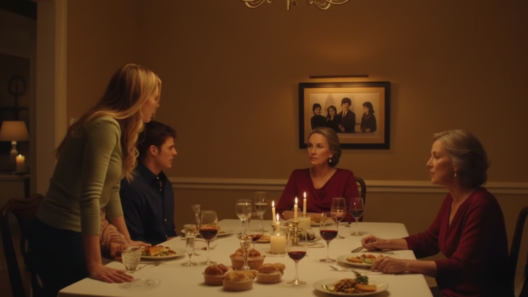
Christine had made a point of inviting their cousin Robert and his wife Paula, which meant the table was full, which meant there were witnesses, which Margaret suspected was Christine’s entire strategy from the beginning.
The first hour was careful. Polite. The food was passed and compliments were distributed and Daniel talked about work and Robert talked about his truck and the children created their own separate civilization in the living room that occasionally required adult embassy visits.
Then Christine, who had the instincts of a person who had watched too many courtroom dramas, said pleasantly: “Kayla, it’s so nice you could make it. We were starting to think you’d stopped coming to family dinners altogether.”
Kayla set down her fork. “We’ve been busy.”
“Right. Just, Margaret mentioned she hadn’t seen Eli in over a month. Which I’m sure was just schedules.”
“Christine,” Daniel said.
“I’m just saying, she’s his grandmother. We all missed him.”
Kayla turned to Margaret with a smile that had no warmth anywhere inside it. “I think what Christine is trying to say is that you’ve felt left out. And I understand that. Transitions are hard for everyone.” She paused, letting that land. “But Daniel and I have been working really hard to establish boundaries that support our family’s wellbeing. That’s not personal. That’s just good parenting.”
The table went quiet in the specific way that happens when everyone suddenly becomes very interested in their food.
Margaret looked at her son. Daniel was staring at the tablecloth.
“Kayla,” Margaret said carefully, “I don’t believe I’ve ever done anything to harm your family’s wellbeing. I brought a birthday cake—”
“It’s not about the cake.” Kayla’s voice sharpened just slightly. “It’s about a pattern of behavior. The way you insert yourself. The way you undermine decisions that Daniel and I make together.” She glanced around the table with a brief, almost apologetic smile. “I’m sorry to get into this here. But since it’s been brought up — I think everyone at this table knows what I’m talking about. Margaret has a way of making herself the center of everything, and frankly, it affects our son.”
There it was. The accusation, spread wide enough to include everyone. The appeal to the room.
Margaret looked around the table. She saw Robert staring at his plate. She saw Paula blinking. She saw Christine’s jaw tighten. And she felt something sink inside her — the fear that Kayla was right, that they all agreed, that she had imagined herself closer to this family than she really was.
Then she heard a small voice from the doorway.
“Mommy?”
Eli was standing at the edge of the dining room, holding a toy truck. His hair was messed up from playing. He was looking at his mother.
“What is it, sweetheart?” Kayla said, her voice instantly shifting to warmth. “Go play with the other kids. The grown-ups are talking.”
“Are you talking about Grammy?”
A beat. “We’re just having a conversation.”
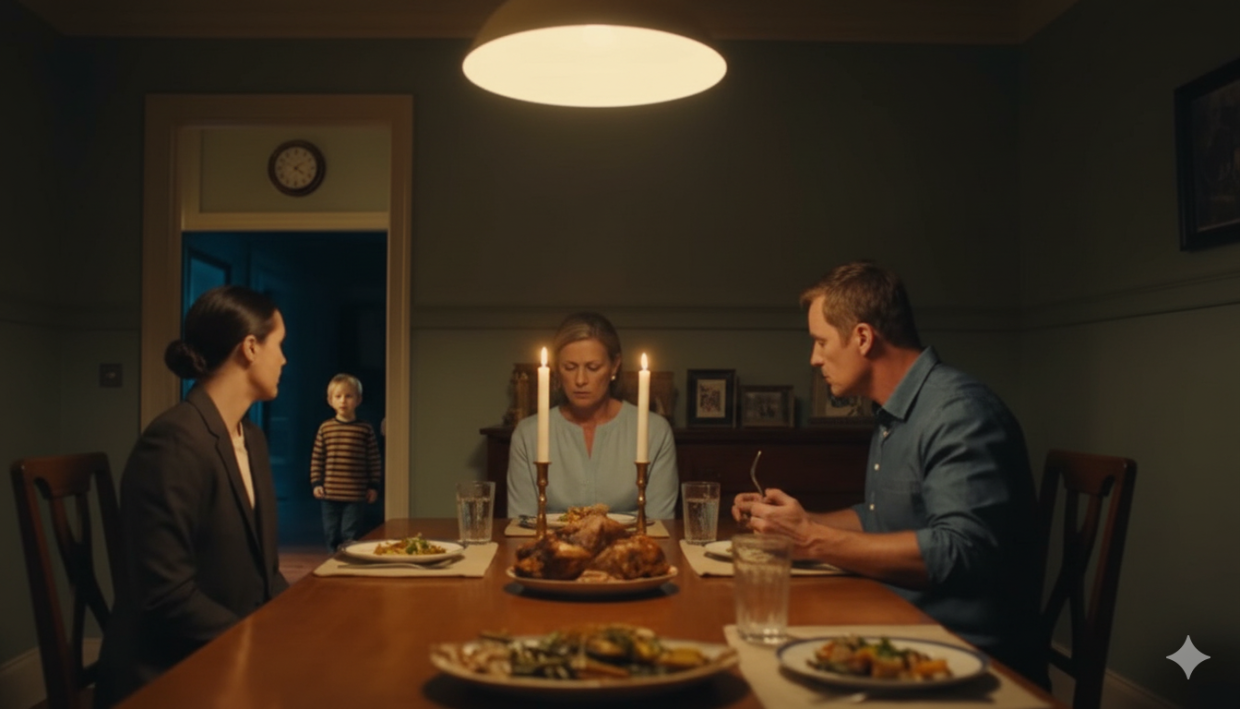
Eli looked at Margaret with his large, direct, five-year-old eyes. Then he looked back at his mother. “But Grammy wasn’t busy,” he said. “She called. You said she was busy but I heard you on the phone. You said to tell her we weren’t home. But we were home. I was right there.”
Nobody moved.
“Eli—”
“She called three times.” He held up three fingers, utterly serious. “I counted. You said ‘tell her we’re not home’ and Daddy said it to her on the phone. But I was right there. We were all home.” He frowned slightly, with the specific confusion of a child who has not yet learned to smooth over contradictions. “Why did you say we weren’t home?”
The silence that followed was a different kind of silence than the one before it.
Margaret looked at Daniel. Daniel had gone completely still. His fork was suspended halfway between the table and his plate. His face had done something complicated — the look of a man who has just heard his child say out loud a thing that he cannot unhear.
“Kayla,” Christine said. Her voice was very quiet. “How many times did Margaret call?”
“This isn’t—” Kayla started.
“How many times?”
“Children misunderstand things. He’s five—”
“How many times did she call?”
Eli, apparently satisfied that he’d contributed, went back to the living room. His sneakers squeaked on the hardwood floor. The sound was almost absurdly ordinary.
Kayla tried three more times to redirect.
She said Eli was confused about the timeline. She said the phone calls in question were from a different time. She said the real issue was the pattern of behavior she’d already described, and that everyone was being derailed by a misunderstanding.
Each time, someone at the table looked at Daniel.
Daniel didn’t look at anyone.
Finally, Robert, who was the most straightforward person Margaret had ever known, looked at his plate and said, “Daniel, your kid just said your mom called and you told him to pretend you weren’t home.”
“That’s not—” Kayla started.
“I’m talking to Daniel.”
The table waited.
Daniel set down his fork. He looked at his hands for a long time. Then he said, “She called on a Sunday. And a Thursday. And… I think there was one during the week.” His voice was very low. “I told her we weren’t home.”
“Why?” Margaret heard herself ask. She hadn’t meant to say it out loud.
Daniel finally looked at her. And the thing she saw on his face wasn’t anger, or justification, or even guilt exactly. It was something older. Exhausted. The look of a person who has been carrying something heavy for a long time and has just set it down somewhere he can’t pick it back up.
“Because it was easier,” he said. “Because she—” He stopped. Started again. “Because there was always going to be a reason. And it was easier to just say we weren’t home.”
“Than to tell me why.” Margaret kept her voice steady. “It was easier to let me think I’d done something. To let me wonder for forty-three days what I’d done wrong.”
He didn’t answer.
“To let your son watch you lie.” She said it gently, not cruelly. “He counted, Daniel. He’s five years old and he counted the phone calls and he knows his grandmother wasn’t busy.”
Kayla pushed back her chair. “I think we should table this conversation for another time, when we haven’t all had wine and emotions aren’t—”
“Sit down.” Christine’s voice was not unkind. It was the voice of someone stating a fact. “We’re going to finish this.”
What came out over the next hour was not a revelation in the dramatic sense. There was no single smoking gun, no secret that rewrote everything. It was smaller than that, and sadder.
Kayla had decided, sometime around Eli’s fourth birthday, that Margaret was competition. That was the word Christine used later, privately, to Margaret: competition. Not an enemy. Not even a bad person, necessarily. Just someone who had been framed, in Kayla’s mind, as a rival for her son’s primary attachment.
Every small thing had been catalogued and reframed. The birthday cake. The time Margaret had instinctively comforted Eli when he scraped his knee before Kayla could reach him. The way Eli ran to Margaret first when they arrived somewhere. Each instance had been saved and weaponized into a narrative about undermining, about inserting, about not respecting boundaries.
And Daniel — exhausted, conflict-avoidant, trying to keep his household from igniting — had done what he’d been doing for years. He’d taken the path of least resistance. He’d agreed, and redirected, and quietly lied, and told himself it was temporary, it would blow over, he’d fix it later.
He’d told his son to say they weren’t home.
His son had counted.
By nine o’clock, the children were all watching a movie in the living room.
The adults had moved to the kitchen. The good china had been cleared. Coffee had been made. The conversation had become quieter, more human — the kind of conversation that can only happen after something has broken and before anyone has figured out how to begin fixing it.
Kayla sat at the end of the table with her hands around her coffee mug. The sunglasses were long gone. She looked smaller than she had at dinner. Not defeated — Kayla was not the kind of person who went to defeated easily — but stripped of something. The performance, maybe.
“I didn’t think it was that bad,” she said finally. She wasn’t talking to anyone in particular. “I thought — I don’t know what I thought. I thought she’d understand eventually. I thought it was manageable.”
“It was forty-three days,” Margaret said. Not viciously. Simply.
“I know.”
“He thought I was busy.”
Kayla pressed her lips together. “I know.”
A pause. Then Kayla looked directly at Margaret for the first time all evening — really looked, without the armor of the practiced smile. “I don’t know how to do this. The grandmother thing. My family wasn’t—” She stopped. “It wasn’t like this. It wasn’t warm like this. And I don’t always know what to do with warm.”
Margaret looked at her for a long moment. “You could have said that.”
“I know.”
“You could have told me you were feeling crowded, or overwhelmed, or whatever it was. I would have listened.”
“I know.” A pause. “I’m not good at that.”
“You’re going to have to learn.” Margaret’s voice was firm, but not harsh. “Because that boy in there is going to grow up. And one day he’s going to be old enough to understand more than you think he understands right now. And he is going to remember what kind of people surrounded him when he was small.”
Kayla was quiet for a long time. Then: “I’ll call the school on Monday. About the events.”
“Thank you.”
“And… I’m sorry. About the phone calls.” She said it slowly, like someone reading from a language they hadn’t fully learned. But she said it.
Margaret nodded. “I know.”
Daniel found her later, in the hallway, where she was looking at the photographs on the wall — decades of them, Christmas mornings and first days of school and one particularly blurry summer vacation photo that she’d kept anyway because everyone was laughing in it.
“Mom.”
She turned.
“I’m sorry,” he said. “Not just for tonight. For all of it.”
She looked at her son — this person she had held when he was the same size as Eli, this person she had watched become a man, this person who had, somehow, somewhere along the way, learned to take the easy path even when it led somewhere wrong.
“You’re going to have to do better,” she said. “Not for me. For him.”
“I know.”
“He counted, Daniel.”
“I know.” He closed his eyes briefly. “I know.”
She reached out and put her hand on his arm. He was still her son. That didn’t change. “Then start there,” she said. “Start with knowing.”
Before they left, Eli came to find her.
He pressed his face against her shoulder and wrapped his arms as far around her as they would go. “Grammy,” he said, muffled, “are you going to be busy again?”
She held him tight. “No, baby. I’m not going to be busy.”
“Promise?”
She looked across the room at Daniel, who was helping Kayla with her coat, his hand on her back — careful, attentive, the small visible effort of a man trying to do better. She looked at Christine, who raised one eyebrow in a way that said don’t you dare say maybe.
“I promise,” Margaret said.
Eli leaned back and looked at her with those clear, serious eyes. Then he smiled — the full Eli smile, the one that took up his whole face — and said, “Okay, good,” and ran back to collect his truck from the living room floor.
Margaret stood in the hallway of the home she’d lived in for thirty-one years, and listened to her family move around inside it, and felt, for the first time in forty-three days, like something had been returned to her.
Not unchanged. But returned.
Some things only come back through the truth. And sometimes the truth is five years old and counting phone calls on his fingers and asking, with perfect uncomplicated clarity, why you said you weren’t home when you were right there.
The whole time.
Right there.