A wealthy man screamed at a waitress and demanded she be fired on the spot… But when the manager leaned down and whispered four words, the entire restaurant went silent.
The reservation was for eight o’clock sharp.
Derek Calloway arrived at seven forty-two, because that was how he operated. Early enough to make the staff scramble. Early enough to establish, before a single word was spoken, that his time was the commodity being traded here — not theirs.
“Calloway,” he said to the hostess. “Party of two.”
She was maybe twenty-three, dark curls pinned back, the practiced smile of someone who’d been doing this long enough to recognize a difficult table by the way a man said his own name.
“Of course, Mr. Calloway. Your table will be ready in just a moment. Can I offer you something at the bar while—”
“I don’t wait at bars. That’s for people who didn’t make a reservation.”
“Of course. Right this way.”
She led him through Hayes & Co. — a mid-sized American bistro that had earned a James Beard nomination three years running, been profiled twice in the city magazine, and was booked out six weeks on weekend evenings. Derek’s assistant had flagged it as the best new restaurant in the city. Derek had said fine without looking up from his laptop.
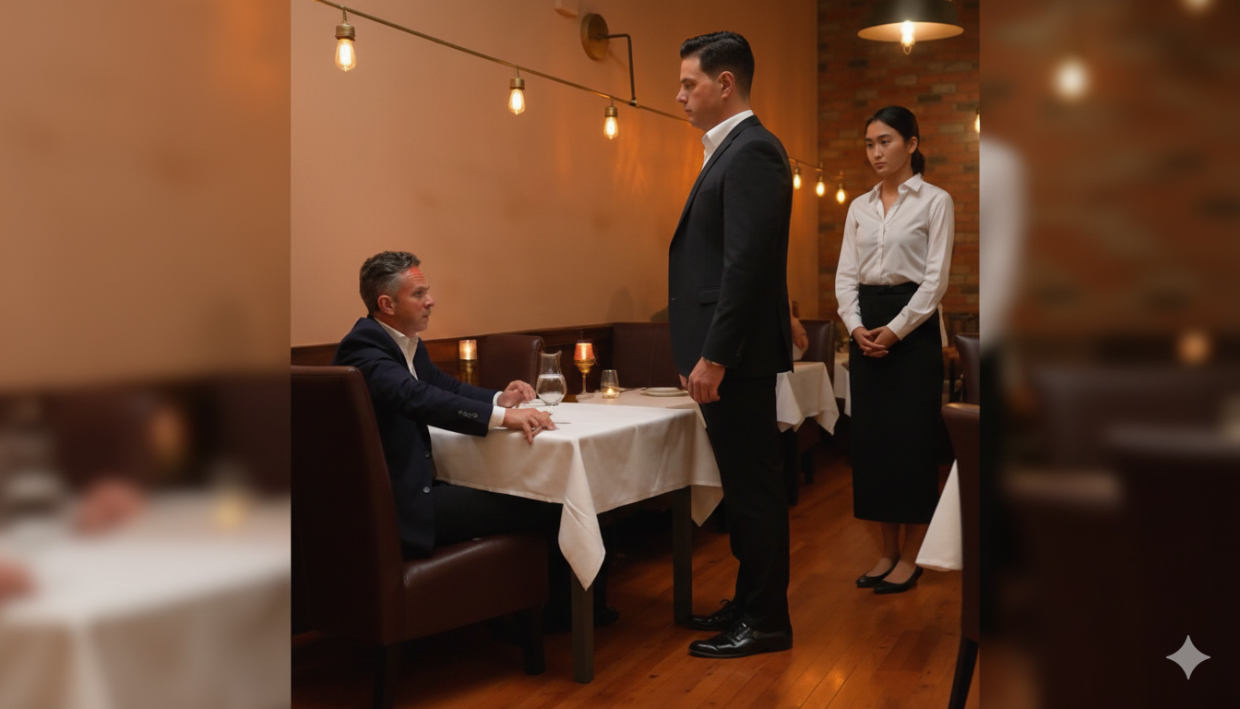
The space was warm. Exposed brick. Soft Edison bulbs strung between iron beams. The kind of place that looked effortless and cost a fortune to maintain that way — every surface chosen, every piece of furniture considered, every corner lit as if someone understood that hospitality was architecture first.
Derek scanned it with the practiced eye of someone who measured everything.
“This table’s too close to the kitchen,” he said.
“I’m sorry?”
“You heard me. I can smell the fryer from here. It’s not the ambiance I came for.”
“Mr. Calloway, this is actually one of our preferred—”
“Are you arguing with me right now? About where I’m going to sit?”
The hostess faltered. Her smile stayed, but something behind her eyes adjusted. “No, sir. I’ll see what I can find.”
She relocated him to a corner booth — the best seat in the house, actually; the one regulars requested by name. He didn’t know that. He slid in, straightened his jacket, and checked his phone.
Ryan Holt arrived four minutes later — slightly breathless, slightly apologetic in the way that had become his resting state around Derek over the eight years they’d worked together.
“Traffic was brutal,” Ryan said.
“Traffic is a constant. Being on time is a decision.”
Ryan sat down and picked up the menu without comment.
The waitress appeared two minutes later.
She moved with the unhurried efficiency of someone who had spent years on their feet and stopped apologizing for the pace. Early thirties. Dark hair pulled back cleanly. Black slacks, white button-down — the restaurant’s simple uniform, worn with the ease of someone for whom a uniform had never meant invisible.
“Good evening, gentlemen. I’m Claire. I’ll be taking care of you tonight.” She set menus down with smooth precision. “Can I start you with something to drink?”
“Water,” Derek said, not looking up from his phone. “Filtered. And make sure the ice is filtered too. Last place I was, the ice tasted like a municipal pool.”
“Of course. Everything we serve is filtered — water, ice, all of it.”
“We’ll do the tasting menu,” Ryan said, with the quick, compensatory warmth he deployed in restaurants to balance the atmosphere Derek created. “Both of us. And whatever wine pairing you’d recommend.”
“Excellent. Tonight’s pairing opens with a 2021 Willamette Valley Pinot that—”
“I didn’t agree to the tasting menu,” Derek said.
Ryan looked at him.
“Don’t order for me.” He turned to Claire. “I want the New York strip. Medium rare. And when I say medium rare, I mean a warm red center, soft to the press — not medium, not medium-rare-plus, not whatever temperature your kitchen defaults to when nobody’s paying attention.”
“Noted. Would you like the truffle fries, or—”
“Truffle fries, but light on the oil. Half the restaurants in this city pour it on because they think it reads as sophisticated. It just means your kitchen doesn’t know when to stop.”
“I’ll pass that note to the chef directly.”
“And that table over there got a bread basket before they even opened their menus.” He nodded toward a four-top near the window. “We’ve been sitting here five minutes. Why don’t we have ours?”
“I’ll bring it right now.”
“You should have already brought it.”
Claire looked at him. Not with hostility — with the particular stillness of someone deciding how much grace to offer, and choosing more than was required. “I’ll be right back.”
Ryan waited until she was gone.
“You know,” he said quietly, “you don’t have to—”
“I’m paying for a service,” Derek said. “If they can’t deliver the basics, I’m not obligated to pretend otherwise.”
“You could just… not say everything out loud.”
“That’s how standards slip.”
The bread basket arrived within two minutes. Sourdough, warm, with whipped honey butter that Ryan made an involuntary sound over.
Derek ate one piece and said nothing about it.
The evening held its unpleasant equilibrium until eight thirty-four, when the steak arrived.
Derek cut into it. Studied the center.
“No,” he said.
Claire materialized at the table with the attentiveness of someone who’d been watching the cut. “Is everything—”
“This is medium.” He pushed the plate toward her. The gesture had the finality of a judge handing down a ruling. “I said medium rare. This is medium.”
Claire looked at the steak. The center was a deep, rosy pink — the color a culinary school instructor would hold up as the textbook example of medium rare. She’d seen it come out of the pass. She’d checked it herself, because she checked everything.
“I want to make sure we get this right for you,” she said. “I’ll have Chef prepare a fresh—”
“No. Take that back and have them finish it correctly. I’m not waiting another twenty minutes for a new cut.”
She took the plate back.
It returned eight minutes later — rested, replated, the same steak. If anything, the additional heat had moved the center incrementally toward medium on the edge nearest the cast iron.
Derek looked at it for four seconds. Didn’t cut it.
“This is worse,” he said.
He said it at full conversational volume. The table to their left — a couple celebrating, the woman wearing a dress that suggested occasion — went quiet.
“I don’t know what’s happening in your kitchen tonight,” Derek continued, “but somebody back there has a serious problem with basic execution. Medium rare is not a complex concept. It’s taught in the first week of culinary school. If your kitchen can’t—”
“Mr. Calloway.” Claire’s voice was even. Controlled. A wire under tension.
“—can’t produce a properly cooked steak on the second attempt, I genuinely question what else is going wrong back there that I can’t see.” He looked around, as if taking inventory of the dining room’s other tables. The couple to his left had returned to their food with the careful attention of people pretending not to listen. “This is a quality issue. And it starts with service.”
“I understand your frustration. I can have Chef Alvarez come out personally to discuss—”
“What I want,” Derek said, “is your manager.”
He said it the way people say it when they want an audience to know they’ve said it. Loud enough to carry. Loud enough to matter.
“Right now. And I want to have a conversation about the kind of service this restaurant thinks is acceptable to offer a paying guest.”
The room had gone quiet in a graduated way — nearby tables first, then a ripple outward as the silence became the loudest thing in the space.
Ryan set his fork down.
Derek pointed at Claire. Not looked at her — pointed, the way one indicates a malfunctioning piece of equipment to a technician.
“And I want her removed from my section. Immediately. Tonight.” A pause for effect. “Actually, let me be direct about it. I want her fired. Because what I’ve experienced this evening doesn’t represent the standard any professional establishment should tolerate.”
The request hung in the air.
Claire stood exactly where she’d been. Hands clasped at her waist. Posture unhurried. Expression — and this was the part that would stay with Ryan for a long time afterward — entirely, deliberately, composedly neutral. Not wounded. Not angry. Not afraid.
Just still.
Like someone who knew something the room didn’t know yet, and was content to wait for it.
Ryan looked at the tablecloth.
Derek picked up his phone and began typing.
Marcus Chen appeared from the direction of the service corridor. Forty-one years old, impeccably dressed, the kind of man whose calm was structural — not performed, not maintained, just load-bearing.
He walked to the table at a measured pace. Not hurried. Not stiff. The pace of someone who had managed high-conflict situations often enough that urgency no longer looked like speed.
“Good evening, Mr. Calloway,” he said, hands clasped. “I understand you have some concerns tonight.”
“Your waitress,” Derek said, with the brisk efficiency of someone who’d rehearsed this, “has failed to properly execute a basic dinner order twice, argued with me when I raised the issue, and represents a serious problem for your front-of-house quality. I want her off my section and I want her let go. Tonight.”
Marcus looked at Derek.
Then he looked at Claire — brief, steady, carrying something complex in its brevity. Acknowledgment. Reassurance. A kind of shared patience.
He turned back to Derek.
“Sir,” he said, “before I respond, I want to make sure I understand what you’re asking. You’d like me to terminate this employee.”
“Immediately. Yes.”
“I see.” A pause — perfectly calibrated, not dramatic, just the pause of someone selecting their words with care. “There’s something I should clarify for you first.”
Derek looked up from his phone.
Something in Marcus’s tone — too measured, too precise, carrying the specific weight of information that was about to reorganize the entire situation — made him set the phone down.
“Claire doesn’t work for me,” Marcus said quietly.
The silence that followed was the kind that happens in rooms when something irreversible has just been said.
“I work for her.”
He said it simply. Without flourish or malice. As a fact.
“Claire Hayes owns this restaurant.”
The ripple moved outward through the dining room immediately and completely. The couple to the left let their careful neutrality dissolve. A woman two tables back pressed the back of her hand to her mouth. Her husband looked straight ahead with the intense, focused expression of a man working extremely hard to hold a neutral face.
Someone near the back of the room made a sound — brief, involuntary, immediately suppressed.
Derek didn’t move.
He looked at Marcus. Then at Claire. Then at Marcus again, as though checking whether the information would change if examined from a different angle.
It didn’t.
Claire stood where she’d been standing. Hands clasped. Expression unchanged. Watching Derek with a patience that was neither warm nor cold — just absolute. The patience of someone who had been here before, in a thousand versions of this room, and had never once needed rescuing from it.
“She’s a—” Derek started. He stopped. He looked at her uniform. “She’s waiting tables.”
“She owns the restaurant,” Marcus said again. Gently. Clearly.
“Why would she—” He stopped again.
Claire spoke. Her voice was the same as it had been all evening — unhurried, professional, carrying no particular heat.
“Because I like it,” she said.
Derek looked at her.
“I started as a waitress,” she said. “Sixteen years old, lying about my age to get the job. Worked every position in this industry for the next decade — prep cook, line cook, front of house, catering, banquets, management.” She let that settle. “When I had enough capital to lease a space and build something from scratch, I did. I’ve owned Hayes & Co. for seven years.” A brief pause. “I still take a section on Friday nights. Keeps me connected to what we’re actually doing here.”
The room was very quiet.
“The steak,” she continued, in the same even tone, “was medium rare. I checked it personally before it went out the first time. Our kitchen doesn’t make that mistake.” Her eyes met his. “But when a guest is dissatisfied, we want them to be satisfied. Which is why I brought it back.”
Derek had nothing.
He was a man who lived inside the architecture of leverage — who always had a next move, a counter, a card to play. He had built a career on the assumption that money was power, and power was permission, and that anyone who looked like a service worker could be managed into compliance or discarded and replaced.
He had no architecture here.
“As for the termination request,” Claire said, “I’m afraid that’s outside my ability to accommodate.” The faintest shift in her expression — not quite a smile; something quieter and more permanent. “You were asking me to fire myself.”
The laugh from the back of the restaurant was short and helpless and real.
Someone started clapping — once, twice, three times — and stopped, embarrassed. But the damage was done. The sound had happened.
Derek’s face had gone a deep, particular red. Not the flush of anger — that would have been easier to carry. This was the color of a man who understood, fully and without escape route, what had just occurred. Not just that he’d been wrong. That he’d been wrong loudly. Publicly. In front of strangers who would tell other strangers. In front of a business associate who would remember this for the rest of their professional relationship.
In front of the owner of the restaurant, who had served him bread and absorbed his condescension and checked his steak and stood here for the last twenty minutes being pointed at — literally pointed at — while waiting for exactly this moment.
“The meal is on us this evening,” Claire said. “Consider it our apology for any confusion.”
The generosity of it was worse than any confrontation could have been. Because there was nothing hostile in it. No satisfaction, no performance, no “how does it feel.” She was simply being gracious — the way a person is gracious when they can afford to be in every possible sense — and the effect was total and final.
Derek looked at his plate.
He had no review to write. Any version of it ended with the internet knowing he’d tried to get the owner of the restaurant fired. He had no complaint to escalate. He had no authority to invoke. He was a man sitting in someone else’s house, in the best seat she’d given him despite everything, eating bread he hadn’t thanked her for, having just demanded, at full volume, that she terminate her own employment.
Ryan picked up his wine glass and drank deeply and said absolutely nothing.
Derek ate the rest of the steak in silence.
It was — and he knew this with the certain, hopeless clarity of someone who ate well for a living — extraordinary. The center was a perfect deep rose, the crust caramelized with precision, the fat rendered completely clean. It was the best steak he’d had in two years. Possibly longer.
He did not say this out loud.
Ryan finished the tasting menu in focused silence and also said nothing, which was its own form of commentary.
When the check came — zeroed out, as promised, with a handwritten note at the bottom of the receipt that said only: Thank you for dining with us. We hope to see you again — Derek reached for his wallet out of reflex. He opened it. He looked at the comped bill.
He set three hundred dollars in cash beside it.
He wasn’t sure why. It wasn’t an apology — he wasn’t capable of those in any direct form, and he knew it. It wasn’t strategy. It was something smaller and less comfortable than either: an acknowledgment, rendered in the only language he fully trusted, that the evening had extracted something from him he hadn’t come prepared to pay.
On the way out, he passed Claire near the host stand.
She was greeting a couple just arriving — her hand gesturing toward the dining room with the easy, instinctive warmth of a person showing someone around their home. Her attention fully on them. Entirely present.
She didn’t look at Derek.
He slowed.
He kept walking.
Ryan caught up to him on the sidewalk.
The night air was cool and clean after the warmth of the restaurant. Down the block, cabs moved through the intersection in their slow evening rhythm.
“So,” Ryan said.
“Don’t.”
“I wasn’t—”
“You were going to say at least four things.”
Ryan put his hands in his pockets and walked alongside him for a moment. “The food was exceptional.”
Derek said nothing.
“That tasting menu was one of the best meals I’ve had in years.”
Nothing.
“The steak especially. Did you think so? Because it looked—”
“Ryan.”
“—medium rare to me. Textbook, really.”
Derek stopped walking. He turned. Ryan was looking out at the street with the careful, studious neutrality of a man who absolutely had a smile he was not deploying.
“Are you finished?”
“Almost.” Ryan took his phone out. “I’m going to leave a review.”
“A review.”
“Five stars. Incredible atmosphere, outstanding food, exceptional service. Owner was gracious, warm, and handled a difficult situation with complete professionalism.” He looked up. “I’ll leave out the specific details of the difficult situation.”
Derek studied him.
“You’re going to do that whether I tell you not to or not.”
“Probably, yes.”
Derek turned and walked.
Ryan called after him. “Derek—”
“Call the car,” Derek said, over his shoulder. “Early meeting.”
Ryan watched him go — the set of his shoulders, something different in his posture that wasn’t usually there. The slight diminishment of a man accustomed to filling every room he walked into. He thought about the three hundred dollars left beside a comped bill. He thought about a woman who’d worked every station in a kitchen for sixteen years before she owned the building. He thought about the specific texture of Derek’s silence when the steak turned out to be exactly what she’d said it was.
He took out his phone.
He left the review.
By morning, it had over a hundred upvotes and a reply from the restaurant account: Thank you. That means the world to us. Come back soon.
Derek read it at six fifty-one a.m. in the back of his car, over the first coffee of the day. He read it once. He read it again.
He set the phone face-down on the leather seat beside him.
He looked out the window at the city moving past — the early-morning version, still gray at the edges, all delivery trucks and dog-walkers and people heading somewhere with purpose.
After a long time, he reached back for the phone.
He opened the restaurant’s page.
He looked at Claire Hayes’s photo on the About section — the professional headshot, warm and direct, the same composed expression she’d had at his table, the same unhurried confidence.
He read the bio. Sixteen years in the industry. Built Hayes & Co. from nothing. Still works a Friday night section.
He read it twice.
Then he closed the app.
He didn’t leave a review. He didn’t call his assistant to complain. He didn’t do the thing he would have done the day before, which was to tell the story at the next dinner party as an anecdote about restaurant quality control, positioning himself as the protagonist of a consumer rights issue.
He sat with it.
The car moved through morning traffic, and Derek Calloway — who had spent forty-seven years being the most important person in every room he walked into — sat quietly in the back seat of a car he hadn’t driven himself in fifteen years, and thought about a woman who still waited tables on Friday nights because she said it kept her honest.
He didn’t say anything about it to anyone.
But the next Friday evening, his assistant got a call from Hayes & Co. confirming a reservation — party of one, eight o’clock, the corner booth — accompanied by a special note from the guest himself.
Please tell Ms. Hayes the steak was perfect.