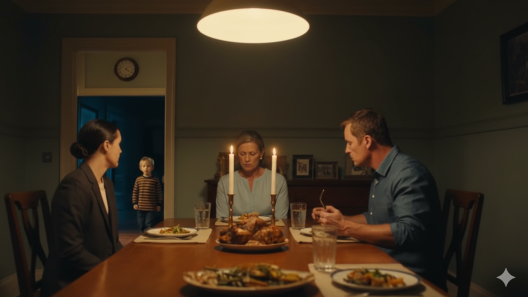
She dropped her mother at a nursing home and drove away laughing… But the lawyer who showed up the next morning had one condition attached to every dollar of the inheritance — and she had already failed it.
The drive took forty minutes.
Carol Whitfield did not speak for most of it. She sat in the passenger seat of her daughter’s Audi with her hands folded in her lap and her overnight bag at her feet and watched the familiar streets of her neighborhood give way to roads she did not recognize.
“You’ll like it,” Renee said. She was doing the thing she always did when she had made a decision she knew was wrong — talking quickly, eyes forward, filling the air so there was no room for anyone else’s voice. “It’s got a garden. Activities. You’ll have people your own age to talk to.”
“I have people my own age,” Carol said. “Dorothy. Frances. The women from my book club.”
“Mom. Come on.”
“I am coming on,” Carol said. “Apparently.”
Renee’s jaw tightened. “This is not a punishment. This is practical. I work sixty hours a week. Kevin travels. The kids have school. There is nobody home to—”
“To what?”
“To keep an eye on you.”
Carol looked at her hands. “I didn’t ask anyone to keep an eye on me.”
“You fell.”
“I tripped on the rug in the hallway. Which I have told you for two years needs to be replaced.”
“You could have broken your hip.”
“I didn’t.”
“Mom.” Renee exhaled. The exhale of someone who had been rehearsing this conversation in their head and had reached the part where the other person was supposed to stop pushing back. “I don’t have time to babysit an old woman. I’m sorry if that’s harsh. But that’s where we are.”
Carol turned to look at her daughter.
She looked at her for a long time — long enough that Renee finally, briefly, glanced over.
“Your father would be very sad,” Carol said quietly. “To hear you say that.”
“Dad’s not here.”
“No,” Carol said. “He isn’t.”
They did not speak again for the rest of the drive.
Sunrise Gardens was clean.
That was the most charitable thing Carol could find to say about it in the first hour. It was clean, it smelled of industrial lavender, and the woman at the front desk had a smile that reached exactly as far as her training required and no further.
Renee handled the paperwork with the efficiency of someone completing a task from a list. She signed things. She initialed things. She answered questions about Carol’s medical history in the third person, as though Carol were not sitting eighteen inches away.
“Does she have any dietary restrictions?”
“She doesn’t like fish,” Renee said. “Other than that, no.”
Carol said, “I also don’t like being referred to as she when I’m in the room.”
The intake woman smiled her trained smile. “Of course, Mrs. Whitfield. We’ll make a note.”
Renee walked Carol to her room. It had a window that looked out over the garden, which was real and which had roses in it, which Carol noted and did not say anything about because she was not going to give Renee the satisfaction of finding something right.
“I’ll call you Sunday,” Renee said at the door.
“Will you.”
“Mom. Don’t do this.”
“I’m not doing anything,” Carol said. “I’m standing in my new room. You’re the one who’s doing something.”
Renee left.
Carol sat on the edge of the bed. She looked at the window. She looked at the roses.
She did not cry, because she had raised herself not to cry over things that couldn’t be undone yet. The “yet” was important. She had learned that from fifty-two years of marriage to a man who believed, without exception, that most things could eventually be undone.
She thought about that for a while.
Then she unpacked her overnight bag, found the detective novel she’d been reading, and got into bed with it at four-thirty in the afternoon.
If this was what her life was now, she was going to read as many books as she wanted.
The lawyer arrived at ten-fifteen the next morning.
Carol was in the garden with her novel when the staff found her. A young woman she hadn’t met yet — one of the junior care aides, nervous and apologetic — appeared on the path and said there was a man in the front lobby asking for her. He had a briefcase. He had given his name as Warren Holt.
Carol put her bookmark in at page forty-seven, put on her cardigan, and went inside.
Warren Holt was sixty-something, with the particular bearing of a man who had been sitting in boardrooms longer than most of the people in them had been alive. He stood when she came in. He offered his hand with both of his.
“Mrs. Whitfield,” he said. “I’m Warren Holt. I was your husband’s attorney for the last eighteen years. I’m sorry I wasn’t able to reach you at home. Your daughter informed my office of your change of address.”
Carol sat down across from him. “What can I do for you, Mr. Holt?”
He opened his briefcase. He removed a document. He set it on the coffee table between them.
“Your husband’s estate,” he said. “He updated his will fourteen months ago. There are some provisions you should be aware of.”
Her husband, Martin Whitfield, had built two things in his life that he was proud of.
One was his family. The other was a regional construction company that bore his name and that had, over thirty-one years, grown from three employees and a pickup truck to a $14 million operation with contracts across four states.
Martin had known, for the last two years of his life, that his heart was failing. He had not told Renee this. He had told Carol, and Carol had kept it because he’d asked her to, because he was a private man and it was a private thing and he had wanted to handle it in his own way.
Part of handling it in his own way had been calling Warren Holt.
“The estate,” Warren said, setting the second page beside the first, “is valued at approximately eleven-point-three million dollars, inclusive of the business, the property holdings, and the liquid assets.”
Carol nodded. She had known the approximate number.
“The primary beneficiary is you,” Warren said. “That has not changed. You have full access to income from the trust immediately, and the principal becomes available to you at your discretion.”
“All right,” Carol said.
“However.” Warren placed a third page. “Your husband added a conditional clause fourteen months ago regarding secondary distribution. The estate has three secondary beneficiaries — your daughter Renee, your son Patrick, and your granddaughter Sophie.”
“Sophie gets her share regardless,” Carol said. “Martin adored her.”
“Correct. Sophie’s portion is unconditional — a trust that activates at twenty-five. The others are not unconditional.” He paused. “Your husband specified that the secondary shares — each valued at approximately two-point-one million — would be released based on a determination of how each beneficiary treated you in the period following his death. The language he used was ‘demonstrated ongoing care and consideration for Carol Louise Whitfield.'”
Carol looked at the page.
“He built in an evaluation period,” Warren continued. “Eighteen months from the date of his death. He named me as the independent assessor. I’ve been watching. I’ve been taking calls. I’ve spoken to Dorothy Marsh and Frances Gilmore, both of whom you listed as references.”
“Frances has a very good memory,” Carol said.
“She does,” Warren agreed. “I’ve also spoken, this morning, with the intake staff here. And with the administrator.”
A silence settled between them.
“When did Martin die?” Carol asked, though she knew the answer.
“Seven months ago.”
“So there are eleven months left in the evaluation period.”
“Yes.”
“And Renee.”
Warren let the pause do the work.
“She dropped me here yesterday,” Carol said. “She told me she didn’t have time to babysit an old woman.”
“I’m aware,” Warren said. “There is a staff member here who made a note of that phrase at intake. Part of my role includes reviewing those records.”
Carol looked at the roses through the lobby window.
“What happens,” she said, “if a secondary beneficiary doesn’t meet the standard?”
“Their share returns to the primary beneficiary,” Warren said. “To you. You may redistribute it at your discretion, or retain it, or establish a new trust. At your sole judgment.”
Carol was quiet for a long moment.
“And Patrick?” she asked.
“Your son has called you every Sunday for seven months,” Warren said. “He drove four hours to fix your roof in September. He came alone, with his own tools, and he declined the money you offered him afterward.”
“He gets his two-point-one,” Carol said.
“That would be my assessment as well.”
Carol folded her hands the way she had in the car — but differently now. Not the resigned folding of someone being transported somewhere. The composed folding of someone deciding.
“Mr. Holt,” she said, “I’d like to make a phone call before we continue. Do you mind waiting?”
“Of course not,” he said.
She called Renee from a chair near the window, with the roses behind her and Warren Holt sitting discreetly across the room with his briefcase on his lap.
Renee picked up on the fourth ring with the slight edge of someone interrupted.
“Mom. I said I’d call Sunday—”
“There’s a lawyer here,” Carol said. “From your father’s estate. His name is Warren Holt. I think you should come.”
A pause.
“A lawyer.” Renee’s voice shifted — the edge replaced by something more careful. “What does he want?”
“He wants to explain the terms of your father’s will. The parts you weren’t aware of.”
“I was at the reading—”
“Not all of it,” Carol said. “There were conditions. I think you should come and hear them in person.”
Another pause. Longer.
“I can be there in an hour,” Renee said. Her voice was different now. The quickness was gone. In its place was the careful, considered tone of someone who had just heard a sound they didn’t recognize and was trying to decide if it was dangerous.
“Take your time,” Carol said. “Mr. Holt has cleared his afternoon.”
She hung up.
She went back to the chair across from Warren.
“She’s coming,” Carol said.
“Good,” he said.
“I want you to tell her everything,” Carol said. “Exactly as you told me. I’m not going to soften it.”
“I wouldn’t expect you to,” he said.
“Martin wouldn’t have either,” she said. “He was a fair man. Fairness was the thing he cared about most. He just expressed it quietly.” She looked at the window again. “I think he knew something like this might happen. He built a structure around it.”
“He did,” Warren said. “He was very deliberate.”
“Did he say anything? When he changed the will? About why?”
Warren considered the question with the care of a man choosing his words.
“He said,” Warren told her, “‘I want Carol to be looked after. But I know Carol. If I leave it entirely up to her, she’ll forgive everyone and look after herself last. So I’m building in a reason for people to do the right thing, because the right thing ought to have a reason behind it when people forget to do it on their own.'”
Carol’s eyes were bright, but her expression held.
“That sounds like him,” she said.
“It did to me as well,” Warren said.
Renee arrived in fifty-three minutes, which meant she had driven faster than was advisable. She came through the lobby door in her work clothes — the blazer, the good shoes — with her hair not quite as composed as usual and her eyes moving quickly around the room until they found Carol and Warren at the corner table.
She crossed to them. She sat down. She looked at Warren and then at her mother.
“What’s going on?” she said.
Warren explained. He was thorough, methodical, and scrupulously neutral. He placed the pages in order. He cited the dates. He used Martin’s exact language where it mattered.
Renee listened.
The color left her face around the point where Warren explained the evaluation period.
It did not return.
When he finished, the room was quiet except for the distant sound of a television from a common room down the hall and the faint mechanical hum of the building doing what buildings do.
“Two-point-one million dollars,” Renee said.
“Approximately,” Warren said.
“And it depends on—” She stopped. “On how I’ve treated her.”
“On how you treat her,” Warren said. “The period runs for eleven more months.”
Renee turned to Carol. Carol looked back at her with the same expression she’d worn in the car — clear, unhurried, certain of itself.
“Mom,” Renee said. “I didn’t know—”
“I know you didn’t,” Carol said.
“If I had known—”
“I know that too,” Carol said. “That’s actually the part your father thought about. He knew you’d do the right thing if there was a reason. He wasn’t trying to trick you. He was trying to give you a reason.”
Renee’s face did something complicated — guilt and relief and grief all arriving at once, pushing against each other behind her eyes.
“He was too good,” she said, and her voice broke slightly on the last word.
“He was exactly good enough,” Carol said. “Which is a harder thing to be.”
“I want to take you home,” Renee said.
“I know you do.”
“Mom. I mean it. We’ll fix the rug. We’ll get someone to come in during the day — a proper care aide, someone you actually like. You can have the whole back of the house. I’ll convert the sunroom—”
“Renee.”
“—and Kevin can set up the spare bathroom, it wouldn’t take long—”
“Renee.” Carol’s voice, quiet and absolute. “Stop.”
Renee stopped.
“I’m not going to come home because you suddenly need me to,” Carol said. “That would be the wrong reason and we’d both know it every day.”
“Then what do you want?” Renee’s voice was raw with something real for the first time. “Tell me what you want and I’ll do it.”
Carol looked at her.
“I want you to call me on Tuesdays,” she said. “Not to check in. To talk. About what’s happening in your life. About the kids. About whatever you’re worried about. Like we used to.”
“Okay,” Renee said.
“I want you to come for lunch on the first Sunday of every month. Bring the kids. Bring Kevin. We’ll eat here in the garden if the weather holds.”
“Okay.”
“And I want you to replace that rug in the hallway. Not for me. Because it’s a hazard and someone’s going to trip on it regardless.”
Renee made a sound that was almost a laugh. It didn’t quite make it.
“And the nursing home?” she said. “Are you going to stay?”
Carol considered the question.
The garden was visible through the lobby window. The roses were the pale orange kind that Martin had always called “the good ones.” The aide she’d met this morning had brought her tea without being asked.
“For now,” Carol said. “I’ll decide what I want in my own time. That’s the arrangement.”
Renee nodded. She was quiet for a moment, and then she said, “Did you know? About the will?”
“I knew he’d seen Warren,” Carol said. “I didn’t know the specifics. He told me he’d taken care of it.”
“And you didn’t ask?”
“I trusted him,” Carol said. “That’s what fifty-two years looks like. You don’t always need to ask.”
Renee looked at her hands.
“I’m sorry,” she said. “About what I said in the car. About babysitting. That was—” She shook her head. “That was a terrible thing to say.”
“Yes,” Carol said. “It was.”
“I don’t have an excuse.”
“I know you don’t.”
“But I am sorry.”
Carol looked at her daughter — the particular way mothers look at their children when they are trying to find the person they raised inside the person sitting in front of them. She found her. She was there, underneath the blazer and the careful hair and the sixty hours a week. She’d always been there. She’d just gotten buried.
“Tuesday,” Carol said. “Call me Tuesday.”
“I’ll call you Tuesday,” Renee said.
Warren Holt packed his briefcase and said his goodbyes with the quiet professionalism of a man who had witnessed the right outcome and considered his work done.
At the door, Carol stopped him.
“Mr. Holt,” she said. “Did Martin say anything else? When he changed the will?”
Warren smiled — the first real one she’d seen from him.
“He said, ‘Tell Carol she’s the whole point of all of it. The business, the money, the house — all of it was for her. The rest of them just need to remember that.'”
Carol stood with that for a moment.
“Thank you,” she said.
“Mrs. Whitfield,” Warren said, “it’s been a genuine pleasure.”
Renee called on Tuesday.
She called the Tuesday after that, and the one after that.
She came the first Sunday of the following month with both kids and Kevin, who brought a folding chair because he’d heard the garden benches were uncomfortable, and they ate lunch with the pale orange roses in the background and stayed two hours past when they’d planned.
Patrick drove up the second weekend and walked the garden with his mother for an hour, telling her about the new contract at work and asking her opinion on a disagreement he was having with his business partner, the way he always had, because he was the kind of son who actually wanted the answer.
Eleven months later, Warren Holt filed his assessment.
Patrick’s two-point-one million transferred without condition.
For Renee, Carol made a decision.
Not out of sentimentality. Not out of the particular fog of guilt that had hung over the last eleven months of Tuesday calls and Sunday lunches and genuinely, slowly, improving things. She made it out of the clear-eyed judgment of a woman who had watched someone decide to become better and had seen them follow through.
She authorized the transfer.
She did it on a Tuesday, right after Renee called.
She told her on the call.
There was a long silence on the line.
“Mom,” Renee said. “You didn’t have to—”
“Your father built a structure,” Carol said. “You filled it. That’s all either of you had to do.”
“I don’t know how to—”
“You don’t need to,” Carol said. “Come Sunday. Bring the kids. Kevin can bring that folding chair again — I’ve decided the benches actually are uncomfortable.”
Renee laughed. The real one, the one from when she was young, the one Carol had been waiting eleven months to hear again.
“Sunday,” Renee said. “I’ll be there.”
Carol hung up and sat with the phone in her lap and the pale orange roses outside the window.
Martin, she thought, you magnificent, deliberate man.
You took care of everything.
You always did.