
She screamed “freeloader” at her mother-in-law and threw her suitcase onto the front lawn for the whole street to see… But the lawyer who pulled up sixty seconds later had one quiet woman’s name on every single document.
Margaret Hayes had lived in that house for thirty-one years.
She had painted every room herself. She had planted the maple tree in the front yard the year Daniel turned five. She had buried her husband from that front porch, accepting casseroles from neighbors who still remembered when she and Robert had first moved in with nothing but a used truck and a plan.
She had never once considered that she might be asked to leave.
“I need you out by Friday.”
Diane said it the way she said most things — quickly, cleanly, without looking up from her phone. She was standing at the kitchen island, scrolling through something that apparently required more attention than the woman she was speaking to.
Margaret set down her coffee mug.
“I beg your pardon?”
Diane finally looked up. She had the expression she always wore during these conversations — patient in the way that people are patient when they consider themselves to be doing you a favor by explaining the obvious.
“The room you’re in? We need it. I’ve been talking to Daniel about converting it into a home office for months. The kids need space. This house is crowded. And honestly, Margaret, it’s just time.”
“Time,” Margaret repeated.
“You’ve had a good run here. Three years since Robert passed and you’ve been comfortable. That’s wonderful. But Daniel and I have a family to think about.”
Margaret looked at her son.
Daniel was standing near the back door with his arms crossed and his eyes on the floor. He had his father’s jaw and none of his father’s backbone. He’d had that problem since middle school. Margaret had always hoped it was a phase.
“Daniel,” she said quietly.
“Mom, it’s just—” He stopped. Started again. “The house is getting tight. Lily’s getting older. Diane has a point.”
“Does she.”
“We’re not kicking you out.” He finally looked up, and she could see the guilt there, which meant he still had some piece of himself intact. “We just think maybe an apartment. Somewhere close. We’ll help with the deposit—”
“I don’t need help with a deposit.”
Diane set her phone down. “Then there shouldn’t be a problem.”
Margaret picked up her coffee mug again. She drank the rest of it slowly. She washed it in the sink, dried it with the dish towel that hung from the oven handle — the one with the small embroidered roosters that she had bought at a craft fair in 2009 — and she set it back in the cabinet where it had lived for a decade.
“I’ll think about it,” she said.
“Friday,” Diane said again.
That was Monday.
By Wednesday, Margaret had not moved a single item.
She had, however, made a phone call.
She had made it from the back porch, sitting in the wooden chair Robert had built her for their twenty-fifth anniversary, speaking quietly to Arthur Cole, who had been her attorney for nineteen years and who picked up on the second ring because that was the kind of man he was.
“Margaret,” he said. “What can I do for you?”
“I may need you on Friday,” she said. “Around noon, if you can manage it.”
“I can manage it,” he said. “Do you want to tell me what’s happening?”
She told him.
There was a pause on the line.
“Shall I bring the full file?” Arthur asked.
“Please,” Margaret said.
She hung up and sat with her coffee and watched a cardinal land on the maple tree.
Thursday evening, Diane escalated.
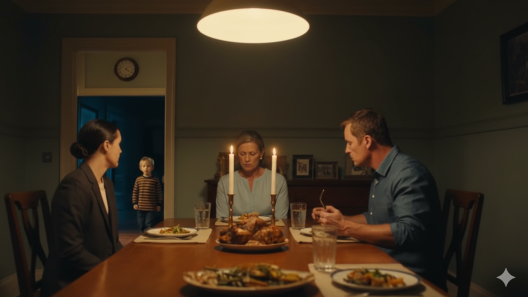
She appeared in the doorway of Margaret’s room — which had been the master bedroom for thirty-one years and which Diane had clearly already mentally redecorated — holding a box.
“I thought I’d help you start packing.”
“That’s kind of you,” Margaret said. “No thank you.”
“Margaret.” Diane’s voice dropped into the register she used when she wanted to sound reasonable while saying something unreasonable. “I don’t want this to be difficult. You’re making it difficult.”
“I’m sitting in a chair reading a book.”
“You know what I mean.”
Margaret looked at her over the top of her reading glasses. “Diane. I have given this situation a great deal of thought. I’ll be ready tomorrow.”
Something in her tone made Diane pause. Not suspicion exactly. More like a small, unidentified noise in a house at night. You hear it, you tell yourself it’s nothing, you go back to sleep.
Diane went back to sleep.
Friday arrived bright and cool, a perfect October morning.
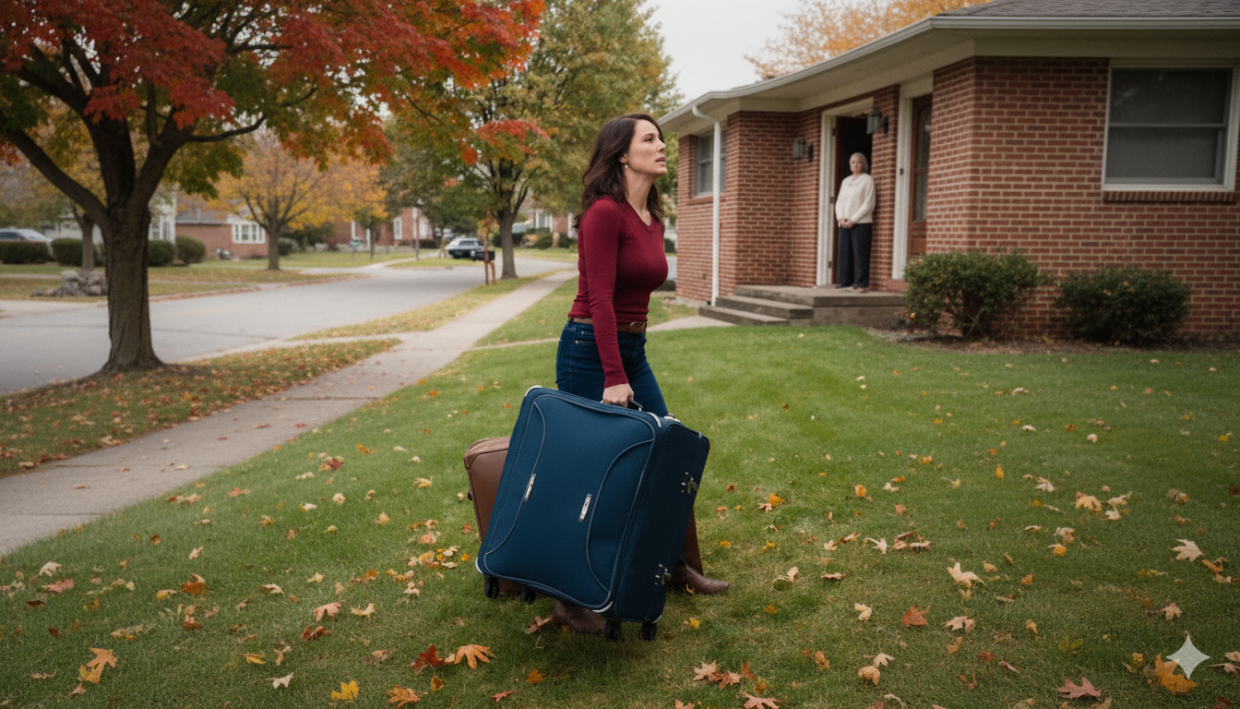
At eleven-forty-five, Diane appeared on the front lawn with the energy of someone who had been waiting for this moment and had perhaps rehearsed portions of it. She was holding two of Margaret’s suitcases. She set them down on the grass with a thud.
“Daniel is at work,” she announced. “I want this done before he gets home. It’ll be easier.”
“Easier for whom?” Margaret asked. She was standing in the doorway, still wearing her cardigan, her hands folded in front of her.
“For everyone.” Diane went back inside.
She came back with a third bag. Then a box. Then a small lamp that had been Robert’s mother’s, which she carried with the same reverence she might give a bag of old shoes.
Margaret watched from the doorway.
Carol from next door appeared on her porch with the particular stillness of a woman who knows she is witnessing something important and is not going to pretend otherwise.
Two teenagers from down the block slowed their walk.
Diane, fueled now by audience and righteousness, turned to face the street.
“This is what happens,” she announced to no one and everyone, “when you let freeloaders live with you out of guilt. Three years. Three years of cooking for her, cleaning around her, watching her sit in that chair—”
“You have never cooked a meal for me,” Margaret said clearly, from the doorway.
“—and she acts like we owe her something. This is our house. Our family. And she needs to understand that her time here is done.”
She was still talking when the black sedan pulled up to the curb.
It parked precisely, unhurried, the way cars park when their drivers are very sure of where they are supposed to be.
Arthur Cole stepped out. He was sixty-one, silver-haired, wearing a charcoal suit that cost more than Diane’s monthly car payment. He carried a leather briefcase. He nodded at Margaret. He looked at the suitcases on the lawn.
“I see I’m just in time,” he said.
Diane looked at him the way you look at a stranger who just walked into the middle of your argument. “Who are you?”
“Arthur Cole.” He offered his hand. She didn’t take it. He continued without missing a beat. “I’m Margaret’s attorney. You must be Diane. She’s told me about you.”
“Her attorney.” Diane said it like she was testing the words to see if they made sense. “Why does she need an attorney?”
“Why don’t we step inside?” Arthur said. “I have some documents you’ll want to see.”
“I don’t need to see any—”
“Diane.” Margaret’s voice was quiet. It was the same voice she had used when Daniel tracked mud into the house at age nine, when the plumber quoted her an outrageous number, when the hospital told her Robert had six months. It stopped people. It always had. “Go inside.”
They sat at the kitchen table.
Arthur set the briefcase on the counter and opened it with the particular efficiency of a man who had done this before and would likely do it again.
“I’ll keep this straightforward,” he said. He placed a document on the table. Then another. Then a third. Each one slid precisely into position. “This is the deed to the property at this address. This is the title to Hayes Family Printing, the business that has operated under that name for twenty-six years. And this is Robert Hayes’s last will and testament, executed in full in 2019 and uncontested at probate.”
Diane stared at the papers.
“The deed,” Arthur continued, “is registered in the name of Margaret Louise Hayes. Has been since 1993, when the original mortgage was paid off and the property transferred fully to her name. Robert always felt—” He glanced at Margaret, who gave a small nod. “—that she had earned it.”
“That’s not possible,” Diane said.
“I assure you it is.”
“Daniel said—” She stopped.
“Daniel may have been under a misimpression,” Arthur said, with the diplomatic neutrality of a career that had seen a great many misimpressions. “The business title is similarly straightforward. Hayes Family Printing was incorporated with Margaret Hayes as sole owner. Robert served as operational director, but ownership was never transferred. Upon his death, full ownership reverted to Margaret without condition.”
The room was very quiet.
The refrigerator hummed.
Diane’s face moved through several expressions in quick succession — confusion, disbelief, calculation, and then something that looked very much like fear.
“This is a mistake,” she said.
“It isn’t.”
“Daniel would have known. He would have told me.”
“Perhaps you should ask him what he knew and when,” Arthur said pleasantly. He began organizing the documents back into a neat stack.
Diane turned to Margaret. “You did this on purpose. You’ve been sitting on this, waiting—”
“I’ve been sitting in that chair,” Margaret said, “reading my book.”
“You let me humiliate myself out there. You could have said something.”
“I tried on Monday,” Margaret said. “And Tuesday. And every Tuesday before that for three years. You didn’t find it worth your time.”
Diane’s mouth opened. Closed.
“You called me a freeloader,” Margaret continued. She said it without particular heat, which made it worse. “In front of Carol. In front of those kids. In front of my home, which I paid for with thirty years of my life.”
“Margaret, I—” Diane shifted forward, voice dropping, pivoting with an agility that came from long practice. “I was upset. I didn’t mean — you know how I get when I’m stressed. Daniel and I have been under so much pressure lately and I just—”
“You put my mother’s lamp on the grass.”
That landed.
Diane looked at the lamp, which Arthur had carried inside and set on the counter without being asked.
“I’ll fix this,” Diane said. “We can figure this out. We’re family. Whatever you need, we can—”
“What I need,” Margaret said, “is for you to understand that I have been gracious in my own home for three years because I love my son and I wanted to believe you would grow into someone worth that grace.” She folded her hands on the table. “I no longer believe that.”
Diane went very still.
“Arthur,” Margaret said, “what is the process?”
“For what, specifically?” he asked, though his expression said he knew exactly.
“For asking someone to vacate a property.”
Arthur reached into the briefcase again. He produced a single folded document. “I took the liberty,” he said, “of preparing a notice. Given the circumstances you described.”
He set it on the table in front of Diane.
Diane looked at it. She looked at Margaret. “You can’t be serious.”
“I don’t make jokes about property law,” Arthur said.
“Where are we supposed to go?”
“That,” Margaret said, “is genuinely not my problem. Although I’ll note that you solved it very easily for me forty-five minutes ago, so I imagine you’ll manage.”
Daniel arrived home at twelve-thirty.
He walked in through the back door the way he always did, calling out a hello that died in his throat when he saw Arthur Cole sitting at the kitchen table, his mother across from him, and his wife standing at the counter with the expression of someone who has just realized the ground beneath them is not solid.
“Mom?” He looked between them. “What’s — why is Arthur here?”
“Sit down, Daniel,” Margaret said.
He sat. He was told. He listened.
It took about four minutes.
The color drained from his face slowly, like water from a bathtub.
“You knew,” Diane said. It wasn’t a question. Her voice had changed — the persuasive warmth was gone, replaced by something colder. “You knew the house was in her name.”
Daniel said nothing.
“Daniel.” Her voice rose. “Did you know?”
“I thought—” He stopped. “I thought it would transfer. After Dad died. Automatically.”
“And you never checked.”
“I didn’t think I needed to—”
“You told me we owned this house.” Her voice was shaking now, but not with the fear it had been a moment ago. With rage. “You let me spend three years reorganizing and redecorating and planning around this house like it was ours—”
“It felt like ours—”
“Because you lied to me!”
“I didn’t lie, I just—”
“Daniel.” Margaret’s voice, again. Quiet. Absolute. They both stopped. “I don’t want to hear this argument in my kitchen.”
A silence fell.
Daniel looked at his mother. Really looked at her — maybe for the first time in years, maybe for the first time since the funeral, maybe for the first time since he had let a version of himself go dormant because it was easier than the alternative.
“Mom,” he said. “I’m sorry.”
“I know you are,” she said.
“I should have—”
“Yes,” she said. “You should have.”
He nodded. He looked at the table.
“What happens now?” he asked.
Arthur slid the second document across to him. “Margaret is offering a sixty-day notice rather than thirty, in acknowledgment of your daughter. She’d like to see Lily on weekends and holidays. Those arrangements are hers to offer, not obligations — meaning she can withdraw them depending on how the next sixty days go.”
Daniel read the document. He didn’t argue.
When he looked up, his eyes were red.
“I want you to know,” he said to Margaret, “that I love you. I know that doesn’t fix what—”
“It fixes nothing right now,” Margaret said. “But it’s a true thing. I’ll hold onto it.”
Diane tried one more time.
She cornered Margaret in the hallway near the coat closet — the tactical choice of someone who had run out of rooms — and she dropped her voice to its most intimate register, the one she saved for when she really needed something.
“Margaret. Woman to woman. I know I went too far today. I know I said things I can’t take back. But I am asking you — I am begging you — to think about Lily. That little girl loves this house. She loves you. Don’t blow up her home because of me.”
Margaret looked at her for a long moment.
“Lily,” she said finally, “is always welcome in this house. She was welcome before today. She will be welcome after. I have never once confused that child with her mother.”
Diane’s eyes filled. Whether from genuine feeling or from the simple experience of a move not working, Margaret couldn’t say with certainty. She had made her peace with not knowing.
“The sixty days is fair,” Margaret said. “Use them wisely.”
She walked past her and went to the back porch.
She sat in Robert’s chair.
She picked up her book.
She found her page.
Carol appeared at the fence a little while later, holding two mugs.
“I made tea,” she said. “I watched that whole thing from my porch and I want you to know I am absolutely going to need every detail.”
Margaret smiled — the real one, the one that had been waiting all morning.
“Come around,” she said. “I’ll put something stronger in yours.”
Six weeks later, Daniel and Diane moved into a rental three miles away. The moving truck was rented in Daniel’s name.
Diane did not say goodbye.
Daniel hugged his mother on the front porch for a long time. He smelled like the house — the soap she still bought, the particular cedar of the coat closet — and she held him the way she had when he was small, before he had learned to pretend that he didn’t need it.
“I’m going to be better,” he said.
“I know,” she said. “That’s why you’re getting the sixty days.”
He laughed, a little broken, a little real.
Lily was in the back seat of their car. She pressed her hand against the window as they pulled away.
Margaret pressed hers back.
That evening, she called Arthur to close out the notice.
“You handled that beautifully,” he told her.
“Robert always said the house was mine,” she said. “I suppose I just had to say it out loud.”
She hung up and stood in the hallway, the quiet house around her — thirty-one years of it, the walls holding everything they had ever held — and she walked to the kitchen, put the kettle on, and got out the rooster dish towel.
Some things, she thought, you earn.
Some things, you simply have always owned.
It just takes other people long enough to figure that out.