


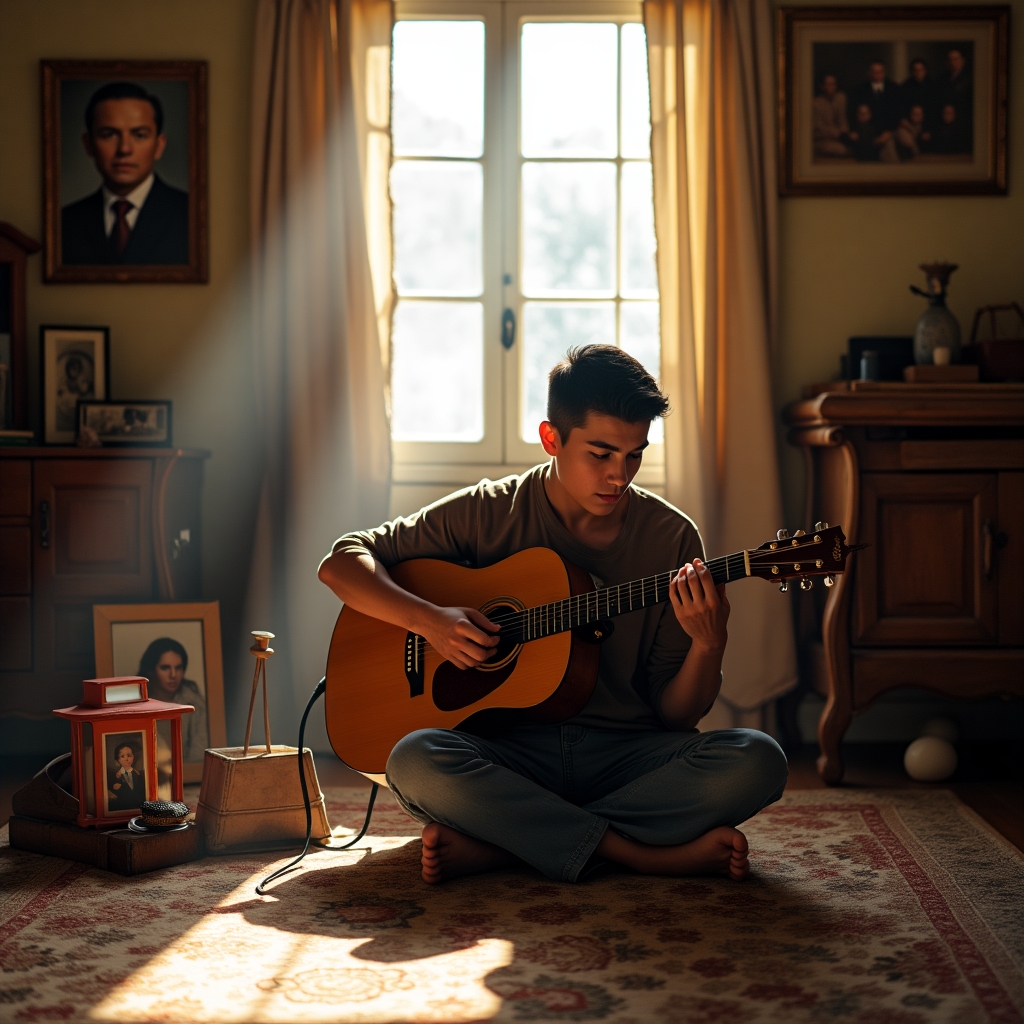
Ayaan sat on the edge of his bed, staring at the wooden floorboards that had seen the footsteps of his ancestors for generations. His room was a sanctuary, filled with the familiar scent of sandalwood and old books, the walls lined with photographs documenting family gatherings, festivals, and moments of tradition. It was a repository of countless memories, and yet, to Ayaan, it often felt like a cage.
From a young age, Ayaan understood the weight of expectations. His family, deeply rooted in their cultural traditions, placed a heavy emphasis on family honor and collective identity. To step outside of these boundaries was to risk disapproval and disappointment, sentiments Ayaan desperately wished to avoid. Yet, as he grew, Ayaan felt a growing sense of dissonance between who he was expected to be and who he felt he could become.
Every Sunday, they gathered for family lunch. His grandmother, a woman of stern resolve and profound love, presided over these meals. Her stories of their ancestors, of pride and dignity, hung in the air along with the aroma of spices. Ayaan respected her deeply, but the stories, once a source of inspiration, began to weigh on him like a heavy cloak.
Ayaan’s true passion lay in music. He found solace in the gentle strum of a guitar, the ability to craft something beautiful from silence. Yet, the world of notes and rhythms felt worlds apart from the life charted for him by his family. He had tried to share his music with them, but his attempts were met with polite smiles and sidelong glances, as if indulging a child’s whim.
Saturday afternoons were his own, a slice of time when he could explore the city with his closest friend, Priya. They would visit bustling markets, sit for hours in coffee shops, and talk about everything and nothing. Priya understood him in ways his family couldn’t; she saw the yearning in his eyes and heard the unspoken words in his silences.
“Have you told them yet?” Priya asked one afternoon as they walked by the river.
Ayaan shook his head. “I wouldn’t even know where to start.”
“You know they’ll still love you, right? Even if they don’t understand at first.”
He wanted to believe that, but years of quiet acceptance had taught him to tread carefully. There was no animosity in his heart, only the fear of losing the fragile balance he had maintained.
The turning point came quietly, on a day like any other. Ayaan found himself at the old record store, flipping through vinyls, when he stumbled upon an album he’d heard about but had never seen. It was a compilation of traditional songs reimagined through contemporary music. The artwork on the cover was a fusion of old and new, a visual metaphor that resonated deeply with him.
He bought the album on an impulse and spent that night listening to it over and over, the familiar melodies cast in a new light. It was as if someone had opened a door he hadn’t known existed, showing him a path where the old and new could coexist.
The next morning, as the sun rose, casting long shadows across his room, he picked up his guitar. With tentative strokes, he began to blend the traditional songs with his own style, creating something uniquely his own. The room filled with music, notes soaring and intertwining, echoing a truth that had long been silent.
In that moment of clarity, the psychological tension that had gripped him loosened. It was not about choosing one over the other, he realized, but about harmoniously blending the two worlds. The generational expectations could coexist with his personal values, not in opposition but in dialogue.
He took a deep breath and felt an emotional strength take root within him, one that surged with the courage to share his truth with his family. It would not be easy, but he now understood that bridging the gap between tradition and individuality was a form of loyalty, too.
The next family lunch, Ayaan brought his guitar along. As they settled around the table, he gently strummed, capturing their attention. “I want to share something,” he began, his voice steady, “Something that I’ve been working on.”
His grandmother’s eyes, a tapestry of wisdom and expectation, met his own, and he saw something there—perhaps a glimmer of understanding, or the acknowledgment of his quiet struggle. As he played, blending the old with the new, the room filled with a new kind of silence, one that embraced his truth.
Ayaan knew the journey toward acceptance would take time, but in that moment, as the music echoed in the space between them, he felt the first notes of generational healing.