




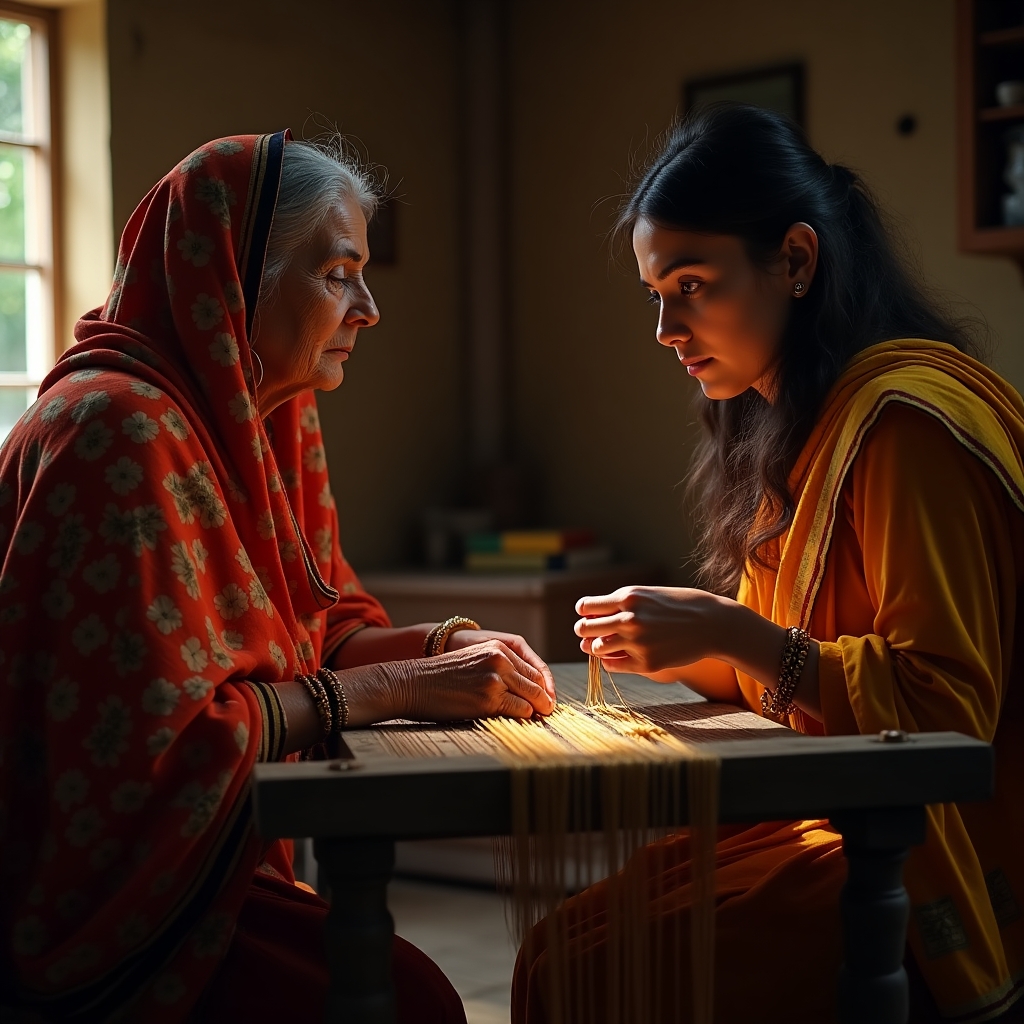
In a small, picturesque village nestled between lush green hills and a gently flowing river, lived a young woman named Aisha. Her life, like the river, moved in the rhythms dictated by generations before her. Aisha was the first daughter in a family of proud weavers, a craft handed down through the ages like precious heirlooms. The village, with its cobblestone paths and clay-roofed houses, had seen little change over the years, much like the unchanging expectations that rested heavily upon Aisha’s shoulders.
From an early age, Aisha had been immersed in the stories and traditions of her people. Her grandmother, Amma, was the cornerstone of her world, a woman of formidable presence and grace. Amma’s tales were woven with the threads of duty and honor, painting a picture of life where every person had a role to play. Aisha’s role, as Amma saw it, was to learn the intricate patterns and techniques of their weaving heritage, eventually becoming a leading figure in their small community.
Yet, as Aisha grew, so did her awareness of a world beyond the village boundaries. Books, a gift from her father who often traveled for trade, opened windows to distant lands, provoking dreams of exploring life in broader colors. The contrast between the colorful vistas in her books and the monochrome path laid out for her incited a quiet turmoil within Aisha.
The tension was subtle, barely perceptible to those around her. Aisha performed her daily tasks with diligence, her hands deftly sorting through threads, her face a serene mask. Inside, however, she was a sea of swirling emotions, torn between love for her family and an unexplainable yearning for something more.
As the years passed, the pressure intensified. Amma began to speak of alliances and marriage, the next traditional step for a young woman of her standing. Each conversation on the topic was an unspoken reminder of the life that awaited Aisha, a life that felt increasingly confining.
Aisha’s quiet rebellion took the form of late-night reading sessions, under the dim light of a lantern, where she would lose herself in stories of exploration and self-discovery. With every page turned, her inner world expanded, making the village feel ever smaller.
It was during one of these solitary nights that Aisha stumbled upon a particular passage in a book—a quote about freedom and authenticity that resonated so deeply within her that it stirred something dormant. “To live without knowing your own truth,” it read, “is to wander in shadows, forever adrift.”
This moment began a quiet revolution in Aisha’s heart. She started to question, gently at first, the rigid boundaries set by her family and culture. The questions grew bolder, fueled by her desire to honor both herself and her loved ones.
Aisha’s breakthrough came during a family gathering at the annual festival of colors, a time when the village celebrated life’s vibrancy. As she watched the joyful expressions of those around her, eyes bright with tradition and legacy, she felt a profound sense of connection. Yet, there was also a moment of clarity—an understanding that loyalty to family did not have to come at the expense of her dreams.
In the weeks that followed, Aisha began delicate conversations with her family, sharing her dreams with earnest sincerity. It was not easy, and there were tears and quiet disappointments. Amma listened, her eyes soft but her posture resolute, a complex mix of pride and concern.
The pivotal moment occurred one misty morning as Aisha and Amma sat by the loom. The rhythmic clacking of the wooden frame was the only sound as Aisha poured out her heart, weaving her truth into the air with each word. She spoke not of leaving, but of evolving—of bringing new colors into the tapestry of their lives.
Amma, with a wisdom born of years and love, nodded slowly, her eyes glistening with unshed tears. “Every thread has its path,” she whispered, embracing Aisha in a warmth that spoke of understanding and acceptance. In that quiet moment, a new pattern was born, one that honored both tradition and individuality.
As Aisha’s dreams took flight, she did not forsake her roots. Instead, she found a way to merge them with her aspirations, creating a new narrative that became a beacon for others in the village. This subtle shift paved the way for a different kind of legacy, one where personal values and cultural expectations could coexist harmoniously.
Aisha’s journey is a testament to the quiet strength needed to navigate the complexities of familial duty and personal truth, a reminder that courage often dwells in gentle whispers rather than loud declarations.