



Maya always found comfort in the gentle cadence of her grandmother’s sewing machine, the rhythmic thrum echoing through the small apartment’s walls like a heartbeat. It was the lifeline that tethered her to her roots, to the worn stories woven with threads of gold and silver in the tapestries that adorned their home. Here, among these relics of tradition, Maya felt both at home and alienated—a paradox that defined her existence.
Growing up in a family of tailors, Maya learned early on the value of precision, patience, and tradition—a trinity that was repeated like a mantra at every family gathering. But Maya harbored a secret passion, one that her family might never understand. She longed to be an artist, to breathe life into canvases with paint and brush, to explore the untamed wilderness of creativity beyond the confines of expectations.
The apartment was always bustling with the hum of activity, her grandmother’s friends coming and going, bringing colorful fabrics and spoken words of wisdom. Maya’s parents worked long hours at the family shop, leaving her under the watchful gaze of her grandmother, who expressed love through elaborate meals and soft-spoken tales of their homeland.
Maya loved these stories, felt the weight of history in each one, and yet, as she listened, her fingers itched to sketch, to capture the emotions they stirred within her soul. She feared telling her parents. Every time she hinted at her dreams, they seemed to misunderstand, believing her desire to be a distraction rather than a calling.
The cultural expectations felt like a garment too tight, stitched with love but ill-fitting, suffocating her burgeoning self. She smiled through family dinners where the future was discussed in earnest tones, her compliance masking the whispers of dissent in her heart.
Her room was her sanctuary. The walls bore witness to her quiet rebellion—a tapestry of sketches and paintings hidden behind closet doors. Here, she painted in the hours before dawn, her soul coming alive with each stroke, the smell of turpentine mingling with jasmine from the window.
Maya’s inner turmoil was a silent storm, a tension that simmered beneath her skin, manifesting in her quiet demeanor and the faraway look in her eye. Her grandmother noticed but said nothing, her wisdom worn by years of patience. Instead, she watched, understanding the language of silent suffering.
One autumn afternoon, as the leaves turned copper and the air grew crisp, Maya found herself alone in the apartment. The sewing machine sat dormant, a reminder of expectations. She stood before it, her heart pounding with an unspoken question: Was following tradition an act of love, or a betrayal of herself?
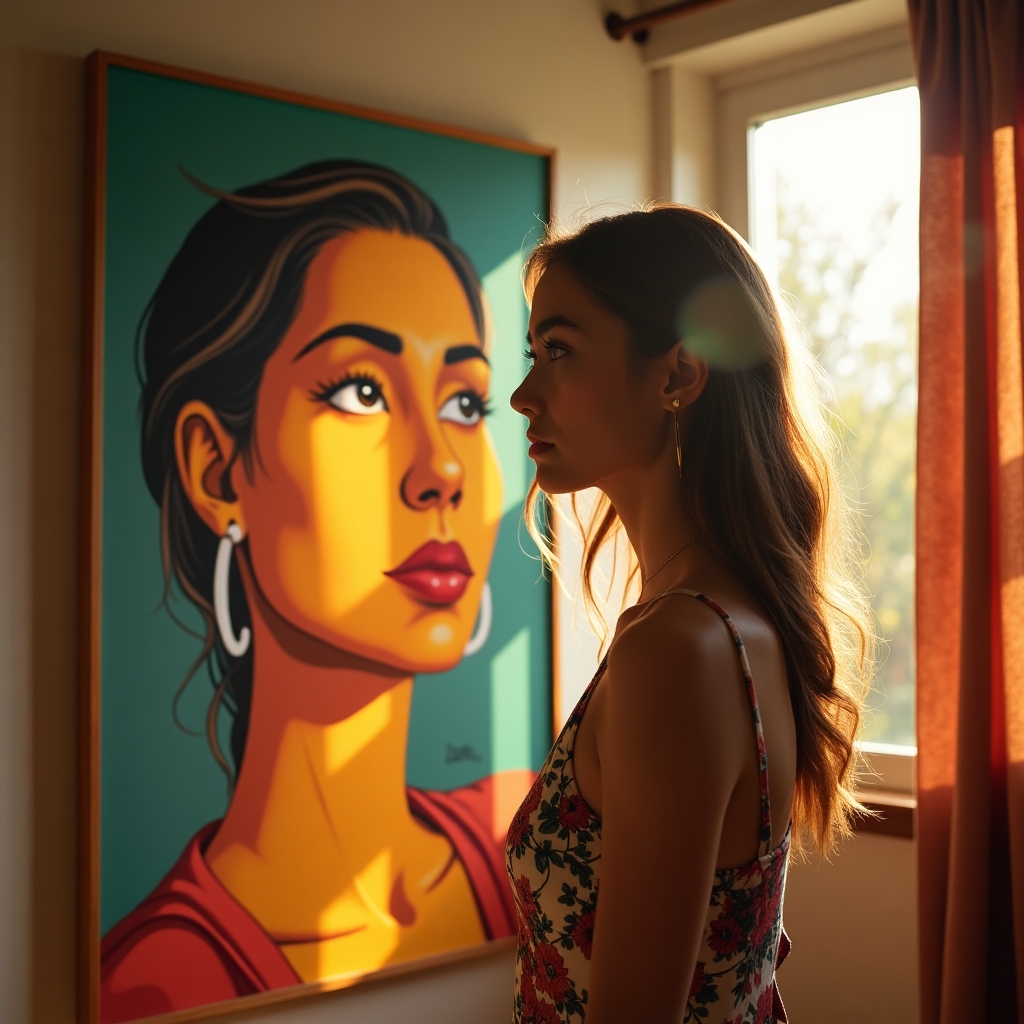
She pulled out a canvas, uncapped her paints, and began to work. Her strokes were bold, the colors bright—a poignant contrast to the quiet heaviness of her heart. Time slipped away as the image unfolded before her: a woman standing at a crossroads, paths winding into the distance, one well-trodden, the other wild and untamed.
In this act of creation, Maya found clarity. She realized that honoring her family did not mean sacrificing her own voice. Her love for them and for her art were not mutually exclusive but rather two threads of the same tapestry.
As the sun dipped below the horizon, flooding the room with golden light, Maya gazed at her painting. A knock at the door broke the spell, and her grandmother entered. She looked at the painting, then at Maya with eyes full of unspoken understanding.
“Beautiful,” her grandmother said, her voice a soft caress. “You must follow where your heart leads. Our stories, they live in you, Maya. Let them be heard in your own way.”
The knot in Maya’s chest unraveled, her grandmother’s words a balm to her conflicted soul. She embraced her, the warmth of generational love wrapping around them both.
In that moment, Maya knew she would honor her legacy not through a sewing needle, but through her art. She would weave the stories anew, painting with the colors of her own truth.
### Reflective Questions
1. What does emotional courage look like in the quiet moments of introspection, and how can we cultivate it within ourselves to pursue our genuine path?
2. In what ways can honoring familial and cultural heritage coexist with personal authenticity, fostering healing between generations?