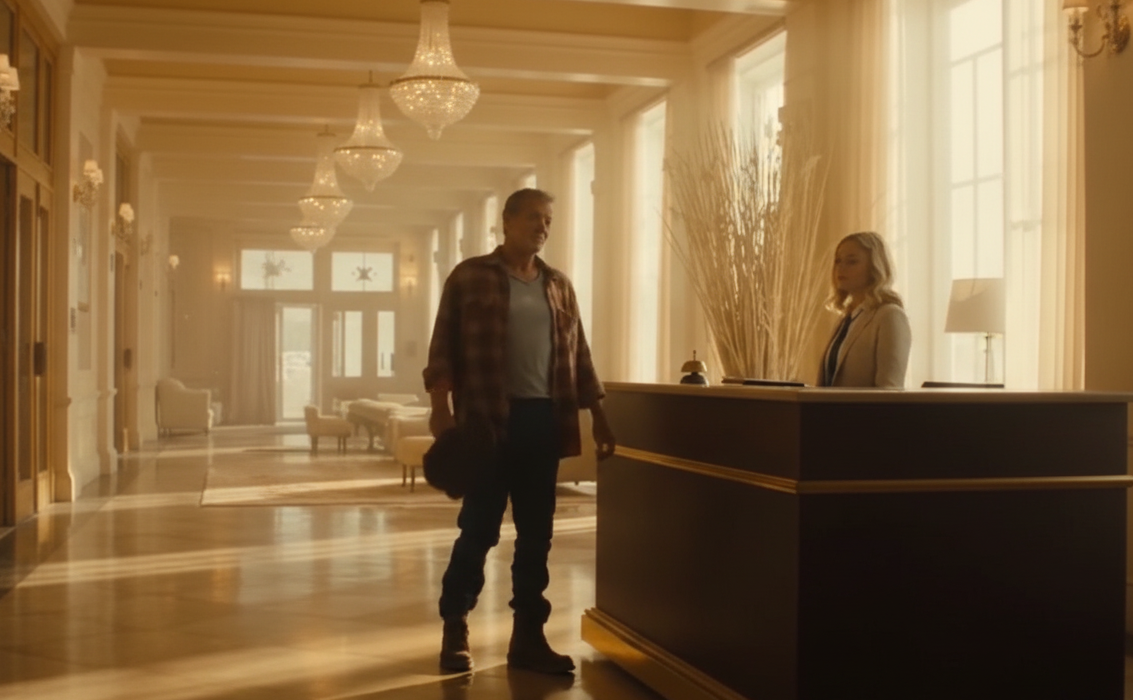
A dirt-covered farmer asked for a room at a five-star Chicago hotel… The receptionist laughed until he pulled out his phone and made one call that changed everything.
The revolving doors of the Grandview Hotel spun slowly as a man in his early fifties stepped into the marble lobby. His work boots left faint dust prints on the polished floor.
He wore a faded flannel shirt with soil stains on the sleeves. His jeans were worn thin at the knees. Anyone could see he’d spent the day working outdoors.
The receptionist, Madison, glanced up from her computer. Her perfectly styled hair didn’t move as her eyes traveled from his boots to his weathered face.
“Can I help you?” Her tone was already dismissive.
“Yes ma’am. I’d like a room for tonight.”
Madison’s lips pressed into a thin line. “Sir, our rooms start at four hundred dollars per night.”
“That’s fine.”
She blinked. “We’re a five-star establishment. Perhaps you’d be more comfortable at the Super 8 off the interstate?”
A businessman in a gray suit chuckled from the sitting area. His colleague whispered something. They both smirked.
The farmer smiled gently. “I appreciate the suggestion, but I’d prefer to stay here.”
“Sir.” Madison’s voice sharpened. “This hotel caters to business executives and international travelers. I don’t think—”
“You don’t think I can afford it?”
“I didn’t say that.”
“But you meant it.”
Her cheeks flushed. “I’m trying to save you money. Our rooms are very expensive for someone who—”
“Someone who what?”
The lobby went quiet. Three guests near the fireplace turned to watch.
Madison’s jaw tightened. “Look, I’m busy. Maybe try somewhere else.”
She turned back to her computer screen, dismissing him entirely.
The security guard, Frank, shifted uncomfortably by the entrance. He’d worked here fifteen years. Something about this felt wrong.
The farmer stood there for a long moment. Then he reached into his pocket.
Madison didn’t look up. “Sir, I already told you—”
He pulled out a sleek smartphone and dialed.
“Hello, John? It’s me. I’m standing in your hotel lobby right now.”
Madison’s fingers froze on her keyboard.
The farmer’s voice remained calm, almost gentle. “Yeah, I tried to check in. There seems to be some confusion about whether I’m welcome here.”
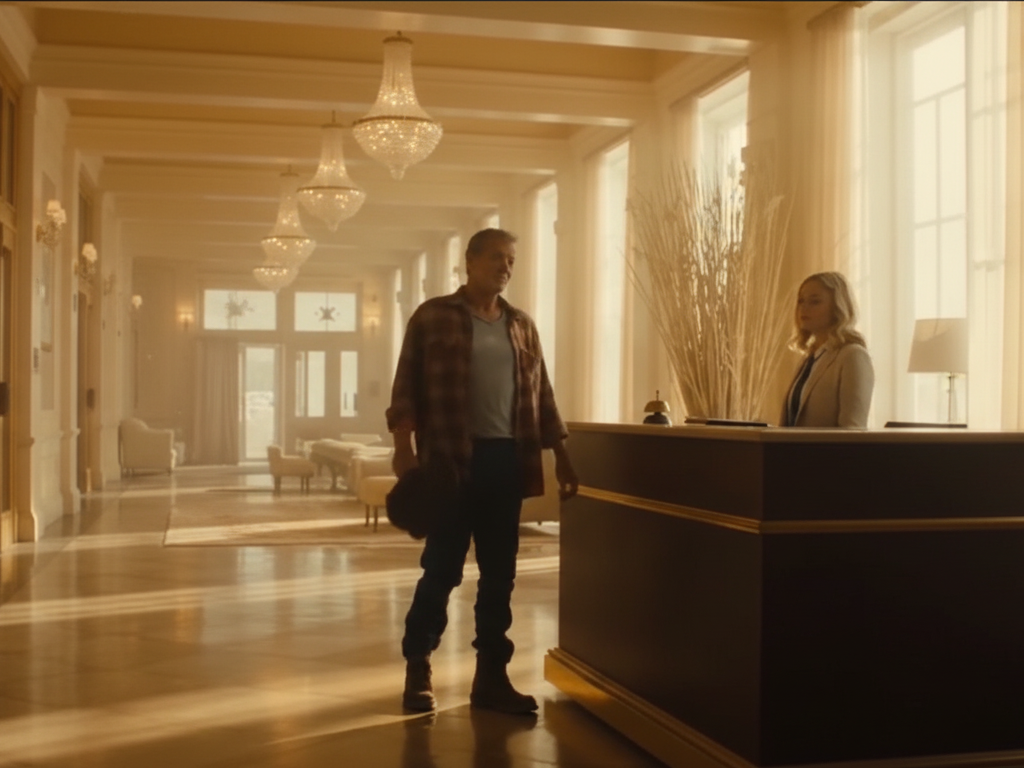
Silence stretched across the marble floor.
“Uh-huh. Right at the front desk.” He paused. “Sure, I’ll wait.”
He ended the call and placed the phone carefully on the counter. His calloused hands rested beside it.
Madison’s confidence wavered. “Sir, who did you just—”
The elevator chimed.
A man in an expensive navy suit emerged, walking fast. Behind him, two managers in hotel blazers hurried to keep up.
“Mr. Carter!” The suited man’s face lit up. “Why didn’t you tell me you were coming to Chicago?”
The businessman in the gray suit stopped mid-conversation. His colleague’s mouth fell open.
Madison went pale.
The farmer—Mr. Carter—smiled warmly. “Didn’t want to make a fuss, John. Just needed a place to sleep.”
John extended his hand. They shook like old friends. “We would’ve sent a car to O’Hare. Or straight to your farm in Iowa.”
“I drove myself. Easier that way.”
John turned toward Madison. His friendly expression vanished. “Why hasn’t Mr. Carter been checked in?”
“I… I thought…”
“You thought what exactly?”
“He wasn’t dressed like our usual guests, and I assumed—”
“You assumed wrong.” John’s voice cut like ice.
One of the managers stepped forward. “Mr. Carter supplies all the produce for our Michelin-star restaurant. Has for eight years.”
Whispers erupted through the lobby.
The businessman in the gray suit stood up abruptly, face red.
Frank, the security guard, smiled to himself. He knew it.
Madison’s hands trembled. “I’m so sorry, Mr. Carter. I didn’t know—”
“You didn’t know because you didn’t ask.” His voice stayed gentle, which somehow made it worse. “You saw dirt and assumed worthless.”
“That’s not what I—”
“Yes, it is.” He wasn’t angry. Just tired. “You looked at my clothes and decided I didn’t belong.”
“I made a mistake.”
“You made a judgment.”
John’s jaw clenched. “Mr. Carter, please accept our sincere apologies. Your usual suite is ready. Top floor, corner view.”
But Carter raised a hand. “Before we go anywhere, I need to say something.”
The lobby held its breath.
He turned toward the gathered guests. Some looked away, embarrassed.
“I wake up at four-thirty every morning. I work twelve-hour days, sometimes more during harvest season. My hands are rough because I use them. My clothes get dirty because that’s what happens when you grow food.”
No one spoke.
“The lettuce on your salad? I grew it. The tomatoes in your pasta? Mine. The cream in your coffee? From cows I raise.”
The businessman who’d laughed earlier stared at his shoes.
“I’m not telling you this to brag.” Carter’s voice stayed steady. “I’m telling you because somewhere along the way, we forgot that honest work has value. That the people who feed you matter just as much as the people who wear suits.”
Madison’s eyes glistened. “Mr. Carter, I’m truly sorry. I was wrong to treat you that way.”
He nodded once. “Thank you for saying that.”
John stepped in. “Your stay is complimentary. It’s the least we can do.”
“No.”
Everyone froze.
“No?” John looked confused.
“I’ll pay full price. I came here as a customer, not looking for charity or special treatment.” Carter pulled out a worn leather wallet. “Four hundred dollars, you said?”
Madison nodded, unable to speak.
“Then that’s what I’ll pay.”
He handed over his credit card. His name was embossed on it: “Thomas Carter, Carter Family Farms.”
As Madison processed the payment with shaking hands, one of the managers leaned toward John and whispered something.
John’s expression shifted. “Actually, Mr. Carter, there’s something you should know. The hotel owner wants to expand our farm-to-table program. We’ve been trying to reach you all week.”
Carter raised an eyebrow. “I’ve been in the fields. No cell reception.”
“We want to triple our order. Maybe quadruple. We’re talking about a half-million-dollar annual contract.”
The lobby gasped. The businessman in the gray suit looked like he might faint.
Carter considered this. “That’s a lot of vegetables.”
“You’d need to hire more people. Expand your operation.”
“I’d have to think about it.”
“Of course. No pressure.” John smiled. “But the owner specifically requested you. Said your quality is unmatched.”
Madison handed back his credit card, her hand trembling so badly she almost dropped it. “Mr. Carter, your room key. I… I put you in the Presidential Suite. No extra charge.”
“I said I’d pay full price.”
“Please.” Her voice cracked. “Let me do this one thing right.”
He looked at her for a long moment. Really looked. She was young, maybe twenty-four. Probably working her way through college. Trying to impress her bosses.
“What’s your name?”
“Madison.”
“Madison, you made a mistake. That happens. We all do.” He took the key card. “The question is what you learn from it.”
She nodded, tears spilling over. “I will. I promise I will.”
Frank approached, offering to carry Carter’s single duffel bag. It was old military surplus, patched in three places.
“I got it,” Carter said. “But thank you.”
As they walked toward the elevator, the businessman in the gray suit stood up. “Mr. Carter?”
Carter turned.
“I… I laughed when you came in. That was wrong. I apologize.”
Carter studied him for a second. “What do you do for work?”
“Investment banking.”
“Good profession. Honest work.”
“Not like yours.”
“Different, not better or worse.” Carter extended his hand. “We all contribute something.”
The banker shook it, looking humbled.
In the elevator, John pressed the button for the top floor. “I meant what I said about that contract. The owner’s serious.”
“I’ll think about it. Farming’s not just about money. It’s about the land. The animals. Doing right by them.”
“That’s exactly why we want to work with you.”
The doors opened to a hallway lined with expensive art. The Presidential Suite was at the end.
Inside, floor-to-ceiling windows overlooked downtown Chicago. The sunset painted the sky orange and purple.
Carter set his duffel on the bed. “This is too much.”
“No, sir. It’s not nearly enough.”
After John left, Carter stood at the window for a long time. The city sprawled below him, all glass and steel and ambition.
He thought about his farm. The quiet mornings. The smell of fresh earth. His dog, Rusty, probably wondering where he was.
This world down here—the marble lobbies, the thousand-dollar suits, the judgments based on appearances—it all felt foreign.
But maybe that was okay. Maybe both worlds needed each other.
His phone buzzed. A text from John: “Owner wants to meet for breakfast tomorrow. 8 AM. He’s excited.”
Carter smiled and typed back: “I’ll be there. But I’m wearing my farm clothes.”
Three dots appeared. Then: “Wouldn’t have it any other way.”
Downstairs, Madison sat in the break room, her makeup ruined from crying. Her supervisor, Linda, sat beside her.
“You could be fired for this,” Linda said quietly.
“I know.”
“Mr. Carter could file a complaint.”
“I know.”
“But he didn’t. John told me he specifically said you should keep your job. Said everyone deserves a second chance.”
Madison looked up, shocked. “He said that?”
“He also left something for you at the desk.”
They walked back to the lobby. On the counter sat a small basket of vegetables—tomatoes, lettuce, carrots—and a handwritten note:
“Madison – These came from my farm. They’re not fancy, but they’re grown with care. Sometimes the most valuable things don’t look like much at first glance. – T. Carter”
She pressed the note to her chest and sobbed.
Frank patted her shoulder. “Learn from it, kid. That’s all he’s asking.”
Two months later, the Grandview Hotel’s restaurant unveiled a new menu. Every dish featured ingredients from Carter Family Farms. The owner, who’d met Thomas for breakfast that morning in November, stood at the podium during the press conference.
“We’re proud to partner with Mr. Thomas Carter,” he announced. “A man who represents the best of American agriculture. The best of honest work.”
Carter sat in the back row, uncomfortable with the attention. He wore a clean flannel shirt and his good jeans. Still farm clothes, but presentable.
Madison, who’d been promoted to assistant manager, caught his eye and smiled. He nodded back.
After the event, she approached him. “Mr. Carter, I wanted to thank you again.”
“For what?”
“For not getting me fired. For the vegetables. For… teaching me something important.”
“You taught yourself. I just gave you the chance.”
“I tell that story to every new employee now. About respect. About not judging.”
He smiled. “Then something good came from it.”
As he drove back to Iowa that evening, past cornfields and small towns and silos silhouetted against the darkening sky, Thomas Carter felt something he hadn’t felt in years.
Hope.
Not for himself—he’d always had enough. But hope that maybe, just maybe, people were starting to remember what really mattered.
That dignity wasn’t about designer labels or corner offices.
It was about how you treated people. All people.
And sometimes, the most important lessons came from the quietest voices.
The next morning, Madison arrived at work to find a line of guests waiting to check in. Among them, a woman in paint-splattered overalls.
Madison smiled. “Good morning, ma’am. Welcome to the Grandview. How can I help you today?”
The woman looked surprised. “I’m here for a room. I’m an artist, just finished a gallery installation. I know I’m not dressed for—”
“Your clothes don’t matter here,” Madison said warmly. “What matters is that you’re welcomed. Let me find you our best available room.”
The woman’s eyes filled with tears. “Thank you.”
Frank watched from his post by the door and smiled.
Some lessons stick. Some changes last.
And Thomas Carter, driving past his barn as the sun rose over Iowa, had no idea that the seeds he’d planted that day in Chicago were still growing.
But they were.
In small acts of kindness. In moments of respect. In the quiet revolution of treating people like people.
That’s what real change looks like.
Not loud. Not flashy.
Just steady. Like planting seeds.
And trusting them to grow.