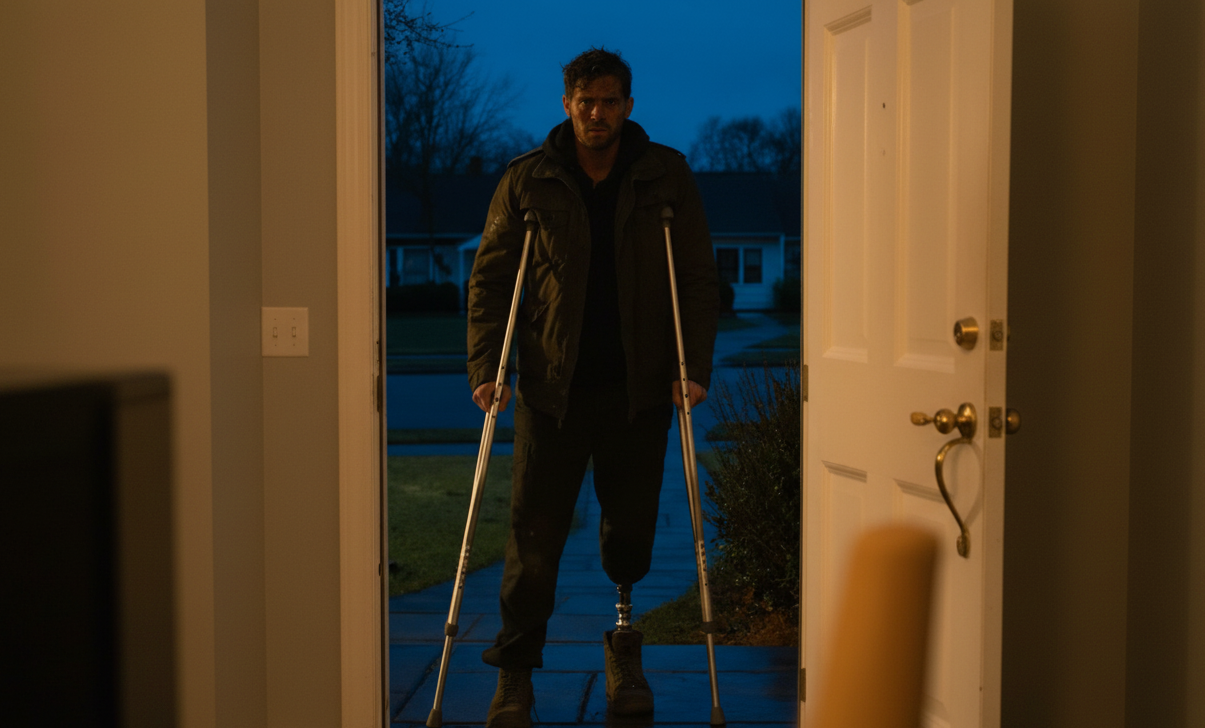
She opened the door expecting the postman, annoyed by the late hour… But when she looked down and saw metal where flesh used to be, her scream turned into the most beautiful sound he’d ever heard.
The sun was dying in the west, suffocated by a bruised skyline of anxious purples and deepening charcoals. It was a cold evening, the kind that didn’t just sit on the skin but tried to burrow into the bone. For Caleb, the cold was different now. It was a dull ache where his right calf used to be, a phantom shiver in toes that no longer existed.
He stood at the bottom of the hill, looking up at the driveway he had sprinted down a thousand times in his youth. Back then, he was all muscle and kinetic energy, a blur of motion. Now, he was a composition of rhythm and mechanics.
Clack. Drag. Squeak.
The sound of his ascent was foreign to this landscape. The silence of the frosted evening was usually only broken by wind or the distant bark of a dog. Tonight, it was broken by the strike of aluminum crutches and the subtle, rhythmic groan of a prosthetic joint.
Every step was a negotiation with gravity. He paused halfway up, his breath pluming in the air like dragon smoke. He gripped the handles of the crutches until his knuckles turned white. It wasn’t the physical exertion that halted him; it was the terror.
Inside that house, behind the windows glowing with the warm, amber light of a sanctuary, time had moved differently. For his parents, it had been a time of suspended animation. A holding pattern.
Inside, the kitchen smelled of roasted rosemary and stale anxiety. Martha wiped the table, her movements automatic. Across from her, Thomas stared at his plate, pushing peas around with a fork, eating not out of hunger but out of habit.
” wind’s picking up,” Thomas mumbled. It was the only thing they talked about lately—the weather, the garden, the leaky faucet. Anything to avoid the gaping silence where Caleb’s name used to be spoken with ease. Now, speaking his name felt like invoking a ghost they weren’t sure was still tethered to this earth.
“I’ll put the kettle on,” Martha said, her voice thin.
Then came the sound. It wasn’t the bell. It was a knock—hesitant, heavy. A knuckle rapping against wood, but lacking the confidence of a visitor who knew they were welcome.
Martha and Thomas froze. They exchanged a look—a shared frequency of fear that only parents of deployed soldiers possess.
“I’ll get it,” Martha said, wiping her hands on her apron. “Probably Mrs. Higgins returning the casserole dish.”
She walked to the door, her slippers shuffling on the hardwood. She prepared a polite smile, the mask she wore for the neighbors to show she was holding it together. She unlocked the deadbolt. She turned the handle.
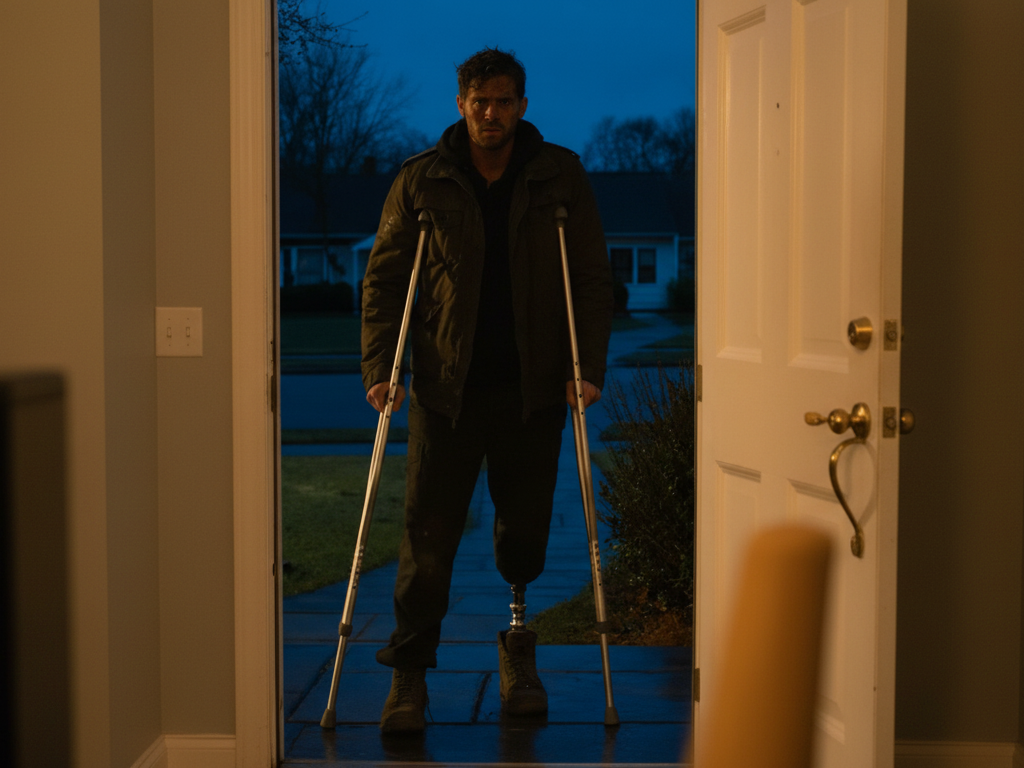
The heavy oak door swung inward, bringing with it a gust of freezing night air.
Time, which had been dragging for two years, suddenly snapped.
He was thinner. That was the first thing she saw. His face was carved from granite, lines etched around eyes that had seen things no mother should ever have to imagine. He wore a heavy coat, but he looked small inside it.
“Mom,” he croaked. The word was rusty, unused.
Martha’s eyes went wide. The casserole dish vanished from her mind. The polite smile shattered. “Caleb?”
But then, gravity pulled her gaze downward. It was instinct. She saw the way he leaned, the unnatural tilt of his hips. Her eyes traced the line of his jeans down to the left boot, planted firmly. Then to the right.
The pant leg was pinned up. Below it, matte black metal and carbon fiber extended down to a mechanical foot. He was leaning heavily on forearm crutches, his body forming a tripod of exhaustion.
The air left Martha’s lungs. It was a physical blow. Her hand flew to her mouth, stifling a sound that was half-sob, half-scream. The pain was sharp and immediate—a mourning for the boy who ran, the boy who danced, the boy who was whole. The war had taken a piece of him as a tax for his survival.
Caleb flinched at her reaction. He looked down, shame burning his neck. “I know,” he whispered. “I’m different.”
That whisper broke the spell.
The bitterness of the injury was vast, but the ocean of happiness that followed was a tidal wave. Martha didn’t see the metal anymore; she saw her son. Her surviving son.
“No,” she choked out, tears instantly flooding the valleys of her face. “You’re here.”
Behind her, a chair clattered to the floor. Thomas had stood up so fast his knees hit the table. He scrambled into the hallway, socks sliding on the floor. When he saw the silhouette in the doorway, the stoic father dissolved.
“Son!” Thomas roared, a sound of pure, primal relief.
They didn’t invite him in; they collapsed onto him. Martha threw her arms around his neck, burying her face in the rough wool of his coat, smelling the cold air and the faint scent of antiseptic and sweat. Thomas wrapped his large arms around both of them, holding them together as if trying to fuse their family back into a single entity.
Caleb let the crutches fall. They clattered loudly on the porch, but no one cared. He leaned into his father, his weight supported by the two people who had built him.
“I’m sorry,” Caleb wept, the stoicism crumbling. “I’m sorry I came back like this.”
“You came back,” Thomas whispered fiercely into his ear, gripping him tight enough to bruise. “That is the only thing that matters. You are home.”
Martha pulled back just an inch, cupping his face, her thumbs brushing away the grime and tears. She looked at the metal leg, then back into his eyes. The grief was there, yes. But the gratitude was blinding.
“We can fix the walking,” she said, her voice trembling but fierce. “But we couldn’t have fixed the hole in our hearts if you hadn’t come back. Come inside, baby. It’s cold.”
As they helped him over the threshold, the warm light swallowed them. The door clicked shut, locking out the anxious purple sky, the freezing wind, and the war. Inside, there was pain, and there was a long road ahead, but there was also dinner on the table, and a family that was, against all odds, finally complete again.