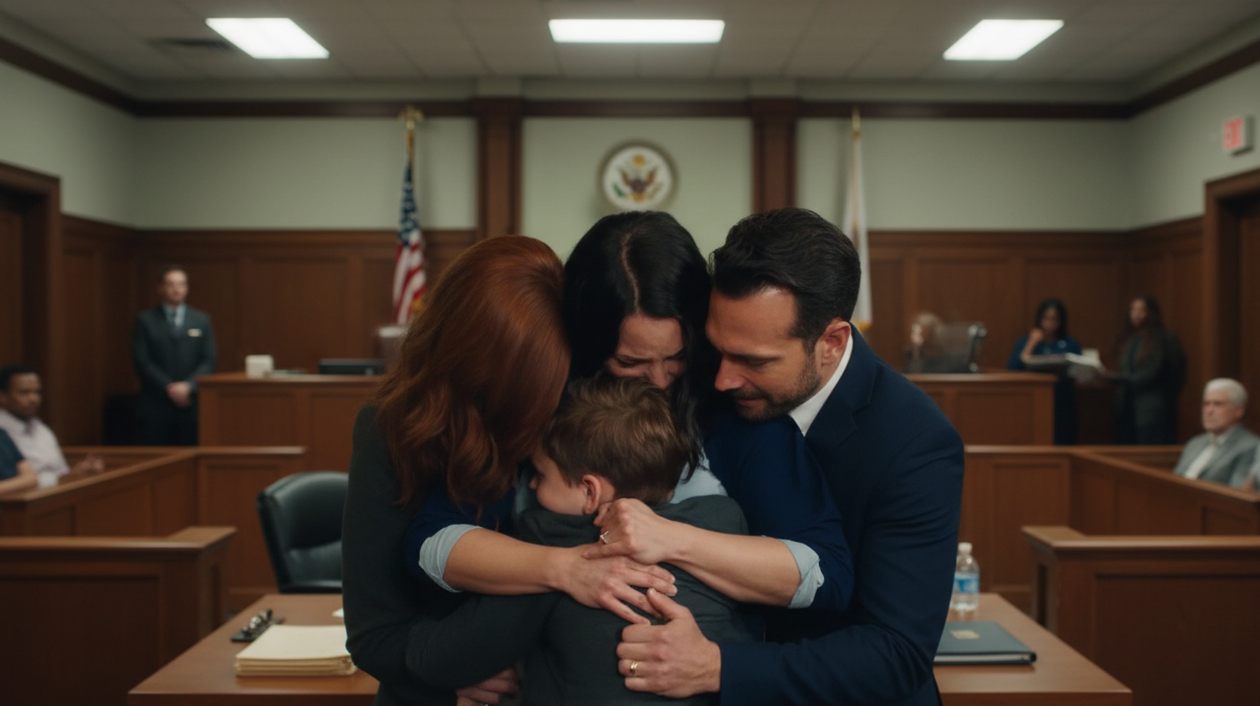




A military officer’s daughter was tormented daily by a wealthy bully who ruled the school with his father’s money… But when she came home drenched in juice and tears, her father walked into that principal’s office and delivered words that changed everything.
Emma Mitchell had learned to keep her head down. At fourteen, she understood that survival at Riverside Preparatory Academy meant staying invisible, blending into the background of designer backpacks and luxury cars that lined the parking lot each morning. Her father’s modest military salary meant thrift store uniforms and last year’s textbooks, but she’d never complained. She was proud of Lieutenant Colonel James Mitchell, proud of the uniform he wore, proud of the twenty years he’d dedicated to serving his country.
But pride doesn’t shield you from cruelty.
It started in September when Marcus Hartwell noticed her worn shoes. Marcus was fifteen, tall for his age, with the kind of confidence that only unlimited wealth can buy. His father, Richard Hartwell, owned half the commercial real estate in the city and sat on the school’s board of directors. The Hartwell family’s donations funded the new science wing, the athletic complex, and probably the principal’s vacation home, Emma thought bitterly.
“Nice shoes, Mitchell,” Marcus had said that first day, loud enough for the entire hallway to hear. “Did you get those at the homeless shelter donation bin?”
The laughter that followed felt like acid on her skin.
From that moment, Marcus made her his personal project. He’d bump her tray in the lunch line, “accidentally” spill her books in the hallway, and whisper “charity case” whenever she walked past. But worse than his direct attacks was his influence. Within weeks, Emma found herself eating lunch alone. Study groups dissolved when she approached. Even teachers seemed to look through her, as if acknowledging her existence might somehow offend the Hartwell family and their generous checkbook.
Emma never told her father. Lieutenant Colonel Mitchell had enough to worry about—long hours at the base, the constant stress of his position, the nightmares that still woke him from his last deployment. She could handle a spoiled bully. She had to.
But on a cold Thursday in November, Marcus went too far.
The cafeteria was packed, every table filled with the usual clusters of wealth and privilege. Emma sat alone at the corner table near the trash bins—her table, as everyone now called it. She’d just unwrapped the sandwich she’d made that morning when Marcus appeared, flanked by his usual crew of sycophants.
“Hey everyone!” Marcus announced, his voice carrying across the cafeteria. “I think Mitchell looks thirsty. Let me help her out.”
Before Emma could react, he upended an entire carton of cranberry juice over her head. The cold liquid soaked through her hair, dripped down her face, stained her second-hand uniform shirt a deep, humiliating red. The cafeteria erupted in laughter—not the shocked, uncomfortable kind, but the cruel, eager laughter of spectators at a execution.
Emma sat frozen, juice dripping from her chin, her vision blurred by tears she refused to shed in front of them. Marcus leaned down, his voice low enough that only she could hear: “That’s what happens to poor little military brats who don’t know their place.”
She gathered her things with trembling hands and walked out, keeping her head high until she reached the bathroom. Only then did she let herself break.
By the time she got home, she’d cried herself empty. Lieutenant Colonel Mitchell was in the kitchen, still in his uniform, preparing dinner. He took one look at his daughter—hair still damp and sticky, eyes red and swollen, the stained shirt she’d tried and failed to clean—and his expression shifted from concern to something harder, something that reminded Emma why her father had earned his rank.
“Emma,” he said quietly, setting down the knife he’d been using. “Tell me what happened.”
She tried to lie. She tried to say she’d spilled something on herself. But when her father gently placed his hands on her shoulders and looked into her eyes with that steady, unwavering gaze, the whole story came pouring out. The months of harassment. The isolation. Marcus Hartwell and his untouchable status. Everything.
Her father listened without interrupting, his jaw tightening with each detail. When she finished, he was quiet for a long moment.
“Go take a shower,” he finally said. “And lay out your uniform for tomorrow. Make sure it’s the one that makes you feel most confident.”
“Dad, please don’t make this worse,” Emma pleaded. “His family basically owns the school. Nothing’s going to change.”
Lieutenant Colonel Mitchell looked at his daughter with an expression she’d seen before—the same one he wore when explaining why he’d chosen to serve, why he continued to serve despite the modest pay and the time away from family.
“Emma, I’ve spent twenty years defending the principles this country was built on. If I can’t stand up for my own daughter against a bully and his checkbook, what have those twenty years meant?” He squeezed her shoulder gently. “Some battles you have to fight. This is one of them.”
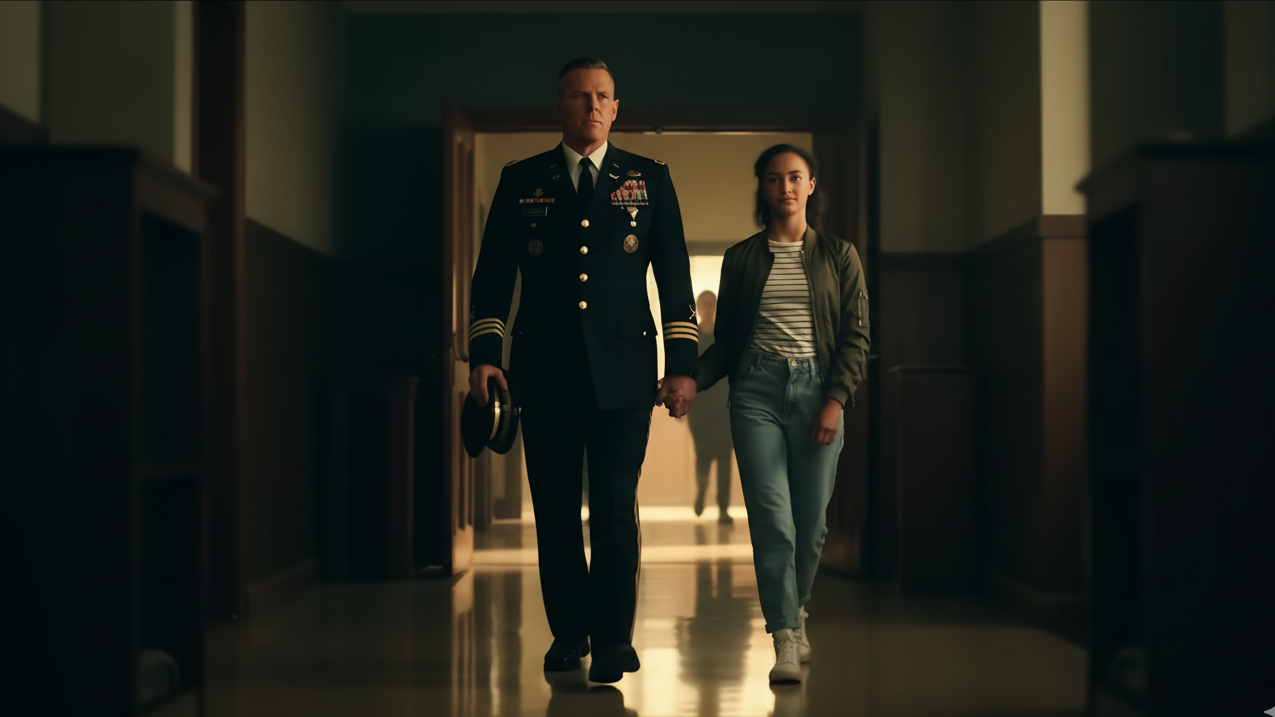
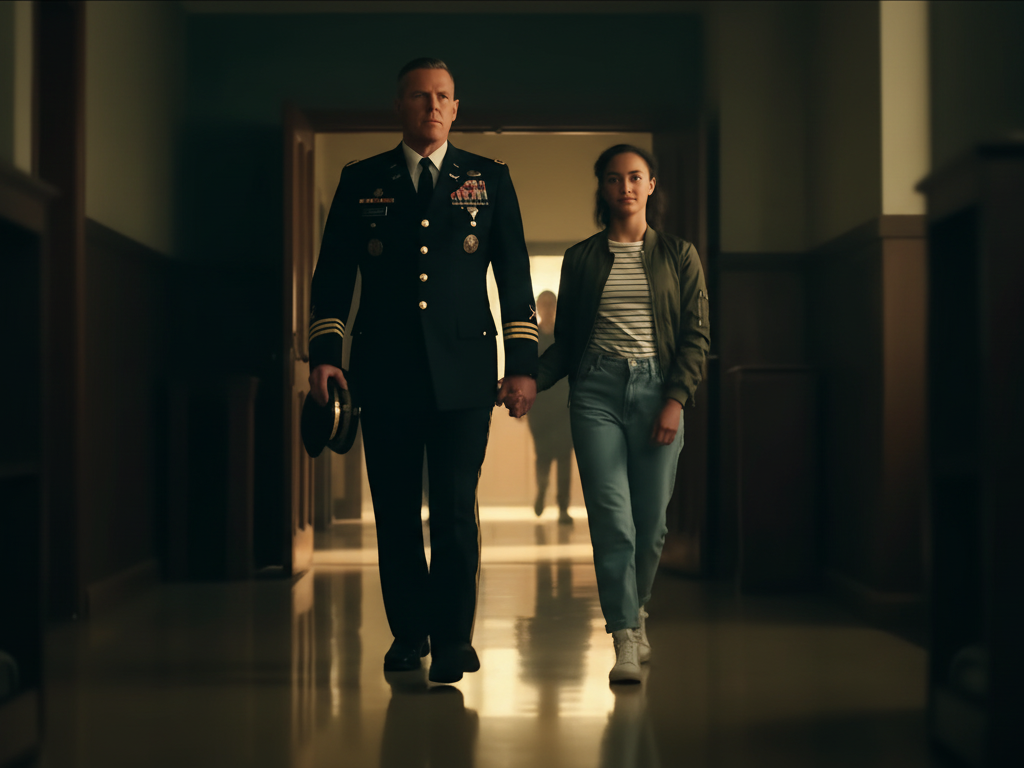
The next morning, Emma walked into Riverside Preparatory Academy with her father beside her. Lieutenant Colonel Mitchell wore his dress uniform, medals aligned perfectly across his chest, his bearing radiating the authority of two decades of military service. Students stopped and stared as they walked through the hallways. Some recognized the insignia, the ribbons that told stories of service and sacrifice. Others simply recognized power when they saw it—real power, earned through dedication rather than purchased with money.
They walked directly to Principal Whitmore’s office.
Through the glass door, Emma could see them—Principal Whitmore behind his desk, looking uncomfortable, and Marcus Hartwell sitting smugly beside a man who could only be his father. Richard Hartwell was everything you’d expect: expensive suit, Rolex watch, the kind of tan that comes from tropical vacations rather than honest work. He was mid-sentence when Lieutenant Colonel Mitchell opened the door without knocking.
“Principal Whitmore,” her father said, his voice carrying the crisp authority of someone accustomed to being obeyed. “I’m Lieutenant Colonel James Mitchell, Emma’s father. I believe you’re currently meeting about yesterday’s incident.”
Principal Whitmore stood up quickly, clearly flustered. “Colonel Mitchell, I’m glad you’re here. We were just discussing appropriate consequences—”
“Consequences?” Richard Hartwell interrupted, barely glancing at Emma’s father. “My son told me what happened. It was just kids being kids, boys being boys. Marcus has already apologized, and I think we can all move forward.” He turned to Principal Whitmore with a smile that didn’t reach his eyes. “In fact, I was just mentioning to Principal Whitmore that we’re considering increasing our donation for the new arts building—”
“Mr. Hartwell.” Lieutenant Colonel Mitchell’s voice cut through the room like a blade. Richard Hartwell finally looked at him, really looked at him, and Emma saw something flicker in the businessman’s eyes. Recognition, perhaps, of someone who wouldn’t be bought or intimidated.
“Your son,” the colonel continued, his gaze unwavering, “believes that money gives him the right to humiliate others. That wealth equals worth. That he can torment a fellow student without consequences because of the size of your bank account.”
Richard Hartwell’s face began to redden. “Now wait just a minute—”
“I’m not finished.” The words were quiet but carried enough authority to silence the businessman immediately. Lieutenant Colonel Mitchell turned to look at Marcus, who had shrunk considerably in his chair, the smugness evaporating from his face.
“My daughter wears second-hand clothes,” the colonel said, “because I choose to serve this country rather than chase maximum profit. She carries a used backpack because we live on a military salary that barely covers our bills. She’ll never have a new car waiting for her on her sixteenth birthday or a trust fund to fall back on.” He paused, letting the words settle. “And I am proud of that. I’m proud that she understands the value of service over selfishness. I’m proud that she knows character isn’t measured in dollars.”
He turned back to Richard Hartwell, and Emma saw the businessman shrink just like his son had.
“Mr. Hartwell, I have to ask you: Are you proud? Are you proud of raising a son who believes humiliating others is entertainment? Are you proud that your boy defines himself by what he has rather than who he is? Are you proud that you’ve taught him money can solve any problem, including being a coward and a bully?”
The silence in the office was absolute. Richard Hartwell’s face had gone from red to almost purple, but he said nothing. He couldn’t. Emma realized with a start that her father had just articulated what everyone in that room knew but no one had dared to say: the Hartwell family had money, but they had no honor.
Lieutenant Colonel Mitchell turned his attention to Marcus, who looked like he wanted to disappear into his chair.
“Young man,” he said, his voice slightly softer but no less firm, “I want you to understand something. The world you live in right now—where your father’s money protects you, where adults look the other way, where you can hurt people without facing consequences—that world is temporary. Eventually, you’ll step into the real world where character matters more than your last name. Where the men and women who serve this country, who teach in our schools, who save lives in our hospitals, who keep our communities safe—we don’t care about your father’s bank account.”
He leaned forward slightly. “If you ever touch my daughter again—if you ever speak to her, look at her the wrong way, or make her life difficult in any capacity—you and I will have another conversation. And this time, your father won’t be there to write a check to make it go away. We’ll discuss the consequences man to man. Do you understand me?”
Marcus nodded frantically, his earlier bravado completely destroyed.
Lieutenant Colonel Mitchell straightened and turned to Principal Whitmore. “I expect you’ll handle this appropriately. If not, I’ll be speaking with the school board—all of them, not just the ones Mr. Hartwell here has in his pocket. I’m also filing a formal complaint with the district about the bullying my daughter has endured and the school’s failure to address it.”
He placed a hand on Emma’s shoulder. “Come on, sweetheart. You don’t want to be late for class.”
They walked out together, leaving a stunned silence behind them.
By lunchtime, the story had spread through Riverside Preparatory Academy like wildfire. Emma heard whispers in the hallway, saw the new way people looked at her. But this time, it wasn’t with pity or contempt—it was with respect.
A girl from her English class—Sarah Chen, who’d stopped talking to Emma in September—approached her at her locker. “Is it true your dad made Marcus Hartwell cry?”
Emma started to deny it, but Sarah continued: “Because if so, that’s the most badass thing I’ve ever heard. My dad’s a teacher, and he’s always complaining about how families like the Hartwells basically run everything.” She paused, then asked tentatively, “Do you want to sit with me and my friends at lunch?”
More invitations followed. A study group for history class. A seat at a different lunch table. Small gestures that meant everything.
Marcus Hartwell avoided her completely. She’d see him in the hallways, but he’d turn and walk the other way. His friends, those who’d laughed the loudest when he poured juice on her, suddenly remembered they had other places to be when she approached.
A week later, Principal Whitmore called Emma into his office. She went nervously, unsure what to expect, but found him apologetic and genuine.
“Emma, I want to apologize,” he said. “Your father was right. I let a wealthy donor influence how I ran this school, and you suffered because of it. That’s unacceptable.” He paused. “Marcus has been suspended for two weeks. When he returns, he’ll be on a strict behavioral contract. One more incident, and he’s expelled, regardless of his father’s donations.”
Emma nodded, not quite sure how to respond.
“Your father is a remarkable man,” Principal Whitmore continued. “He reminded me why I became an educator in the first place. Not to serve the wealthy, but to serve all students equally.” He smiled slightly. “I hope you’ll give me—and this school—a chance to do better.”
That night at dinner, Emma told her father about her day. About Sarah Chen and the lunch invitation. About the principal’s apology. About how different everything felt.
Lieutenant Colonel Mitchell listened, a small smile on his face. “I’m glad, sweetheart. But remember—I didn’t do anything special. I just stood up for what was right. That’s what we do in our family.”
“Dad?” Emma said quietly. “Thank you.”
He reached across the table and squeezed her hand. “You never have to thank me for loving you, Emma. That’s what fathers do.”
In the weeks that followed, Emma Mitchell found her place at Riverside Preparatory Academy. Not as the invisible girl in second-hand clothes, and not as the victim of Marcus Hartwell’s cruelty. She was simply Emma—the girl whose father had reminded everyone that courage, integrity, and standing up for what’s right mattered more than any donation check.
She still wore second-hand uniforms. She still carried a used backpack. But now, when she walked through those hallways, she walked with her head high, carrying her father’s lesson with her: true wealth isn’t measured in dollars, but in character. And by that measure, she was richer than Marcus Hartwell would ever be.