
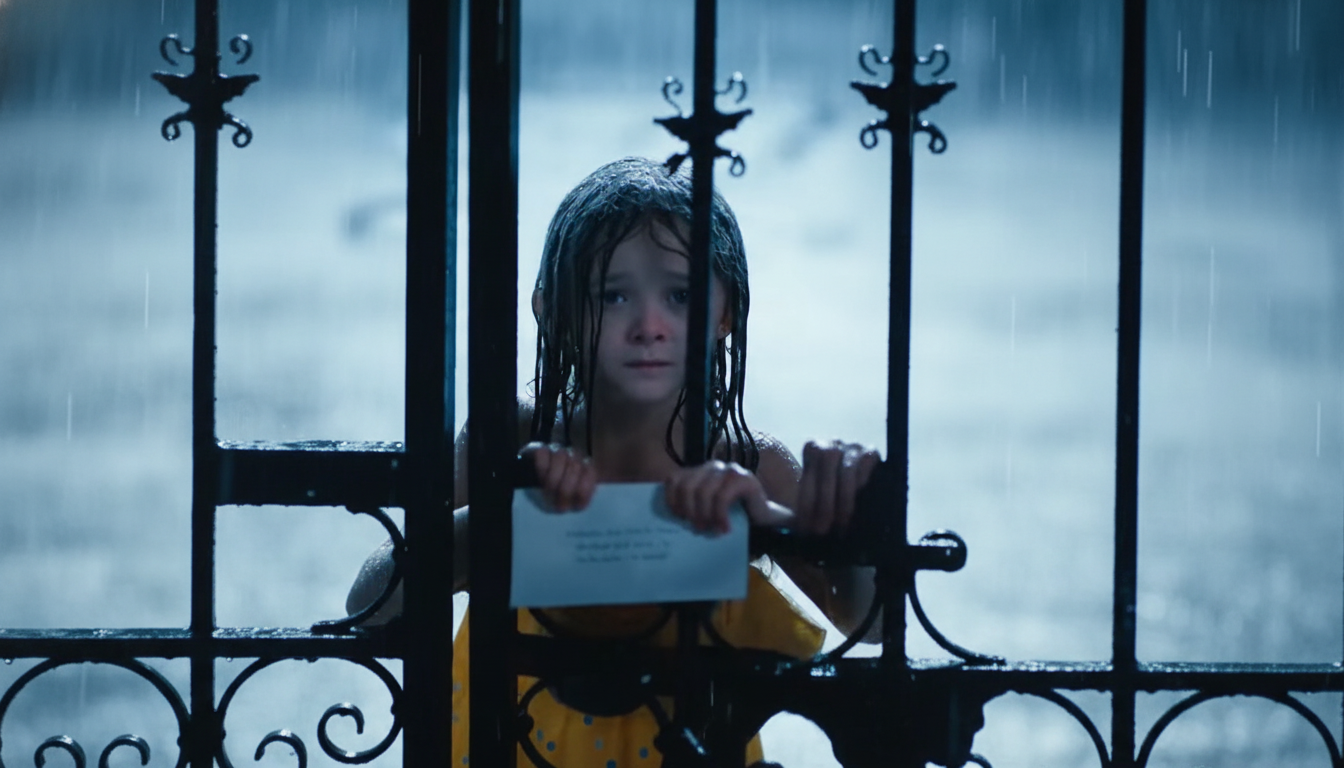
A barefoot girl appeared at his mansion gate every day, whispering to the iron bars… Until he read her lips and his world shattered.
I still remember the first day I saw her—this tiny girl in a faded yellow dress, standing barefoot in front of the black iron gates of Whitmore Estate. She couldn’t have been more than ten. Her hair was tied with a piece of blue ribbon, the kind that frays if you’ve washed it too many times. She stood very still, staring at the carved letters on the stone pillars: WHITMORE. My last name.
I was inside the mansion then—glass walls, marble floors, and a silence so clean it felt like nothing inside had ever been touched by real life. My family liked it that way. Controlled. Cold. Perfect. I used to believe that was normal.
But that day, the girl changed something in me.
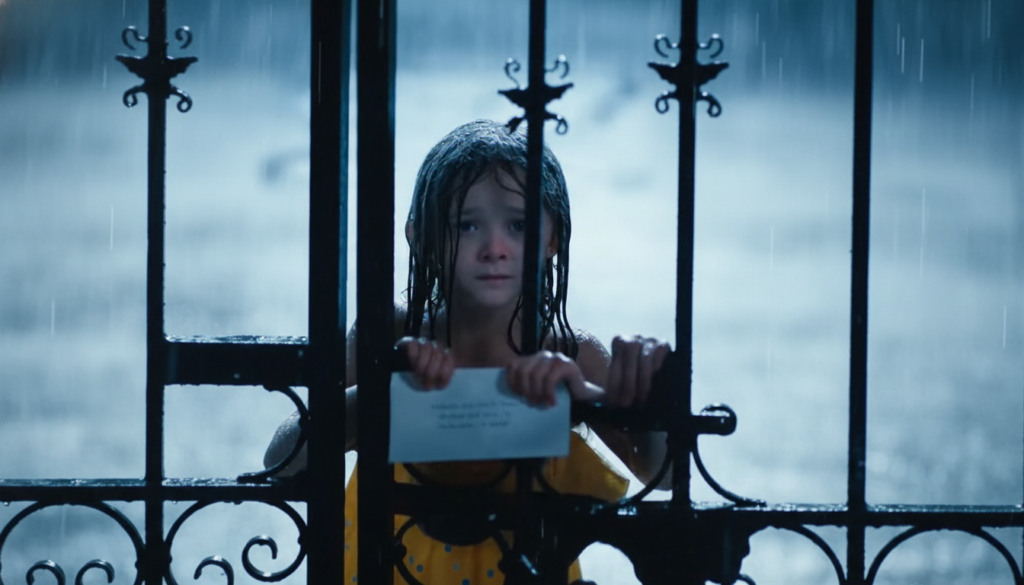
She visited every afternoon at the same hour. She would stand at the gate, press a small flower against the metal bar, and whisper something I never managed to hear. She would stay exactly five minutes, then turn around and walk down the hill with the slow, careful steps of someone who knew every rock by heart.
The guards laughed. The house staff whispered. My mother called her “that delusional child.” But the girl kept coming.
One day, I pulled the security footage. I zoomed in. She didn’t come to stare at the mansion. She came to stare at the letters, tracing them with her eyes as if memorizing them. Whitmore. Whitmore. Whitmore.
It bothered me, in a way I couldn’t explain.
So the next afternoon, I watched from my study window. The guard approached her. He said something—probably told her to leave. She bowed her head politely, apologized, and stepped back. But before she turned away, she touched the gate softly and whispered again.
This time I read her lips. “Hi Mom.”
The world tilted under me. I walked out of the study and into the hallway, feeling like I had just seen a ghost.
The next day I waited at the window again. She came, holding a wrinkled envelope. She didn’t try to open it. She simply pressed it against the gate and whispered, “I’m trying, Mom. I really am.”
The guard snatched the envelope from her and yelled. She flinched. My breath caught in my throat. I fired him the next morning.
On the seventh day, she didn’t come. That absence felt heavier than her presence ever did.
On the eighth day, a storm rolled over the hill. The mansion lights flickered. And through the rain, I saw her—running toward the gate, clutching something under her shirt to protect it from the storm. Her feet splashed through puddles. She nearly slipped, but she kept running.
She reached the gate, soaked from head to toe. She pulled out the object she’d been protecting—a small sealed letter in a pale pink envelope. She pushed it through the bars, into the property, as if placing something precious at an altar.
Then she whispered, louder than usual, as the storm swallowed her voice: “Please… please let him see it.”
I didn’t think. I grabbed an umbrella and ran outside barefoot.
When she saw me, she froze. She stepped back, fear flashing across her face—the kind of fear someone has only after life teaches them not to expect kindness.
“I’m sorry,” she stammered. “I… I just needed to leave it. I won’t bother anyone.” She turned to run.
“Wait,” I said.
She stopped.
I picked up the envelope. It had one word written in delicate, shaky handwriting: For Ezra Whitmore. My name.
My chest tightened.
“Did your mother write this?” I asked gently.
She wiped her nose with the back of her hand. “Yes. Before she… before she left.”
“Left?” I whispered.
She nodded. “She told me… if anything ever happened, I should come here. She said someday the people inside this house would know my worth.”
My throat closed. “What’s your name?”
She hesitated. “Lila.”
“How did your mother know me?”
Lila dug into her pocket and handed me a folded photograph. I opened it, and my entire world cracked in half.
It was my face. Younger. Laughing. With a woman beside me—a woman with the same brown eyes as Lila.
My college sweetheart. The woman I had loved before my mother forced me to end things because “she wasn’t our kind of people.” The woman who disappeared before I could find her again. The woman… who never told me she was pregnant.
My vision blurred. I clutched the photo like it was the last piece of truth I had in this poisonous house.
“Where’s your mother now?” I whispered.
Lila looked at her shoes. “She passed away two months ago.”
The rain seemed to fall harder then.
I opened the letter with trembling hands. Inside, in delicate handwriting, were only three lines:
Ezra, If life was cruel, don’t let it be cruel to her. She is yours. —Mara
I dropped to my knees in front of the gate.
Lila panicked. “I’m sorry—I shouldn’t have come—I just needed you to know—I didn’t want her to be forgotten, too—”
I opened the gate.
“Lila,” I said softly, “you’re coming inside.”
She froze, eyes wide. “Your family doesn’t want me here.”
A bitter smile tugged at my lips. “My family doesn’t decide anything anymore.”
And for the first time in my life, I spoke the truth I had been too cowardly to say for years: “My mother doesn’t run this house. I do. And I should have looked for you both long ago.”
Lila stared at me through the rain. “What will you do now?”
I swallowed hard. “Everything I failed to do before.”
I took her hand gently. She flinched—then let me hold it.
I led her into Whitmore Estate—past the glass walls, the marble floors, the legacy of coldness my mother built. As the door closed behind us, I knew something irreversible had happened.
A dynasty had cracked open. A child had walked in. And nothing in this house would ever be the same again.
The first night, she slept in the guest room—but I stayed awake until dawn, sitting outside her door like a sentinel. My mother found me there in the morning, her face twisted in disgust.
“What is that child doing in my house?” she hissed.
I stood up slowly. “She’s my daughter. And this is my house now.”
The color drained from her face. “You can’t be serious. That woman was nothing. A phase. You have responsibilities—”
“I had a daughter,” I interrupted, my voice low and dangerous. “And while I was building your empire, she was growing up without me. That ends now.”
My mother’s lips trembled. “Your father would never—”
“My father is dead,” I said coldly. “And so is the version of me who listened to you.”
I walked past her, toward the sound of small footsteps padding down the marble hallway. Lila appeared, wearing one of the guest robes that pooled around her tiny frame. Her eyes were puffy from sleep, but when she saw me, she smiled—tentative, hopeful.
“Good morning,” she whispered.
“Good morning, sweetheart,” I said, kneeling down. “Are you hungry?”
She nodded.
“Then let’s get you breakfast. Anything you want.”
As we walked to the kitchen together, her small hand tucked into mine, I heard my mother’s footsteps retreating down the hallway. The war had begun. But for the first time in my life, I knew exactly what I was fighting for.
Over the following weeks, I learned everything about Lila. Her favorite color was yellow, like the dress she wore that first day. She loved strawberries but was allergic to chocolate. She drew pictures of houses with families inside—always a mother, a father, and a little girl holding both their hands. She had never been to school because her mother couldn’t afford it, so I hired the best tutors in the city.
I also discovered the truth about Mara. She had worked three jobs to keep Lila fed and safe. She had been sick for over a year but never sought treatment because she spent every penny on her daughter. When she finally collapsed, it was too late. And in those final days, she had written that letter and made Lila promise to find me.
The guilt nearly destroyed me. But Lila’s laughter, her growing confidence, her joy at simply being wanted—these things slowly stitched together the pieces of my shattered heart.
My mother tried everything to remove Lila from our lives. She offered money. She threatened lawyers. She even attempted to convince the board that I was unfit to run the company. But I had spent years learning her tactics, and I used every one against her. Within a month, she was removed from all positions of power in the family business.
The house changed. The cold marble halls filled with Lila’s artwork. The silent rooms echoed with her questions, her stories, her songs. The staff who had whispered about her now smiled when she passed. The gates that had kept her out now protected her within.
One evening, six months after she first arrived, Lila found me in the study. She climbed into my lap—something she did now without hesitation—and placed a folded piece of paper in my hands.
“What’s this?” I asked.
“Open it,” she said quietly.
I unfolded it carefully. It was a drawing of three people: a woman with wings standing on a cloud, and below her, a man and a little girl holding hands in front of a large house. Above the woman, in Lila’s careful handwriting, were the words: “Thank you, Mommy, for bringing me home.”
My vision blurred. I pulled Lila close, feeling her heartbeat against my chest.
“She would be so proud of you,” I whispered.
“I know,” Lila said softly. “She told me you would love me if you knew me. She was right.”
I held my daughter as the sun set beyond the windows of Whitmore Estate—this house that had once felt like a tomb but now felt like a home. The dynasty my family had built on coldness and control had finally learned what it meant to love.
And it all started with a little girl in a yellow dress, standing at the gate, whispering to a mother who could no longer answer—but who had given her the greatest gift of all: a father who would never let her go again.
good