
He recognized the scar on the maid’s wrist and froze.
Twenty years ago, his little girl had vanished in a fire… and only that scar had remained in his nightmares.
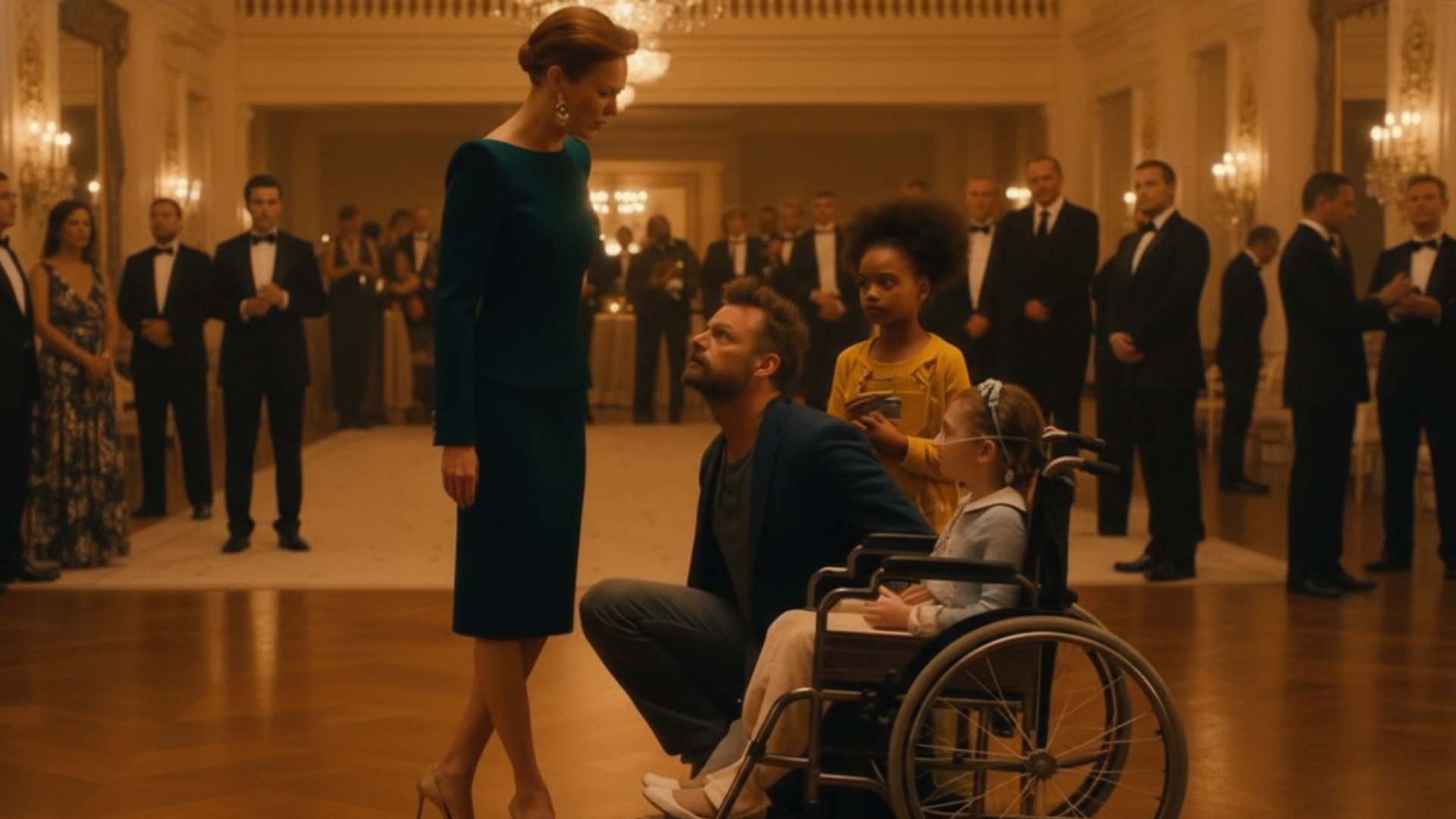
The glass rooftop of the Skyline Hotel glowed like a crown above the city, its edges wrapped in golden lights that bled into the dusk. Inside, everything was calculated perfection: string quartet, curated guest list, and cameras hungry for the billionaire host who loved to be seen as a savior of children’s charities. Leonard Hale moved through the crowd with the confidence of a man who had bought his way out of every mistake—except one. That one still lived behind his eyes every night, wrapped in smoke and sirens.
Tonight’s charity gala was his annual attempt at redemption, a glittering event “for vulnerable children and youth,” as the invitations proudly declared. Photos of smiling kids in shelters and foster homes cycled on the giant screens behind the stage, and every time the images shifted, Leonard felt his throat tighten. He had founded the Havenlight Foundation after the fire that took his own daughter, Olivia. The world called him generous. He called it paying interest on a guilt that never went away.
His sister, Miriam, joined him near the main bar, where waiters in white gloves floated by like silent ghosts with silver trays. “You did it again, Leo,” she murmured. “Look at this place. You could run for president after tonight.” Her voice held praise, but her eyes searched his, as if she knew how hollow the compliments sounded in his head.
“I’m not doing this for cameras,” Leonard replied, though the line of reporters on the far side of the hall told another story. “If even one kid gets a chance Olivia never had, it’s worth it.”
He did not say the rest: that no matter how many lives he changed, he could not rewrite one terrible choice from twenty years ago. Back then, he had chosen a deal, a meeting, a signature over being home that night. By the time the call came—“There’s been a fire”—the sirens were already screaming down his street. He never forgave himself for arriving too late to carry his daughter out of the smoke.
The master of ceremonies tapped the microphone, and a hush rolled over the room. Award plaques glittered on a nearby table, ready to be handed out to “exceptional volunteers” from partner shelters. Leonard half listened to the speech about resilience and second chances, his gaze drifting to the far side of the hall, where the hotel staff moved in rhythmic patterns.
That was when he saw her.
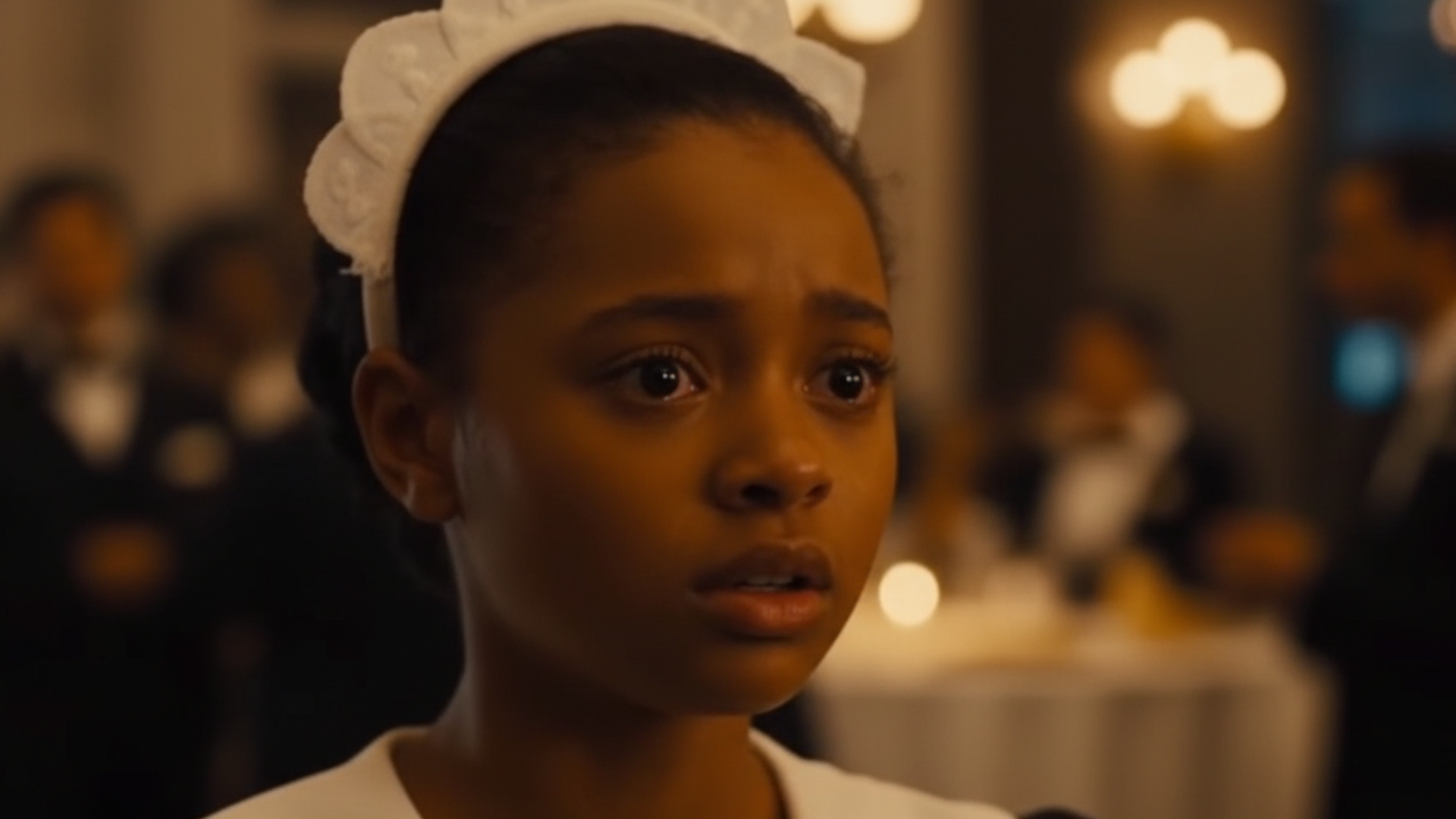
She stood near the balcony doors, balancing a tray with practiced ease, her black-and-white uniform just like the other servers’. Her hair was pulled back in a simple bun, and her eyes were downcast as she moved between guests. Nothing about her should have stood out.
Until the tray slipped.
Someone behind her laughed too loudly, bumping her shoulder. Crystal glasses tilted. One flute of champagne toppled, then another. She tried to recover, but liquid splashed onto a guest’s designer gown. Apologies tumbled from her lips as the woman hissed something cruel and dabbed at the stains with a napkin.
The maid stepped back quickly, shaken. She set the tray on a side table, chest rising in shallow breaths. She reached for a cloth, and in that motion, the cuff of her sleeve pulled back.
Leonard saw the scar.
It ran from the base of her thumb to the inside of her wrist, pale and twisting like a river of cooled wax. He knew every line of that mark. He had kissed it a hundred times when it was still a fresh, angry burn on the tiny wrist of a toddler who had tried to grab a hot pan from the stove. The doctors had said it would fade but never disappear completely.
His world narrowed to that wrist. The music, the lights, the murmur of the crowd—all of it vanished under a rushing sound in his ears. He took one unsteady step forward, then another, weaving between guests without hearing their greetings.
“Sir? Mr. Hale?” his security chief called after him, but Leonard did not stop.
The maid felt his gaze before she saw him. Her shoulders stiffened. When she finally turned, their eyes met, and there was a strange, sharp silence between them, like the moment before glass shatters.
Up close, Leonard could see she was young, maybe nineteen or twenty. Her features were not an exact reflection of his lost little girl—time and life had drawn new lines—but something in the shape of her jaw, the tilt of her eyebrows, the slight dimple at the corner of her mouth when she swallowed hard… It was like seeing a memory aged in secret.
“Your wrist,” he said, his voice rougher than he intended. “That scar… Where did you get it?”
Her hand flew to her sleeve, instinctively tugging it down. “I—I’m sorry, sir. I didn’t mean to spill. I’ll pay for the dress if I have to, I just—”
“I’m not talking about the champagne.” His heartbeat thundered. “The scar. Please. Tell me.”
Around them, conversations faltered. A few curious guests turned their heads, sensing a scene. Leonard’s PR manager started toward him, alarmed, but Miriam stepped in front of her with a subtle shake of her head. Something important was happening. Miriam felt it in her bones.
The maid’s throat bobbed as she swallowed. “I’ve had it as long as I can remember,” she said softly. “They told me it was from a fire when I was a baby. At the shelter.”
The word “shelter” lodged in his chest like a shard of glass. Photos of the Havenlight partner homes flashed through his mind—smiling kids, colorful walls, hope painted over old wounds. He had built those places because one shelter, two decades ago, had taken in a nameless child from the ashes of his burned house. A child they told him had not survived.
“What’s your name?” he asked, his voice nearly a whisper.
She hesitated, as if the answer might change everything. “Lia,” she said. “They call me Lia at Starlight House.”
Lia.
He heard the echo of Olivia in that simple, shortened name. The nickname he and Miriam used when his daughter toddled after them, clutching her stuffed rabbit: “Come on, Lia, slow down!”
Leonard’s vision blurred. The room swayed. He forced himself to breathe. “Lia… from Starlight House shelter?” he repeated.
“Yes, sir.” Confusion furrowed her brow. “They took me in when I was little. I don’t remember anything before that. Just nightmares sometimes. Flames. Sirens.” Her eyes flickered with something fragile and aching. “Why do you ask?”
Because every nightmare you’ve had is the other half of mine, he thought. Because I thought you were dead.
Aloud, he managed, “Can we talk somewhere private? It won’t take long. I promise.”
She glanced toward the head waitress, who hovered nearby, nervous at the sight of the billionaire singling out one of her staff. Before the woman could intervene, Miriam stepped in with a smile that carried both warmth and unyielding authority.
“I’ll borrow her for a few minutes,” Miriam said. “On Mr. Hale’s behalf.”
The three of them slipped out of the hall into a smaller lounge down the corridor. The city glittered beyond the floor-to-ceiling windows, unaware that a story twenty years in the making had just collided with the present.
Inside, the room was quiet, just the faint thrum of music filtering through the closed doors. Lia stood by the armchair, hands twisted together, unsure whether to sit. Leonard remained standing, afraid that if he sat, his legs would give out.
“Miriam,” he said hoarsely, “show her.”
Without a word, his sister took out her phone and pulled up an old photograph she always carried—one Leonard could never look at for long. It showed a little girl with dark curls and bright, fearless eyes, a faint fresh bandage peeking out from under her tiny wrist. Miriam turned the screen toward Lia.
“This was my niece,” she said gently. “Her name was Olivia Hale. We called her Lia.”
The maid’s eyes widened. She stared at the image with an intensity that made the room feel smaller. “She… she looks like me,” she whispered. “Or… I look like her.”
Leonard lowered himself into a chair at last, his hands trembling. “Twenty years ago,” he began, “there was a fire in my house. I was supposed to be with her that night, but I wasn’t. By the time I got there, the fire had already torn through the nursery. They found… remains in the rubble. They told me my daughter was gone.”
Lia’s breath hitched. “But if… if they were wrong…”
“I built a foundation after that,” he went on, voice unsteady. “We support shelters all over the city, including Starlight House. I didn’t know until tonight that they had taken in a baby from that fire. A baby with a burn scar on her wrist.”
Silence fell. Only the city’s distant hum filled the space between them.
“I’ve always wondered,” Lia said quietly, eyes still fixed on the phone. “Why I never had a last name on my earliest records. Why there was only ‘Lia’ and a note: ‘found after house fire.’ I used to imagine my parents were out there somewhere, searching. Then I decided that was just a fairy tale I told myself to sleep.”
“It wasn’t a fairy tale,” Miriam said, voice breaking. “He never stopped searching. He just thought… there was no one left to find.”
Tears brimmed in Lia’s eyes. “And now you’re saying—what? That I’m your daughter? That the girl in that picture is me?”
Leonard leaned forward, every word pulled from somewhere deep and raw. “I don’t want to force that onto you. Not without proof. We’ll do tests. We’ll check records. But when I saw that scar, and heard your name, and learned where you came from… I felt something I haven’t felt in twenty years. Hope.”
The word hung in the air like a fragile thing that might shatter if handled too roughly.
Lia wrapped her arms around herself, as if cold had seeped into her bones. “Hope is dangerous,” she murmured. “In the shelter, they always told us not to get too attached when someone came to visit. People would promise to come back and never show up again. So we learned to keep our hearts small.”
“I understand,” Leonard said. “And I know I have no right to ask anything of you. But if there is even a chance that you’re my Lia, I want to take it. Not to show you off to cameras. Not to fix my reputation. Just… to finally look my daughter in the eyes and say I am sorry I wasn’t there.”
For a long moment, she simply looked at him. Not at the billionaire in the tailored suit, not at the founder of a famous foundation, but at the man beneath all that: hollowed, hopeful, terrified.
“My whole life,” she said slowly, “I told myself I was left because I wasn’t wanted. That whoever my parents were, they didn’t care enough to stay. That I was safer believing they were cruel than believing they were lost. Because if they were lost, it meant I was, too.”
She lifted her wrist, the scar pale against her skin. “But I’ve also always wondered why I survived. Why I woke up in a hospital with burns and no name. Maybe this is my answer. Or maybe it’s a mistake.” Her voice wavered. “Either way… I’m tired of not knowing.”
“Then let’s know,” Miriam said firmly. “We can contact the shelter director tonight. There will be intake records. Hospital files. We don’t have to wait for a lab to tell us what our hearts already suspect.”
Lia’s lips trembled into the faintest smile. “You talk like someone who always wins,” she said to Miriam.
“I don’t,” Miriam replied. “But I’ve watched my brother lose every night for twenty years. Maybe it’s time we give him a chance at one victory that actually matters.”
Lia turned back to Leonard. “I’ll do it,” she said. “I’ll check the records. I’ll take the tests. Not just for you. For me.” She paused. “But if it turns out I’m not her… will you disappear? Pretend this never happened?”
He shook his head, eyes burning. “If you’re not my Lia, then I will grieve the daughter I lost all over again. But I will also know another brave young woman who survived the worst night of her life. And I will still fight to give you the future you deserve, if you’ll let me. Not as a replacement. As yourself.”
Something in her posture softened. The small, hunched figure of a maid waiting for permission straightened into someone who had just been told her existence alone was enough.
“Okay,” she whispered. “Then we’ll find out. Together.”
A knock sounded at the door. Leonard’s PR manager poked her head in, anxiety etched on her face. “Mr. Hale, the press is asking for you. They want a statement before the awards portion. Are you—”
She stopped when she saw Lia and Miriam, the tracks of tears on all three faces. Leonard wiped his cheeks, standing with a new kind of steadiness.
“Tell them,” he said, surprising himself with the words that came next, “that for the first time, this gala actually did what it claimed. It gave a lost child a chance to be found. No more details until we know for sure. But you can say this: tonight, the Havenlight Foundation kept one more promise.”
The PR manager stared, then nodded slowly. “Of course, sir.”
When the door closed again, Leonard looked back at Lia. “I don’t know what the tests will say,” he admitted. “But whether they confirm this or not, I want you to hear something from me now, before the cameras, before the lawyers, before the paperwork.”
He stepped closer, leaving only a small, respectful distance between them. “You were never unwanted,” he said quietly. “You were never a mistake. You were stolen from a life that should have been safer and loved every day you were gone. If you are my daughter, I failed you once. I won’t do it again.”
Her tears spilled over, silent and shining. For a heartbeat, she hesitated. Then, as if some invisible string tugged her forward, she closed the gap between them and wrapped her arms around him.
He froze, then held her like a man embraces a miracle: gently, fiercely, as if afraid she might vanish if he blinked. In that fragile circle of arms and scarred wrists and shaking shoulders, twenty years of grief cracked open to let one small beam of light through.
Outside, in the grand hall, the gala continued. Glasses clinked, speeches droned, cameras flashed. Most of the guests would leave that night thinking the story of the evening was about records broken and donations raised.
But the real story unfolded in a quiet lounge, where a maid with a burned wrist and a billionaire with a broken heart decided to face the truth together—whatever it turned out to be.
Later, much later, when the records confirmed what their hearts had already whispered—that Lia of Starlight House was, in fact, Olivia Hale of the fire—people would call it a miracle. Lia would call it something simpler: finally knowing where she belonged.
And Leonard, standing beside her at the next year’s gala, would introduce her not to the cameras, not to the board, but to the kids from the shelters, saying, “This is Lia. She got lost once. Now she helps us find others.”
Because sometimes, the children the world labels “abandoned” are simply waiting for the day when someone recognizes the scar only love would remember.